Archive Page 111

Charges Dropped for Nose Bump


Photo by discarted

UPDATE: Charges were dropped today against Tony Overman, the Olympian photographer who was arrested for bumping a cop with his nose during a heated back-and-forth at a crime scene.


It seems that cooler heads thankfully prevailed, but of course there were commenters on the Olympian site who didn’t agree. One in particular said: “This kind of lawlessness is what drives investors out of our fair city.”


Lawlessness is WAY overstating things. Did this person even read the original story? In no way was there anything close to lawlessness going on.


Talk about hyperbole! This was a case of two tempers that got out of hand and they both probably acted out of line, but to call Overman a “rioter” or say this constituted an “assault on an officer” is so off base.


There is actually real crime out there that needs addressing. Tying up the court system with a case like this would have been a gross waste of taxpayer dollars.


Article from The Olympian

Filmmaker Gets Chile Reception

The Interpress News Agency (IPS) is reporting on the growing concern over a popular filmmaker who’s being held in a Chilean jail. Varela had been working on a documentary on the problems between lumber companies and the indigenous Mapuche people in Southern Chile.

Charged with “illicit association with the intent to commit a crime,” Varela was arrested May 7 for her alleged connections to a revolutionary group that is suspected of committing two robberies in 2004 and 2005. Though what’s most troubling is that much of her materials relating to the documentary were seized, including interviews, diaries, scripts, footage and cameras.

In an open letter to President Michelle Bachelet, Reporters Without Borders said “that other journalists and filmmakers have got into trouble when trying to cover the sensitive subject of the situation of the Mapuches.” 

Yes … its’ highly coincidental. And we’re sure those lumber companies don’t mind at all having her out of the way so they can continue to raze forests.

Article via IPS.

They Can Shoot Us, But We Can’t Shoot Them


Photo by discarted

It only took 17 years, but the LAPD is finally getting dashboard cameras installed in patrol cars. The issue was first suggested in the early 90s, and in an article in New American Media, Councilman Ed Reyes blamed the delay on the fact that it was a “low priority” for the previous administration. The first wave of cameras will be for about 300 cars in the South Bureau, which sees the highest rates of crime and violence.

There will be two different dashboard cams (one facing front, one facing the backseat) and the officers will wear wireless microphones. Data will be automatically uploaded and sent to a computer at the local station.

“From a patrol officer’s point of view, it’s a good thing,” said Officer Danny Hernandez.

From a suspect’s point of view, it’s also a good thing.

Article from New American Media.

Pride and Prejudice

Pride vs Prejudice

Photo by Discarted.

Taken at the LA Pride parade in West Hollywood, June 8.

Update: APD to Undergo Training

We posted on this story earlier, about Albuquerque police officer Daniel Guzman attacking a local NBC news videographer after exchanging some unpleasantries, and it looks like changes are afoot at the APD. It was all caught on tape, and Officer Guzman’s aggression was pretty shocking.

According to the Albuquerque Journal, Police Chief Ray Schultz reviewed the tape and determined mistakes were made. Now, the entire police department will undergo training so that they know how to appropriately respond in such situations.

Lesson #1: Don’t attack journalists while a camera is rolling.

Article via KOB.com New Mexico.

A Sticky Situation in Coney Island

A diver jumps off the pier at Coney Island
Photo by Simon Lund

From an interesting article in the Village Voice, commercial photographer Simon Lund was taking photos in Coney Island over Memorial Day weekend when he was forced to give up his film.

It all started when he unknowingly (if at all) took a photo of a woman’s young son. She became angry and demanded he erase the picture. (Which makes me think the kid was in the witness protection program, but that’s neither here nor there.) Lund explained he couldn’t because he was shooting film, so she involved the cops, who intimidated Lund into handing over his film.

Lund knew he wasn’t in the wrong, and it’s easy to say now, “Why didn’t he just walk away?!” But when a woman and her irate family are yelling at you and you’re surrounded by a group of NYPD — one of which says, “You’ve got to give up your film, or things are going to get much worse for you” — you might not be thinking crystal clearly.

In the article, Christopher Dunn of the New York Civil Liberties Union, says: “Police officers are not allowed to look at images without consent of the photographer, and they have no authority to order someone to let them look at their pictures or to confiscate their film.”

If only Lund could have reminded them of that.

To give Deputy Inspector Robert Johnson and the 60th Precinct (which oversees Coney Island) your thoughts, call 718-946-3311.

Article via Village Voice.

See some of Simon Lund’s Coney Island photos here.

Photographer Arrested for Hitting Cop With Nose


Photo via Discarted

Tony Overman, staff photographer for the Olympian in Washington, was arrested at the scene of a fire on Friday for hitting a Lacey detective in the “nose with his forehead.” That apparently amounts to a charge of simple assault and obstruction.

From Det. David Miller’s perspective, Overman entered a restricted area and was told to leave. Det. Miller told another officer if he did it again he’d be arrested. This prompted a heated exchange between the two, where, Det. Miller claims, the forehead-nose contact took place. His report says:

He appeared to be very upset. He yelled again, ‘What did you say?’ I responded, ‘If you cross the taped area again you will be arrested.’ Overman got inches from my face and yelled, ‘I left didn’t I.’ Overman then hit me in the nose with his forehead.”

As for Overman, he said he did approach the restricted area but did not enter it. He said Det. Miller got aggressive with him and “put his face literally half an inch from my face. I didn’t move. He instigated the contact. He touched his nose to my nose.” He continues:

“When our noses touched, very, very softly, at that point he stopped and slammed me in the chest with two hands, really, really hard.”

Interestingly though, the other four Lacey cops who were at the scene did not mention this physical altercation in their reports. The Lacey Police Department is investigating the incident.

It seems like a MAJOR waste of tax dollars, if you ask us. Not to rail on cops all the time, but that should not have escalated to the point of arrest. Why can’t certain law enforcement keep their egos and tempers in check and keep things in perspective? It was a nose bump for god’s sake! 

By the way, an Austin cop was fired after his department reviewed an incident where he claimed a suspect was aggressive and determined his account wasn’t credible (his dashboard camera told a different story). That is not to say all police fabricate incident reports; it is to say it’s nice when the rotten ones are called out for it.

Article from The Olympian via PDNPulse.

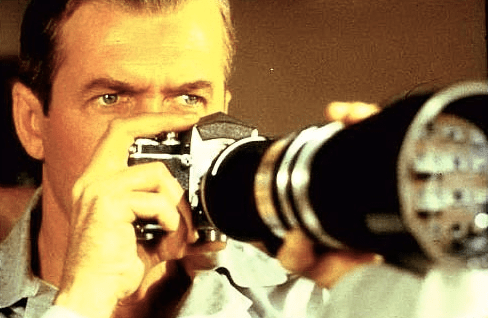
Was L.B. Jeffries Violating Privacy Laws in Rear Window?

Image via IMDB

Although the NPRD and this site are dedicated to preserving the rights of photographers as well as educating the public about those rights, we must be impartial, and discuss the other side of this issue — an individual’s right to privacy.

So, was L.B. Jeffries violating privacy laws using a giant telephoto lens to peer inside his neighbors’ apartments in Alfred Hitchcock’s Rear Window where there was an expectation of privacy? … The answer is YES.

And if you do a quick search on this subject you will quickly find numerous sites and discussions debating this issue. Or just simply type in Andrew Kantor, and you may come across the following PDF explaining a person’s right to privacy.

Whether we can take a photograph is determined by whether the subject has a reasonable expectation of privacy or seclusion. If not — if he’s visible to the public (even on private property) — photography is legal.  The logic is simple: If you can see it, you can photograph it. If it requires extraordinary means to see (e.g., using a telephoto lens, or trespassing on property not open to the public such as a private office), then you may not be able to photograph it legally.

So all of you out there with telephoto lenses, take note. If you would like more information on this subject, there are some links in our Know Your Rights section.

Photog Arrested for Snapping Raid


Photo via discarted

Do photographers interfere with police work — taking photos from a distance?

The Cape Town police in South Africa would say yes; photographer Mlandeli Puzi would probably disagree. The off-duty photographer, who normally works for the newspaper Cape Argus, was arrested over the weekend for taking photos of a police raid on a tavern in Delft South. They charged him with resisting arrest and obstructing police from performing their duties.

Puzi’s friend, who was at the scene, said:

“The officer just grabbed his camera and shoved him inside the van; we couldn’t understand why.”

A police spokesman said:

“No one is allowed in the operation area beside police and the parties concerned, and failure to comply will result in arrest.”

Puzi is expected to appear in court today.

Article via Cape Times.

Let’s Break It Down

Andrew Kantor is a tech writer/pundit/author who wrote this article in USA Today awhile back, but it bears repeating.

The law in the United States of America is pretty simple. You are allowed to photograph anything with the following exceptions:

  • Certain military installations or operations.
  • People who have a reasonable expectation of privacy. That is, people who are some place that’s not easily visible to the general public, e.g., if you shoot through someone’s window with a telephoto lens.

So simple, yet so complicated. But wait — that’s not all:

You can shoot pictures of children; your rights don’t change because of their age or where they are, as long as they’re visible from a place that’s open to the public. (So no sneaking into schools or climbing fences.)

Video taping has some more gray areas because of copyright issues, but in general the same rules apply. If anyone can see it, you can shoot it.

And yes, you can shoot on private property if it’s open to the public. That includes malls, retails stores, Starbucks, banks, and office-building lobbies. If you’re asked to stop and refuse, you run the risk of being charged with trespassing, but your pictures are yours. No one can legally take your camera or your memory card without a court order.

You can also shoot in subways and at airports.  … Airport security is regulated by the Transportation Security Administration, and it’s quite clear: Photography is A-OK at any commercial airport in the U.S. as long as you’re in an area open to the public.

Photo by Andrew Kantor.


Spam Blocked