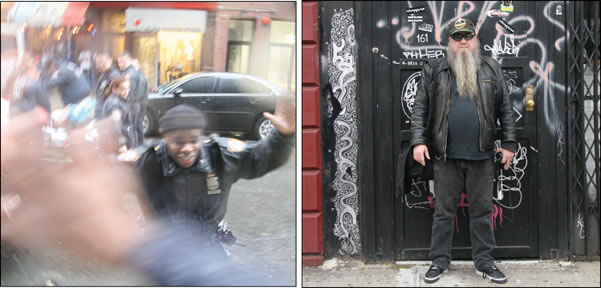
These dogs are in trouuu-ble.
Archive Page 84
Chattanooga Police Hounded & Attacked
Published March 26, 2010 Photographers' Rights Leave a CommentTags: attack dogs, Chattanooga Police, squad car
NYPD Act Like Fools, Mess With Photographer
Published March 25, 2010 Photographers' Rights , Police Harassment 20 CommentsTags: Clayton Patterson, NYPD, photographing crime scenes, Seventh Precinct
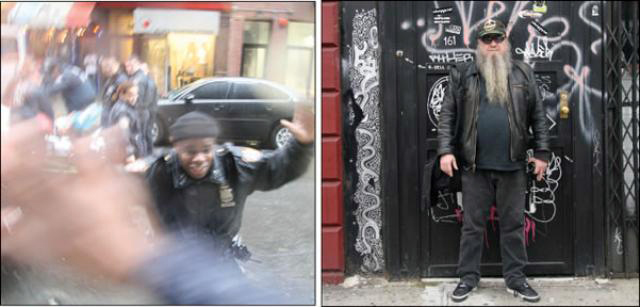 Photos from The Villager
Clayton Patterson is a fixture on the Lower East Side of New York, having documented the neighborhood for 25 years. He’s an artist, activist, photographer for The Villager newspaper, has published books, had a documentary made about him, and been featured in the New York Times.
But being the true iconoclast that he is, his relations with the Seventh Precinct haven’t always been rosy.
On March 13 he was trying to photograph a stabbing victim on Orchard Street when police bizarrely and belligerently harassed and tried to intimidate him. In their effort to block Patterson from shooting the scene, at various points: an officer smashed into him and accused him of starting it; the sergeant screamed at him — “I’m f—ing tired of you!”; two other officers jumped around wildly in front of his camera yelling “I’m a monkey”; and then an officer positioned his squad car on the sidewalk, directly in front of Patterson, to block him.
Now, there is a history here. Patterson has been arrested 14 times over the years, all when he was shooting photos. He is currently suing the NYPD over a 2008 incident where he was arrested for photographing a fire and not stopping when he was told to. So, the precinct officers know who he is (check out his photo — he’s hard to miss), and they want payback. I get it.
But it doesn’t make it right.
For officers to behave like this — in a ridiculously immature manner to impede a photographer who has every legal right to be there? I don’t care whether you like him or not; he could be the biggest thorn in your side, but that’s called life. As long as he’s following the rules, deal with it.
Show your support for photographers’ rights by calling the NYPD’s Seventh Precinct Captain Nancy Barry at (212) 477-7731.
Article from The Villager
Watch Out, Ottawa
Published March 24, 2010 Photographers' Rights Leave a CommentTags: anti-terrorism measures, Ottawa, photographing transit, security theater

Photo by Transit Scope
In another example of security theater — measures that make the public feel like their government is working to keep them safe but are largely ineffectual — the transit authority for greater Gatineau and Ottawa in Canada have instituted a security initiative where riders are asked to be on alert for suspicious activity. Among the suspicious things to look out for:
An individual taking photos or pictures in a location that has no particular interest, drawing maps or sketches, taking notes or wandering in the same location for an unusually long time;
The problem with this directive of course is that who is determine what has “no particular interest”? I might find subway tracks extremely interesting to photograph, but a fellow passenger thinks they’re not of interest and reports me to the authorities. Problems ensue.
And if you want to the sketch the subway? Well, just forget about it…especially if you are prone to pacing.
Article from Boing Boing
“Top Secret” Photo Assignment
Published March 24, 2010 Street photography Leave a CommentTags: Andrew Hetheringon, celebrity photographer, paparazzi, Ron Galella, Smash His Camera
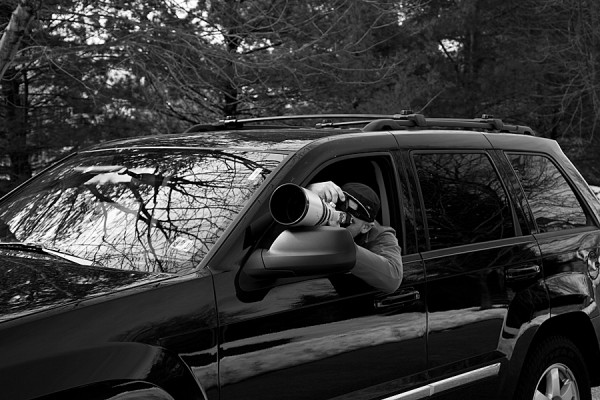
Photo: what’sthejackanory.com
In his blog, photographer Andrew Hetherington recounts the story of getting a photo of notorious paparazzo Ron Galella–paparazzi-style–for a “top secret” assignment for the AARP Bulletin feature called “Where Are They Now?” After staking out his house, Hetherington tails him in his car and pounces at a photo lab. Galella, 78, said he was impressed by the ambush, but was aware he was around the whole time (if not knowing why). Surprisingly though, Galella tells AARP, he likes being photographed.
Smash His Camera, a documentary on Galella’s distinction as the godfather of paparazzo, stalking the likes of Jackie Kennedy Onassis and Marlon Brando, debuted at Sundance this year. His photos of Jackie O. in the 70s are among the most iconic, right up there with the White House years.
Galella calls the current paparazzi “gangbangers.” (But don’t we always think our way of doing things as more refined, when in all actuality Jackie O. felt just as terrorized as modern-day celebrities with him around.) Still, he says the most photos he took of her in a single year was 20. It seems quaint, doesn’t it?
Read the AARP article on Ron Galella here.
Article from What’s the Jackanory? via The Click
Bill Cunningham’s Street Style
Published March 23, 2010 Documentary , Street photography Leave a CommentTags: Bill Cunningham, New York Times, On the Street
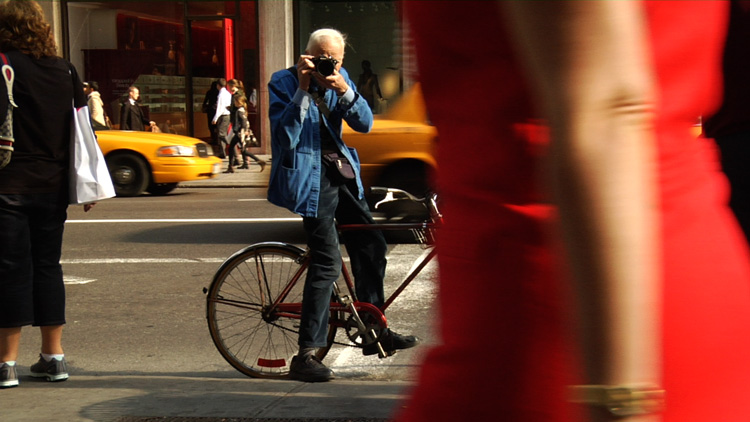
From Bill Cunningham New York
Readers of the New York Times Style section know Bill Cunningham’s work — the guy is a dogged chronicler of the city’s street fashion in his regular column “On the Street.” And at 81, he’s not showing any signs of slowing down. He is also famously idiosyncratic, getting around the city on a bike, wearing his signature blue smock, and living a spare existence in a tiny one-room apartment.
On top of the that, he’s extremely private, so it’s no small feat that the documentary Bill Cunningham New York came to be. It actually took 10 years to make and eight of those were spent convincing Cunningham to participate. The NY Times’ Lens blog tells the story of the documentary here.
“It isn’t what I think, it’s what I see,” Mr. Cunningham says. “I let the street speak to me. You’ve got to stay on the street and let the street tell you what it is.”
There will be three screenings in New York this month. Go here for more info.
Are You Photographing Only 10%?
Published March 22, 2010 Documentary , Photojournalism 3 CommentsTags: Anthony Karen, Nieman Reports, overexposed subjects, Phoebe Sexton, Stephen Mayes

Photo by raffaespo*
Photographers these days are experiencing some major groupthink.
From the current issue of Nieman Reports, Harvard’s journalism review that is devoted entirely to photojournalism this quarter, there is an excerpt from VII Photo Agency’s Stephen Mayes‘ address at the World Press Photo awards.
Mayes talks about his takeaway from five years as a juror for the awards — that certain subjects in photography are overexposed. And, naturally, that means that most other subjects are largely ignored. This, he reasons, is because of the fact that traditional media outlets are shrinking, so more photographers have turned to competitions as an outlet for their work. Mayes says the jurors are “astonished” by the lack of variety and pinpoints the three common themes: the dispossessed, exotic and foreign.
This assessment really rings true and is something we’ve noticed ourselves. But, at the same time, it seems that the only photography that is noticed or appreciated is foreign, whether it be conflict, poverty or strife. (Chicken and egg problem?)
Of the 2009 College Photographer of the Year awards, only one project really stood out as original — Phoebe Sexton‘s series, “Joshua,” on a young bulimic gay man. And that’s why we really like Anthony Karen‘s work. His photos of the KKK are dramatic and powerful but, more importantly, not derivative, addressing a serious, elusive domestic subject matter.
Mayes breaks it down succinctly here:
Overrepresented: commercial sex, suffering black folk, Muslim women in veils, same sex couples kissing, holding hands.
Underrepresented: middle class, affluent drug users, real sex, personal sex, black culture and expanded vision of black life outside Africa.
One juror said 90 percent of the pictures are from 10 percent of the world. So how’s that for a challenge — as a photographer, can you seek out the underreported subjects that are inhabiting 90 percent of the world?
Article from Nieman Reports
*This is a good photograph that we are using as illustrative and is in no way meant to impugn the photographer.
First Amendment Showdown
Published March 20, 2010 Photographers' Rights , Police Harassment 3 CommentsTags: Bert Krages, Christian Science Monitor, photographing crime scenes
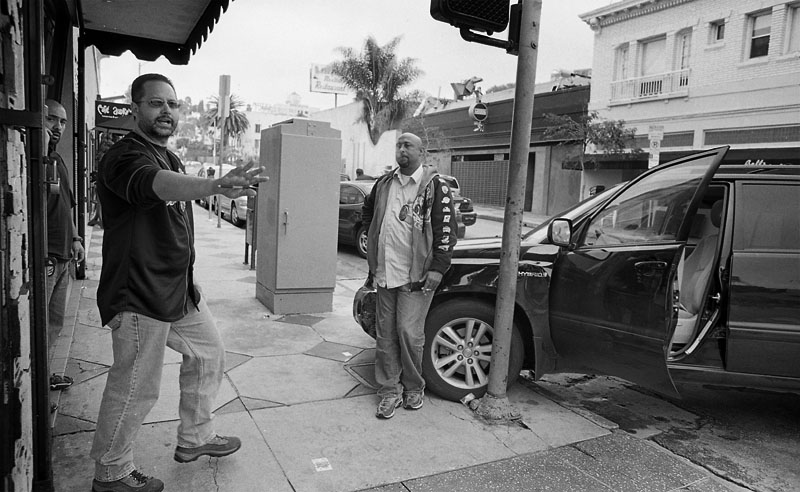 Photo by discarted
The Christian Science Monitor turns its focus on photographers rights this week, reporting on the ongoing clash between police and the photographers who shoot them.
CSM says that the increase in amount of camera seizures and photo deletion is testing First Amendment protections and names a few well-known incidents, including the recent trial in New Orleans where two photographers accused police of wrongful arrest and lost, Carlos Miller‘s trial for refusal to stop taking photos of police in Miami, and the Oakland cop who shot and killed an unarmed man in a BART station.
It’s disappointing that the article says police “often have the upper hand in court.” But it also doesn’t come as a surprise — we’ve seen it a lot here in the blogosphere with reaction to photographer vs. law enforcement incidents as an indication that many people seem to slavishly support police actions despite evidence that shows a clear overstep of legal boundaries.
Nevertheless, the article quotes attorney Bert Krages who says photos (and video) are the best defense when accused photographers are (falsely) accused of obstruction, which is a common charge in these scenarios. He also recommends that photographers who find themselves in these situations file a report with internal affairs and contact local media as they should have a vested interest in photography in public places.
And, finally, from Marjorie Esman of the Louisiana ACLU:
We have this thing called the Constitution, and the idea that you can’t film something that you can see is ludicrous. The sad thing about these cases is it suggests that police don’t want people to know what they’re doing, which then implies that they’re doing something that they don’t want people to know that they’re doing.
Article from Christian Science Monitor
50 Cent’s Goon Assaults Photographers
Published March 19, 2010 Assault , Photographers' Rights Leave a CommentTags: 50 Cent, bodyguard, concert, Denmark
Has-been rapper 50 Cent employs bodyguards who like to beat up photographers. As seen in this clip, a bodyguard goes after a couple of photographers waiting outside the rapper’s hotel in Denmark, physically assaulting them — even putting his hands around one’s neck at one point. On an oddly crazed tear, the bodyguard then goes into the photographer’s car and steals his camera. The photographer also claims he deleted his photos.
The bodyguard, whose name has not been released, was later arrested and charged with assault.
Perhaps the bodyguards would be wise to realize paparazzi photos of 50 Cent would only benefit the rapper’s career at this point (if an outlet would even buy them)…. I mean, wow. Talk about misguided anger.
Article from New York Daily News
Don’t Ask, Tell, or Be Yourself
Published March 19, 2010 Photographers' Rights Leave a CommentTags: Don't Ask Don't Tell, Fearless, gay athletes, gays in the military, Jeff Sheng

Photo by Jeff Sheng
This week the New York Times ran a piece on Southern California-based photographer Jeff Sheng, whose series and book “Don’t Ask, Don’t Tell,” features that very hot-button topic of homosexuals in the military. Though the faces of the servicemen and women are obscured, the portraits are a clear statement about the military’s shameful policy.
Sheng, who himself is gay, tells the story of his path to this book, and it’s interesting how it evolved from him being a closeted athlete who never felt like he could be himself to wanting to document gay athletes he admired for being out and proud. That turned into the well-respected project “Fearless,” which continues to tour the country (including a stint at the Olympics). And from that, because of the reaction he got from military personnel who were moved and inspired, he turned his focus to DADT.
Sheng talks about originally wanting to do a documentary for “Fearless” but decided against it because he didn’t think people who are already opposed to the concept would ever watch it. (Such is the closed mind.) So he decided to do photographs, and his assessment of the power of photos is a good one:
“But people can happen upon a picture. Some pictures — like the ones of civil rights protestors being attacked by dogs — sum up what’s really at stake. People who don’t even mean to see it end up seeing it. And then things change.”
Article from New York Times
 boywithgrenade.org