Archive for the 'Photographers’ Rights' Category


Man Hits Cameraman On Way Into Court

KFOX cameraman Rudy Reyes was outside the federal courthouse in El Paso to shoot video of a defendant’s family members when one of defendant’s brothers smacked him  in the head as he passed by. The brother in question, the very elegant Paul Barraza, then denied it despite a handful of witnesses. Paul Barraza was later pulled out of the courthouse and arrested for assault.

I bet now he wishes he’d thought twice before doing something that stupid. I mean, really….

See the video here and listen to a KFOX reporter explain the backstory here.

Update: Charges Against LA Photographer Dropped

Criminal charges have been dropped against photographer Jonas Lara who was arrested while documenting two taggers in South Central LA in February. Through his legal defense fund, Lara was able to retain the legal services of Joel Koury of the Kavinoky Law Firm, who worked for far less than he normally does because he believed in the injustice of the case.

PDN Pulse reports that Koury knew his stuff and went in aggressively, refusing to take lesser charges that were still unfavorable to Lara.

“We’re not talking about some gang member, we’re talking about an actual photojournalist,” Koury says he told the prosecutor. “Just because a photojournalist takes a picture of someone committing a crime does not turn the photographer into a criminal,” he adds.

Koury’s tactic paid off, and now Lara is a free man, though he does have to pay a $200 fee to the property owner as restitution and he gets a disturbing the peace charge. The judge also ordered that Lara’s equipment be returned.

Put this as a win for photographers’ rights.

Read PDN Pulse’s story here and our own interview with Jonas Lara here.

Chevron Forces Documentarian to Spill

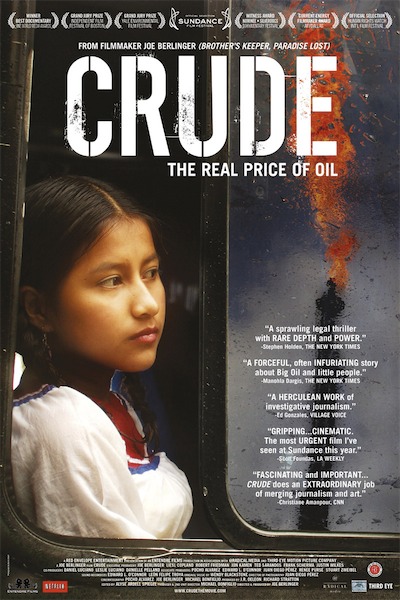
In an effort to defend itself in a $27.3 billion lawsuit, Chevron is trying to get 600 hours of raw footage from the filmmaker behind the 2009 documentary “Crude.” The lawsuit involves 30,000 Ecuadoreans who are suing Chevron for polluting a big chunk of the Amazon rainforest through drilling and dumping, and the documentary covered the ongoing fight.

The “Crude” filmmaker was fighting the request, citing the First Amendment and journalist privilege, but a judge overruled him last week and is allowing Chevron to subpoena their footage. Documentarians and filmmakers are worried the case sets a dangerous precedent. Michael Moore weighed in, claiming the ruling would amount to a chilling effect on whistleblowers. Ric burns told the New York Times that the decision “contributes to a general culture of contempt for investigative journalism.”

The result, he said, would be that “next time, there won’t be a ‘Crude.’ There won’t be a film. That’ll be good for Chevron, I guess. Because the next time you go, you’re going to have a much leerier group of informants.”

Article from New York Times (via The Click)

Parking Enforcement: Still Violating Laws

Excuse us while we go off topic to cover one of our pet peeves: parking enforcement abuse of power. See the above video and learn that this lady (#01795):
1. did not pay the meter;
2. parked more than 18 inches from the curb, with her vehicle’s back end sticking out into the traffic lane;
3. was running personal errands in an official LADOT vehicle on the taxpayer’s dime.
And it’s not the first time. We’ve posted on it before, and LAist.com ran a similar story last week. Apparently parking enforcement agents are above the law, which is mind-boggling. The mayor — yeah, what can you do? Fire department — sure, park in a red zone and get your lunch. But these low-level hourly employees, who are tasked with enforcing parking laws, are abusing their official LADOT cars, using them as carte blanche to basically do whatever the hell they want, and in doing so, are the city’s biggest hypocrites.

Nashville Under Water, Under-Reported?


Photo by the American Red Cross

Nashville is under water right now, but you may not realize how bad it is with the almost constant coverage of the oil spill in Louisiana and the inept Times Square bomber. Yesterday Newsweek’s The Gaggle blog commented on the lack of coverage and that Google results for the spill come in at 13,800 and the bomb at 8,390 — to the flood’s paltry 2,430. It seems that it was poor timing for the Cumberland River waters to rise (not that there’s ever a good time…) when there are other more dramatic events taking over the headlines.

Check out the Boston Globe’s Big Picture blog or the American Red Cross‘s flickr photostream for a look at the situation — it’s pretty impressive.

WaPo Photog Breaks Rules for Hinckley Shot


Photo by erin m

In his column this week, Washington Post ombudsman Andrew Alexander took on an incident of staff photographer Gerald Martineau, who snapped a surreptitious photo of John Hinckley at St. Elizabeths Hospital in southeast DC. Hinckley is the would-be assassin of President Ronald Reagan, who not only shot Reagan, but two law enforcement officers and Press Secretary Jim Brady in 1981. He has been living at the mental hospital since 1982 and preparations are being made for his release sometime in the near future.

For a front-page story in the paper that ran April 26, Martineau entered the St. Elizabeths grounds and found Hinckley feeding some cats, whereupon he took photos from his car. Security was alerted and the guards detained Martineau upon his exit. After some back and forth, in which Martineau refused to allow security to view his photos, DC police were called and they threatened to arrest him if he didn’t hand over his memory card. After consulting with his bosses at the Post, that’s what he did.

Alexander goes over the points of the case and debates the merits of the two arguments — on one hand, that Martineau was in violation of the hospital’s no cameras policy and, as the hospital alleges, violated Hinckley’s dignity, and on the other, that  journalists have been known to flout such restrictions if it means getting a story, especially for the public good. Further, Hinckley is a public figure to an extent, and he’s certainly at a public facility. (St. Elizabeths is run by the DC Department of Mental Health.)

This is a sticky situation, and dare I say that Martineau’s explanation that he didn’t see the two “No Cameras” signs on his way in seems suspect as he was shooting from his car — meaning he was prepared to make a quick getaway. However, calling the police over a photography violation and then confiscating the memory card is a gross overreaction and right in line with many of the photographers’ rights abuses we report on all the time. Any time a photographer’s equipment is seized it’s almost certainly illegal and an overstep of the law.

Alexander brought up a good point, and that is that the photo could have been taken outside the institution on one of Hinckley’s many trips to a local store or to visit his mother in Virginia. It may have taken more time to stake Hinckley out, but there is no gray area there.

So, was the photographer taking a shortcut? Was he being arrogant, thinking he’s above the established rules? Or was he thinking it’s a harmless photo of a well-known individual out in the open, if not for the gates surrounding him?

(Incidentally, there is no trace of the photo on the paper’s web site as far as I can find.)

Article from the Washington Post

OSU Refuses to Back Student Photographer


Photo by Jay Smith/The Lantern

UPDATE: Ohio State has announced they will not be charging Kotran, but he still plans to seek legal counsel to deal with a review by the school’s judiciary committee. Also, several high-profile journalists have pledged their support to Kotran.

We posted on Alex Kotran’s arrest last week and now it turns out he could be facing charges of criminal trespassing. But his school, Ohio State, has washed its hands of the situation, refusing to help him with legal assistance.

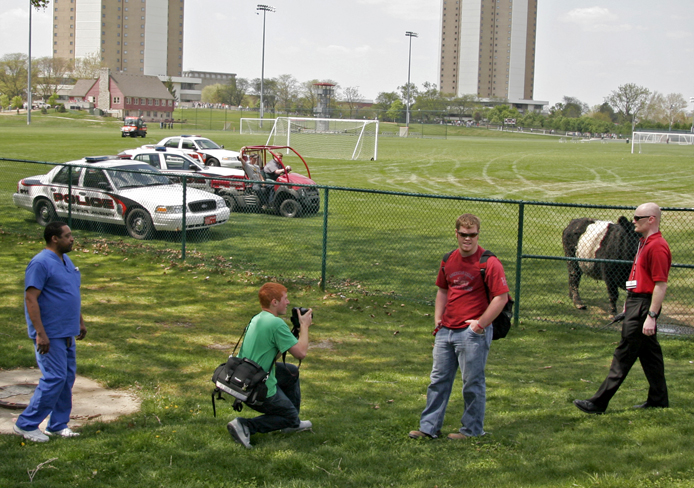
Kotran was photographing two cows that got loose last week as part of his job as a reporter for The Lantern when he was cuffed and detained. So the odd circumstances of this case are not only that he was working as a journalist at the time of the incident, but how can you criminally trespass on a public athletic field at a school you attend (and pay to go to)? The whole situation is asinine and wrong on so many levels.

The school said they cannot provide Kotran with assistance due to conflict of interest because all parties are affiliated with the university. OK, so if everyone is working for or attending OSU, then how about addressing it in house and acknowledging that charges are unwarranted?

Tom O’Hara, The Lantern’s adviser, says this:

“I find it odd that the university has the resources to pursue prosecution of a student who hasn’t done anything wrong, but it doesn’t have the resources to help defend a student who hasn’t done anything wrong.”

Former Washington Post editor Len Downie and OSU and Lantern alumni said this: “It is deeply disturbing to me as an alumnus of the School of Journalism,” and “I can understand the budget issues involved. But budget issues aside, in every other way, the school should be fully supportive of the student journalist.” Let’s hope Downie and other alums of the school write letters and make some noise about this.

Though I guess if you want to be realistic, coming up against authorities and bogus charges is a lesson every journalist needs to learn — though usually in the real world, media outlets are staunch proponents of journalists’ rights and will fight for their employees.

Article from The Lantern

Facing Jail: Q&A With Photographer Jonas Lara

Photo courtesy Jonas Lara

Photographer Jonas Lara is looking at a year in prison if things don’t go his way, and with only a public defender who doesn’t want to consider First Amendment issues, things are not looking good.

The facts: In February Jonas was arrested in Los Angeles while photographing two graffiti artists as part of a long-term project. He was charged with felony vandalism, which was later reduced to aiding and abetting vandals, and his court date is next Tuesday, May 11. His cameras, lenses and memory cards were  confiscated and they still haven’t been returned. He’s currently soliciting donations to his legal defense fund so that he can hire a private lawyer to argue his case.

You can show your support and donate on Jonas’ Facebook page. Here, we talk to Jonas about the situation.

Is this the first time you’ve had a problem with the authorities while photographing?
This is the first time I’ve ever been arrested but not the first time being hassled. Back in 2007 I was working on a freeway series and I was confronted by a police officer who asked why I was taking pictures of bridges and which terrorist organization I was a part of. I explained that I was working on an art project, and after showing my student ID and checking my name on his computer he said I was free to leave.

Did you try to explain you were just documenting the scene?
For the most part I kept my mouth shut, but I did mention that I was a student working on a documentary project.

How did they not believe you even after seeing your work and looking into your background?
The funny thing is that they did believe me and seemed very understanding; they were conducting their investigation on the site while I sat in the patrol car for about two hours. I figured they were going to let me go once they finished, but instead they said I was going to jail and never said what they were charging me with, nor did they ever read me my rights. It wasn’t until after spending six hours in the holding cell and being transferred to the jail cell that I was informed that I was being charged with vandalism. At that point it was felony vandalism. I asked how I could be charged with vandalism for simply taking pictures and they said to take it up with the judge.

What has been happening in your life since this happened?
Well, I haven’t had most of my gear so I’ve been borrowing from other photographer friends or using my point and shoot and vintage cameras to shoot projects.

Are you under a lot of stress?
I have been under a great deal of stress; I have been trying to continue to make work during this process. I’ve been doing some painting and mixed media work to keep me busy since I don’t have my usual photo equipment.

Is it just a whirlwind of lawyers and court appearances?
Yeah well, the only experience I have in the courtroom is watching “Law and Order” so it was unreal being there trying to defend myself with a public defender who didn’t even want to entertain the idea of bringing up 1st Amendment rights or photographers’ rights or anything along those lines.

How likely is that you will be convicted — have you been able to get a feel for what’s going to happen to you?
The thing is, up until this point, I don’t think the court has any sense of who I am (my background, education, credentials). My public defender was only concerned with getting me a plea with a lower sentence, so I’m not sure to be honest. After asking me whether I wanted to take a plea of one month in jail plus drivers license suspended and [me] refusing, he said if I go to trial and lose I could face up to a year in jail, which translates into 180 days. I’m supposed to move to New York in August to start graduate school in September at School of Visual Arts, so if I’m convicted I can forget about grad school.

Are you able to still do photography?
Well, like I stated before, I’ve been using my point and shoot cameras, Polaroid camera and borrowing cameras and lenses, but it’s definitely put a dent in my ability to produce photographic work.

Will this affect how you approach further assignments or projects?
Most definitely; I will be more cautious.

Looking back, what if anything would you have done differently?
Well, if I understood my rights better I would have stated that I had a right to be there and that I’m not obligated to prevent or report a crime because I’m a journalist. Being that it was my first time dealing with this type of thing I didn’t know how to properly navigate the situation.
Tuxedoed Lesbian’s Photo Cut From Yearbook

It seems a high school in Mississippi made a values call when it decided not to include the  portrait of senior Ceara Sturgis in the yearbook. Despite being smart and involved enough to be in the National Honor Society and on the soccer team, Sturgis is a lesbian and wore a tuxedo in her photo. Females are supposed to wear a dress in the portraits.

Sturgis is represented in other parts of the yearbook, but Wesson Attendance Center high school apparently felt that the tuxedo shot was too controversial. The ACLU protested the decision back in October, but it wasn’t until April when Sturgis’ mom, Veronica Rodriguez, saw the final yearbook that she realized Sturgis is not mentioned at all in the senior portrait section, not even named as a member of the graduating class.

The sad thing is, Rodriguez said the class nominated Sturgis for prom queen, showing that she is clearly well-liked and accepted among her peers. It’s just the (older adult) officials who are less tolerant and willing to shun a child because she doesn’t fit into their ideas about sexuality.

Read the whole story at the Jackson Free Press

Help Keep a Photographer Out of Jail


Photo by Jonas Lara

In February, artist/photographer Jonas Lara was photographing two graffiti artists in South Central Los Angeles as part of a long-term project he’s doing when he was arrested for felony vandalism, a charge that was later reduced to aiding and abetting vandals. He was jailed for 24 hours and his equipment was confiscated as evidence. His jury trial is on May 11, and if convicted, he could face up to a year in jail and have his license suspended.

Lara has started a legal defense fund to raise $6,500 for a private lawyer. He has $152.96 as of today. You can (and should) join his Facebook page, donate and spread the word. This is a bogus charge and a waste of our taxpayer dollars.


Spam Blocked