Archive Page 91

“American Power” and Harassment

  Amos-coal-power-plant-001
Raymond City, West Virginia  Photo by Mitch Epstein

The New York Times recently profiled photographer Mitch Epstein, who, as part of a six-year-long project documenting American power plants, was continually harassed by law enforcement and government officials. An FBI agent actually told him, “If you were Muslim, you’d be cuffed and taken in for questioning.” He says it got to the point where he’d almost have a panic attack before taking photos.

It’s really a shame this is the culture now, but it’s also not surprising in the least, as anyone who follows the photographers’ rights issue knows.

A well-respected photographer, Epstein’s work is in the Getty and the Met. But no matter; people saw a man with equipment and that was enough to assume terrorism – someone reported him to police for having a rocket launcher when he was carrying his tripod.

Epstein says he tried to capture the “beauty and terror of early 21st century America.” Which is a nice way to put it. His pictures are quite amazing and the article is worth a read. The book, American Power, will come out this month.

Article via New York Times

H.O.B. Security Guards Attack Hanson Fans

You know things have gotten out of hand when two young women are assaulted for taking photos outside a Hanson concert. 

After a fan at the House of Blues in Chicago took a photo on the sidewalk that apparently included Darrell G. Gibson II, a House of Blues a security guard, he unlawfully seized her camera and an altercation ensued when she fought back. The women are being loud, sure, but where is the motivation for this incident – what is so wrong about taking photos on a sidewalk? And the guard is probably three times their size; you can see how his shove sent one of them flying to the ground.

And then the video goes black as someone – a guard most likely – starts harassing the person filming. You can hear the guy actually say, “What right do you have to record this?” Uh…on a public sidewalk, out in the open? Every right in the world.

Isaac, Taylor and Zac would be outraged!

If you think this is wrong, let the House of Blues know:

Jim Jablonski
General Manager, House of Blues Chicago
Phone: (312) 923-2005

UPDATE: YouTube removed the video due to a – surprise, surprise! – terms of service violation, i.e., complaint from someone who didn’t like seeing himself on the video. YouTube is absolutely spineless. There are unconfirmed reports that the security guard has been arrested and local news in Chicago has picked up the story, which means, really, it’s disaster time for the security guards involved as well as the House of Blues. Thank god for personal recording devices. You can still see the video here.

UPDATE #2: Gibson, the guard seen in the above video, was arrested and charged with misdemeanor battery. Read the story here.

Photojournalist Captures Citizen’s Arrest

We wrote about Chicago freelance photojournalist Mike Anzaldi’s brushes with the law last year. And now it seems Anzaldi has found himself in the news again, though this time because he caught a citizen’s arrest on film. He narrates the incident in the above video.

Article via Chicago Now.

Gas Tower Video Has New Home

1659259207_2f995674cf
The Biltmore Hotel, as reflected in The Gas Company Tower. Photo by teamperks

Enjoy the video here.

YouTube – More Like Censor You Tube

securedownload

Today YouTube caved to a “privacy violation” complaint and took down the video of our conversation with a The Gas Company Tower security manager. What’s most puzzling is the video doesn’t fall into any of the categories in their Community Guidelines. Not even from the Privacy section:

If a video you’ve recorded features people who are readily identifiable and who haven’t consented to being filmed, there’s a chance they’ll file a privacy complaint seeking its removal.

The great majority of the video is of the guy’s torso. But forget that for a minute: We were on a public sidewalk where there is no expectation of privacy.

What’s more, we regarded the encounter as informative and instructive, especially for the guard. Perhaps he’d go back to his supervisors and they’d brush up on the law so building security and photographers can finally all just get along. From our perspective, it was cordial and no one in their right mind (other than paranoid YouTube execs) would agree this discussion on photographers’ rights was a violation of someone’s privacy.  But it seems someone felt the need to file a bogus complaint.

This is setting a scary precedent. So from now on, anyone can complain to YouTube about a video they don’t like of themselves – like all those cops who beat protestors or smash into bicyclists? They’ll just sign up for an account, file a complaint, and – bam – no more public record?

Oh well, it’s not as if that will really make the video go away or anything. We’ll post a new link soon.

LA’s Gas Tower Full of Hot Air

UPDATE: YouTube removed the video due to an apparent “privacy” complaint.

We had to go to downtown for an errand this week and, since we’d been hearing some reports of continued harassment at US Bank Tower, we thought why not do a little photographers’ rights reconnaissance while we’re there? We’re happy to report that the US Bank Tower is as friendly and respectful as ever, with a security guard coming out after a few minutes to hand us a courtesy card – and then turning right back around to go inside.
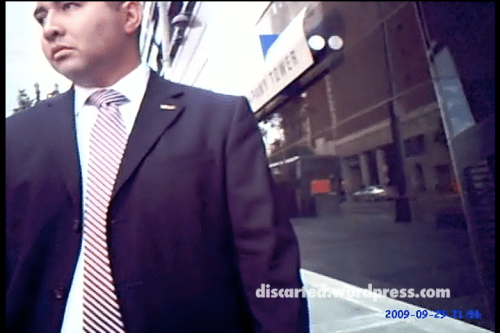
One block down at the The Gas Company Tower, however, they are apparently not on the same page (and it’s owned by Maguire Properties and patrolled by Universal Protection Service, same as US Bank). After a minute or so of harmless shooting of an escalator, a security manager who identified himself as Ivan came out and told us we couldn’t take photos of a private building. We told him that’s not true and we were on a public sidewalk. He said it was a private sidewalk (and we were very aware of the easement plaque). The usual back and forth ensued.

We ended up talking to Ivan for a bit, and he changed his tune once he realized he didn’t really have any facts to go on. He ultimately made some comments about respecting photographers’ rights and kept mentioning a courtesy card inside they normally hand out, but he really didn’t seem very prepared to tackle this issue for his superiors. It was interesting that a security manager of a major skyscraper in LA would come out to reprimand photographers and not be armed with courtesy cards, his own business cards, or any knowledge of the law. But, I guess they pay these guys just to reiterate.

The takeaway is this: Knowing your rights and standing your ground is essential. Undoubtedly nine out of 10 photographers security approaches at the Gas Company Tower apologize and leave immediately. The security staff is then emboldened to enforce a nonexistent law and trample on constitutional rights, and there is absolutely no incentive for them to do otherwise.

Interestingly, someone has filed a privacy complaint with YouTube due to the above video. How does it infringe on anyone’s rights? No face is shown, no last name is given; we’re on a public sidewalk discussing a policy that relates to photography in public. What an incredibly lame move from a very small person – someone who is perhaps embarrassed how he comes off? Just speculation, of course.


Photographing Big Trees

Check out this video on how photographer Michael Nichols set about photographing some seriously tall trees. National Geographic sent Nichols into the Redwood Forest for a year to get the image that appears in the magazine’s October issue. A year! Can you even imagine the budget that magazine must have? I’d love to know the final tally on how much the shot cost.

Nichols eventually got the shot with “three cameras, a team of scientists, a robotic dolly, a gyroscope, an 83-photo composite and a lot of patience,” says NPR’s The Picture Show blog. (And it’s pretty awesome indeed.)

Article via The Picture Show

Talking to…Photographer Richard Gordon

manstreet

In his book American Surveillance photographer Richard Gordon takes on the topic of the ubiquity of surveillance cameras in the US. By documenting security cameras – in malls, buildings, musuems, on the streets – Gordon reminds us we’re being watched nearly all the time.

Gordon is a part-time instructor of photography at City College of San Francisco and Stanford Continuing Studies, and he’ll be a part of “Exposed: Voyeurism, Surveillance and the Camera” at the Tate Modern in London in June 2010. He’ll also have four photographs at the San Francisco Museum of Modern Art from October 23 through January 2010. Here, he answered a few questions about the book and photography for us.

What was the origin of this project for you – the spark or series of events that made you want to do it?

I photograph the social landscape and began to notice what seemed like an exponential increase in surveillance cameras in January ’03 and began to photograph them as part of the urban landscape.

Are these photographs more the result of seeking out the surveillance cameras, or happening upon them?

I avidly sought them out for five or six weeks and quickly came to realize that it was not necessary; they were everywhere and I just go about my business and photograph them in day-to-day life and photography. I did eventually make some trips with the object of photographing them in different places.

Before this project did you have an accurate idea of the amount of surveillance cameras out there? Was it eye-opening?

I have no idea of the number of surveillance cameras then or now except that there are many more now than in ’03. Everything is eye-opening.

It is often difficult to photograph malls and institutions and even architecture in this day and age with security concerns. Did you ever experience problems when taking these photos – either from security or passersby?

Malls are private property and the law regarding photography in public and private places is different and I know the differences. The most obnoxious incident was with an assistant manager at a Safeway market. In general I did not have problems for a few reasons (I suppose, but cannot prove): 1., I am a middle-aged, white-haired white guy. 2., I know how to photograph and when one does something with confidence and competence, most people accept it. I almost never skulked around and at times would make it obvious to any potential viewer of my photographing that I was taking my time, giving the surveillors time to study me as I made my pictures (the precise nature of which they could have no idea). In some circumstances, I would approach a security guard or employee and ask permission. I was chased off the steps of Enron after I made the pictures I wanted to.

xamsrv16

I’ve noticed on our own blog when we write about the erosion of civil liberties, people actually (and often belligerently) write in defending the government or police tactics and call those who are outraged “radicals,” saying things like it’s just keeping us safe from terrorists. What’s your take on that?

I try not to argue with the ignorant. There seems to be more than enough stupidity and/or ignorance on all sides of these issues than I care to indulge in.

Continue reading ‘Talking to…Photographer Richard Gordon’

Another Hearing on Photographer Harassment

Erin McCann, a DC photographer and activist for photographers’ rights, sent an email today with news that there will be a Congressional hearing on photographer harassment this Wednesday, September 23 at 2 pm EST.

We posted on last year’s Congressional hearing on photography rules in Union Station, which ultimately clarified the fact that it’s quite legal to shoot there despite multiple incidents where  their security insisted otherwise. Now, it seems Congresswoman Eleanor Holmes Norton (D-DC) wants to get to the bottom of the similarly outrageous  harassment at the Department of Transportation (we’ve posted on it here and here) in a hearing entitled “Risk-based Security in Federal Buildings: Targeting Funds to Real Risks and Eliminating Unnecessary Security Obstacles.”

Erin will be testifying about the recent DOT incidents. From Erin’s email:

There is no law forbidding the taking of photographs of public buildings–federal or not–and yet our current security climate operates under the assumption that photographers are always suspicious. Photographers have been harassed on a regular basis in recent years, and several have been arrested. Del. Norton’s support for our rights is significant and very much appreciated.
Erin will be Tweeting from the hearing and you can follow her Twitter feed here on Wednesday.

Who’s Watching You? Oh Yeah, Everyone Is

surveillance sign
Hoboken, NJ Photo by let ‘er rip

In so many ways Americans – gladly, willingly – gave up their personal freedoms in the aftermath of September 11. One of those ways is that we now live under surveillance, pretty much everywhere and all the time. Photographer Richard Gordon set out to document the prevalence of surveillance cameras over five years, from 2003 to 2008, in his new book American Surveillance. With photos of security cameras on ceilings and street lamps, in museums and malls, Gordon found there’s precious few places that you’re not being filmed.

The Epoch Times reported on Gordon’s book signing at the University of California, Berkeley recently where he talked about his project – and how he found camera in cities like Chicago and New York, but also suburban malls and rural areas. In one San Francisco mall’s parking structure, he counted 130 cameras. 130! (Do you ever notice how when someone goes missing, like that recent Yale graduate student, there is almost always surveillance footage of them?)

Gordon’s book is a really interesting comment on our times – and a multi-layered issue at that. In terms of street photography, you think, how can anyone object to their photo being taken when it’s taken probably thousands of times a day already? In terms of photographers’ rights, is it fair that certain government and private buildings outlaw photography but are constantly photographing you? And are you fine with your Google searches, emails, grocery store purchases, errands and financial records being tracked in the name of security?

And you might say, “What do I care? I’m a law-abiding citizen, it doesn’t affect me.” But I think the larger issue is that a culture of surveillance breeds a culture of fear, which is very apparent in the US with the accusations of terrorism in very innocuous situations, like with photographing skyscrapers and subway cars. We give up a lot of our innocence when we always suspect the worst of everyone around us.

Article via The Epoch Times


Spam Blocked