Archive Page 90

Sheriff Threatens to Submit Photographer to FBI’s Hit List

It is completely legal to photograph the Los Angeles Metro System.

Be sure to Digg the video here, leave a comment on YouTube, and submit the story to boingboing.

On October 31, 2009 while on my way home from the Hollywood and Highland area, I was unlawfully detained for 25 minutes by LASD Officers Richard Gylfie #2955 and Bayes #456 for taking two photographs of the turnstiles located at the Hollywood and Western Metro Station — an act that is completely legal and occurred in public space.

As you can see in the video (which can be viewed on YouTube, Vimeo, Liveleak, Flickr and discarted.com), Officer Gylfie #2955 and Officer Bayes #456 took it upon themselves to ignore established law and Metro policies in order to bully me, humiliate me, and detain me for conducting a perfectly legal activity in public. More important, by illegally detaining me, Officers Gylfie and Bayes violated my constitutional rights, which protect me as a photographer and against unlawful stops, searches, and seizures.

To voice your concerns regarding my unlawful detainment, contact the following individuals and offices:

Los Angeles County Sheriff’s online complaint form.

Michael J. Gennaco, Chief Attorney
The Office of Independent Review
4900 South Eastern Avenue, Suite 204
Commerce, CA 90040
Phone: (323) 890-5360
Email: mjgennac@laoir.com

Karyn Mannis, Captain
Los Angeles County Sheriff’s Department, Internal Affairs Bureau
http://www.lasd.org/divisions/leadership-training-div/bureaus/iab.html
(323) 890-5300

Eric Garcetti, City Council President
5500 Hollywood Blvd., 4th Floor
Hollywood, CA 90028
Phone: 323-957-4500
Email: councilmember.garcetti@lacity.org

NOTE: Garcetti’s office is directly across the street from where this unlawful detainment took place. Gil Garcetti, Eric’s father, is also a former Los Angeles District Attorney, as well as an acclaimed urban photographer, so Eric should be well aware of photographers’ rights and the issues that we deal with today.

Tom LaBonge, Councilmember, District 4
Hollywood Field Office
6501 Fountain Avenue
Los Angeles, CA 90028
Phone: (323) 957-6415
Email: councilmember.labonge@lacity.org

MTA’s Contradictory Photo Guidelines

0357A007

Last Saturday on Halloween I was detained at the Hollywood/Western Metro stop by LA County sheriffs for taking photos of the newly installed turnstiles that were still under construction and decorated with pretty yellow caution tape. During my detainment (which will be address publicly soon), I was told by one of the sheriffs that taking photos was against MTA’s policy. Well, of course I knew this was not true and stated that to the officer, which didn’t curb his aggressiveness towards me or prevent him from threatening to put my name on the FBI’s “hit list.” But that’s not the point; the officer’s behavior doesn’t matter (for now at least) because the focus of this post is the MTA’s contradictory photography guidelines.

After my exciting detainment, I went home and read over the MTA’s photography guidelines, and sure enough, just like I mentioned during my not-so friendly encounter with the sheriff, photography is allowed on the Los Angeles County MTA system. That is — only in public space.

However, as I read through their guidelines I became rather perplexed because the MTA guidelines also state no photography inside moving trains for privacy and safety reasons.”

What the hell does that mean…“no photography inside moving trains for privacy reasons”?

Whose privacy are they trying to protect? How is there any more privacy on a public train system while it’s moving than when it’s not moving? How can an expectation of privacy even exist inside a public transit car? Does this also mean, according to MTA policies, that a Metro rider can only have an expectation of privacy while riding in one of their moving cars but not anywhere else on Metro property, which is pretty much all public space? Does an expectation of privacy even exist anywhere on Metro property? It’s all public space!

In my personal and non-legal opinion, I would have to say that this specific policy is bogus and designed to protect MTA personnel from any sort of liability. There can’t be an expectation of privacy anywhere on the MTA because the entire system is public. And we should all be able to take photos anywhere on the system, including inside moving train cars. How else will we be able to catch MTA drivers texting on the job?

Best of Times for Photojournalists

Over at the journalists’ resource PoynterOnline, Al Tompkins recently did a post on the shift underway in photography toward video and the DSLR as the must-have gear.

Tompkins does a mini-interview with photographer Ami Vitale, who says this is a great time to be a photojournalist. (Clearly she hasn’t heard that journalism is imploding.) She explains:

We have more tools available than ever before and we also have an audience bigger than anytime in the history of mankind. It’s powerful, and I’d like to harness these tools and use them to communicate and create understanding in a complex world where messages are so easily misunderstood. I see this as a wonderful time to exploit all these tools for the power of good!

But as a commenter points out, the price of upgrading to remain competitive can be prohibitive, if not downright impossible, when you consider the Canon IDMK4 costs about $5,000. Most newsrooms certainly don’t have this money, and if it falls to the individual, then it seems photojournalism will increasingly be about economics.

Article via PoynterOnline

The Dirty Truth About Street Cleaning in LA

In a piece reminiscent of classic “60 Minutes,” USC journalism student Matt Schrader exposes the dirty side of parking enforcement and street cleaning in downtown Los Angeles. Schrader found that while parking enforcement is out in droves ticketing cars, and mostly on street cleaning days (making the city $15,000 an hour!), the streets they’re patrolling aren’t even being cleaned. The best line of the piece is from a guy who got ticketed on one of those streets: “They have the manpower to ticket you, but they don’t have the manpower to actually do the job.”

This is an issue near and dear to our heart, and Schrader told us he was inspired in part by our earlier video where we caught our local parking enforcement agent parking in the loading zone while getting lunch. While LA slides further into bankruptcy and mismanagement, somehow, some way, parking enforcement manages to probably be the city’s most efficient department.  

And though LA’s government is indeed so broken that nothing will likely ever be done, it’s nice to know someone is at least trying to keep them accountable. Long live journalism.

Happy Halloween

1788535326_85289fca8c
Photo by Richard Thompson

Joel Meyerowitz Talks Twitter

meyerowitz_fallen-721855
Photo by Joel Meyerowitz, 1967

In the modern age who has time for real conversation? No one – so fittingly Aperture is hosting a live interview with big-time photographer Joel Meyerowitz on Wednesday, November 4 at 4pm via their Twitter feed. You tweet your questions to @aperturefnd and Joel will supposedly respond in 140 words or less. It’s billed as Joel answering questions about his latest project, “Legacy: The Preservation of Wilderness in New York City,” but I’d imagine there’ll be other topics covered too.

Jet Ski Photos Provoke Police Visit

jetski_low
Photo by Garry Chinchen

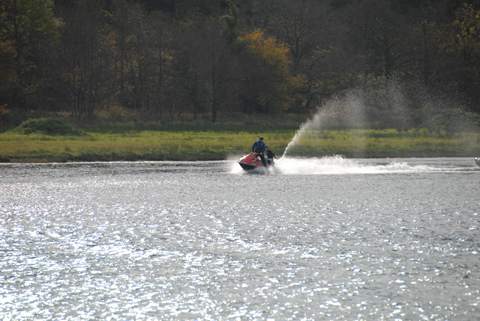
Garry Chinchen, a photographer in England, was approached by police this week for taking photos of jet skiers in South Wales. He was told if he continued he would be arrested for “breach of peace.” All told, the officers checked his images, phoned his employer and ran his name through a database – to which I have only one response, huh?!! Where is the outrage in England? They aren’t just trampling on photographers’ rights; there are apparently no rights to begin with. Apparently the whole incident was touched off by the fact that children were changing into wet suits on the lake’s shore, but Chinchen’s photos are clearly of the jet skis in the water – and not even very close up at that.

The police spokesperson’s statement said in part, “‘The officer carried out all the necessary checks on this person and no offences were disclosed. The photographer was appropriately advised regarding his conduct.” Luckily that was sorted out.

Article via Amateur Photographer

SF Guards Offer Black Eye to Photog

4036820768_dc9607ffb2_b
Photo by Troy Holden

This week Troy Holden of the Caliber photography blog had a little confrontation with security staff at 555 California in downtown San Francisco. Now, San Francisco is known to be a very progressive city, but these guards seem like they’re straight out of an episode of “The Sopranos” on the other coast.

When Holden and a friend starting shooting the building, they were told no photos. Then, he writes:

I decided to challenge this statement and the older of the bunch (left) asked me if I wanted to be punched in the face. No, I replied, I have to go back to work and a black eye would make things awkward for me. He then asked me how I would feel if he broke my camera. I told him I would be bummed, but that I needed an upgrade and if he touched me or my camera I would seek monetary legal action to the extent of a brand new Canon 5D Mark II.

Holden contacted the building’s security department and got a response that indicated they are taking the incident seriously.

But in the meantime, Troy – get a Vievue.

Article from Caliber via Thomas Hawk

Train Operators Sue to Block Surveillance

3457884239_ba0bbfde0d
Photo by rjmcconnell

For your daily dose of outrage consider that the LA Times reports that the Metrolink engineers’ union has filed a federal lawsuit to remove surveillance cameras in commuter trains because it’s a violation of their privacy. The cameras were installed in direct response to the Metrolink crash in Chatsworth, CA, last year that left 25 people dead and 135 people injured. The driver of that crash was reportedly texting on the job.

Maybe these train operators aren’t living in the 21st century because a great majority of companies have surveillance cameras and film their employees’ every move – not  to mention all the cameras blanketing stores, streets and parking lots. But it seems they’re thinking that when you drive public transit and have thousands of peoples’ lives in your hands you are owed some special sort of privacy?

It’s beyond frustrating that people who don’t have a  valid case, or in some cases are blatantly in the wrong (as in YouTube complainers), get to use the old privacy violation when it suits them. If there’s any justice, this lawsuit won’t get far. 

Article via LA Times

Talking to…Photographer Mark Menjivar

foodartist
Food Artist | New York, NY | 1-Person Household | Runs small vegan bakery from her apartment. | 2009

What we eat reveals a lot about us. So as social experiments go, photographer Mark Menjivar stumbled on a great one by documenting the contents of peoples’ refrigerators with his photo project, “You Are What You Eat.” Over three years, Menjivar, a native of San Antonio, traveled to 20 communities in about 12 states and photographed 45 fridges (and he plans to do about 5-10 more before he wraps it up). You can see more of the photos on his web site.

Here, we talk to Menjivar about his time looking deep into the fridges of America.

You said you traveled the country for three years exploring the issue of hunger. Was that for this project or something else that this grew out of?
I was working as a project manager of sorts for a documentary on hunger by artist Michael Nye. Michael is great and really encouraged me to pursue my own project as we traveled. About half of the places I visited were due to working on that project, the others from my own dealings.

How did you find your subjects?
I have found people all different kinds of ways. At food banks, local pantries, restaurants, walking up to strangers on the street, etc. Some are family members or a friend-of-a-friend type thing, but most were strangers to me when I invited them to be a part of the project. 

I have really approached the project like a portrait project. When I am drawn to someone for some reason I ask them if they would like to be a part of the project. For me, it is not about getting as many people as I can but a diverse group.

How much explaining or convincing did you have to do? I’d imagine some people would just be naturally incredulous or suspicious.
For sure. I usually end up talking to them a bit before I tell them what I am doing. Most people think it is pretty odd, but only three or four people over three years have said no. I totally respect that as I would be pretty hesitant to let someone come home with me to photograph [my fridge]. There is always this awkward hesitation in the conversation at some point. Some people start to make excuses or say this is an off week. I really love these interactions and almost always have a good conversation with each person.  

Did you find people were embarrassed or shy about having you see their refrigerators?
Some. But most are pretty okay with it. The fridges are photographed “as is.” Nothing added, moved or taken away.

On your web site, you say these are refrigerators from “Vegetarians, Republicans, members of the NRA, those left out, the under appreciated, former soldiers in Hitler’s SS, dreamers, and so much more.” Tell us about the former soldier. How did you come upon him?
I met him at a food bank in the desert. He was a volunteer there and a really hard worker.  He is a food hoarder due to his past experiences with not having food as a POW. In his house there were probably 30 boxes of food lined up in the hallway, and the kitchen was packed. Each night he would head to the dumpsters to reclaim food that had been thrown out.  

carpenter
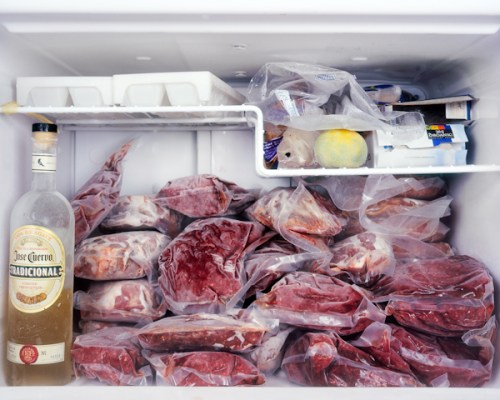
Carpenter/Photographer | San Antonio, TX | 3-Person Household | 12 Point Buck shot on family property. | 2008

I love the freezer packed with bags of a 12-point buck and a bottle of tequila. Did you find the owners matched their contents?
That family is actually one of the healthiest families that I met. They pretty much only eat meat from sources that they can identify. The meat is from a buck that he killed on his family’s land. He does not use any deer stands, but heads out on foot and sees it as a very respectful act. They also have huge garden beds in the backyard that they share produce from.  

Continue reading ‘Talking to…Photographer Mark Menjivar’


Spam Blocked