Archive Page 101

LA Port Police Bust Leisurely Sail

3323188617_ee94eb84bb4

Photo by Bryan Villarin

Whether on land or at sea, LA photographer Bryan Villarin has a knack for arousing suspicion. We posted about his encounter with private building security in downtown LA last July.

And this past weekend he was sailing the waters of Los Angeles Harbor off San Pedro with some friends when they were stopped by Port Police. As Bryan posts on his blog, they were told there were reports about their speed, which he says was about five knots. In addition, they said they had video of the group taking photographs.

Soon there were two Port Police boats surrounding them. The sailors were pulled over, detained, given background checks and questioned about their ethnic origins and professions. The police insisted Bryan’s friend Danita hand over her social security number, which she did. They were told the stop constituted a warning, and now they were in the database as a non-threat.

Bryan asks some good questions in his post, namely:

  • Our information is in their office on some slip of paper and/or their computer system. Danita was asked to give her Social Security number, but that was wrong. What would’ve happened if she refused to give them that information?
  • Being in a public area, weren’t we free to photograph as we please?
  • Would they stop a cruise ship if some of their passengers had DSLR cameras with super telephoto lenses?

The story is unbelievable and goes to show you the lengths law enforcement will go these days in “keeping our country safe.” So safe, in fact, that now it’s routine to overreact to what used to be normal, everyday activities. As is almost always the case in these situations, it boggles the mind that these officers thought this leisurely sailing trip around the harbor was some sort of terrorist reconnaissance mission.

Story via All Narfed Up

To see more photos from the sailing trip, including what Port Police deemed not a compromise to security, go here.

Found on Flickr: ockermedia

better-hope-the-wind-doesnt-change

This is another installment in our continuing series where we talk to photographers whose work we’ve appreciated on Flickr.

This week we feature Lee Jordan/ockermedia.

cinemafia: The first thing I want to ask you is how you began doing street photography, as it is generally a different story for everyone who does it. Did you have any particular influences that helped you along the way?

ockermedia: My first connect to photography was in college in 1986. I was 16, and just left school to go to college to study media and film. My first year was taken up by a film project called “Life in the Shadows.” I met many a colourful character – one called Teddy Ruxpin and another called Elvis… back then, as you may or may not remember, tramps were real tramps! Quirky characters who drank far too much, lived under bridges and made funny grunts and noises at people as they walked by, good, old massive beards… anyway it was a good short film that paved the way into my sports filming career.

Although my filming progressed into extreme sports, I remained interested in capturing local street life and would often include edits of street people in sports videos. In terms of other artists that have inspired me, Joel Meyerowitz’s 1980s New York street photography was certainly influential; Martha Cooper and Henry Chalfant also influenced my style as I was interested in all aspects of street culture, street art, music, sports and lifestyle. It was only at the start of ‘08 [that] I picked up a DSLR and started my photography hobby. Having enjoyed all aspects of the creative control that filming gave me, I found digital photography a very accessible medium.

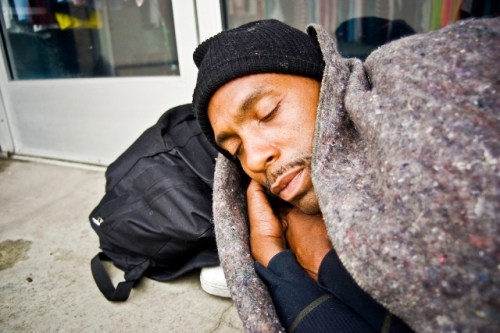
cinemafia: Why do you think it is important to photograph people who live or otherwise spend most of their time on the streets? Do you think these types of photographs will ever really make any difference in the world?

ockermedia: I think that it is an important record of people whose lives go largely undocumented and unrecorded [as] they slip through the net of any government statistic. Excluded from any family photograph, they have little or no paper trail of bank statements and addresses. A photograph gives them a lasting image, a record of their existence. “I am” is the simple statement they make in the photos. It is the way we view their existence that influences how we look at the photographs.

I think that street photography provides an important insight to all lifestyles in the city, for both current and future generations. We should all spare a thought for these otherwise forgotten souls. However, while I think that photographs of marginal characters in society can be useful in promoting awareness of social and cultural issues and provoke debate, I do not take the photos with this as an agenda; it’s simply a personal record of the characters I meet.

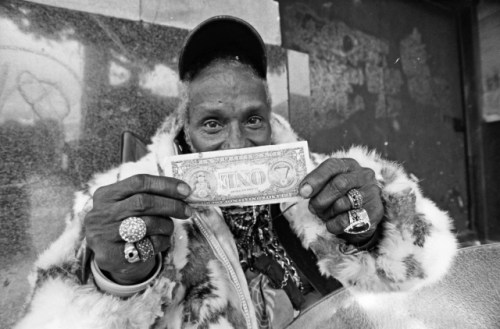
goliath

cinemafia: One of my favorite shots of yours is of Goliath (above). It’s a striking image, and the story behind it is all the more interesting. It speaks a lot to the idea that those of us who shoot people who are frequently on the streets, whether by choice or by chance, often come to know these people very well, even becoming  friends with them. I wonder if you could talk a little about how it feels going out and seeing these people regularly, and how you think they feel about you photographing them.

ockermedia: Goliath is a gentle giant of a man that I met while shooting on the streets of Bristol. [I] sat on a bench having an in depth chat about life, and his role in it, and then I realized that I knew him many years ago. Back in his heyday he was a bouncer on the doors of many an establishment I frequented. Many Bristol locals would remember him from the Thekla, late 80s, early 90s, as the dominating figure on the door. He then went onto explain that he was also head of security at many famous festivals like Glastonbury, Reading, Leeds,etc, etc. But because of the nature of clubs and festivals he ended up an alcoholic, drinking maybe 30 cans of strong larger a day! So much of his time [now] is spent sitting around on streets drinking all day. However he does have a house – and a big house in the most sought after part of Bristol, yet he spends most of his time on the streets.

I know I was fuelling his addiction, but I bought him a couple of beers to say thanks for the photos. This put a beaming smile on his face – RESPECT he said! As I was leaving he called me back. He offered to repay my gift of beer with some old photography books he had. I didn’t want to take his books, but I saw it as a chance to see him more over the lonely Christmas period, if only to make sure he was well and happy. He is the most gentle of giants with an honest heart, and most of all, he is my new friend.

Continue reading ‘Found on Flickr: ockermedia’

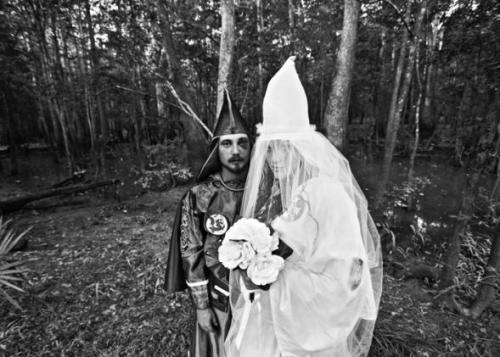
Anthony Karen & the KKK

wedding-high-res
Photo by Anthony Karen

Just when you think we’re getting somewhere, you realize we have a long way to go. Racism is a fact of life in this country, and the Ku Klux Klan is, sadly, very much alive and well. It could be said they’re even more fired up with the election of Barack Obama as president.

We interviewed photojournalist Anthony Karen last June about the unparallelled access he’s had to the KKK, photographing their secret ceremonies and rituals in several states in the deep South. The UK’s Independent recently did this article on the KKK and Karen’s work, and it’s worth a read.

Article via The Independent

The Diatribes of Dunces

Due to their content, and more importantly, their unforgettable cast of laugh-out-loud characters, it’s amazing that these two videos went under the photographers’ rights radar.

My favorite character, reminiscent of a powerless, rage-induced, temper-tantrum throwing 4-year-old screaming over and over because he’s not getting what he wants, is definitely Arnoldo #08458.

Rather than making a fool out of himself, maybe he should have just used his walkie to check with his supervisor regarding the validity of the videographers’ claims (which in the end were true).

It’s evident by Chad Michael Buchanan’s video that these guys don’t like power trips, are well trained, deserve to keep their jobs, and don’t have anger management issues (at all).

Regarding the second video, my favorite line from this gem is definitely, “Ah, ah, ah, ah.”  That woman, and her boy’s regular with bangs, are priceless.

In all seriousness though, if the videographers were trespassing on private property and breaking the law, just call the real cops, press charges, and let the police deal with the problem.

Turning yourself into a belligerent moron is not the right way to prevent someone from videotaping or photographing a newsworthy event, or anything for that matter.

Plus, when you act this way, you become the main story and get plastered all over the internet for your friends, family, and neighbors to see you behaving like a “d-wad.”

A special thanks to freelance news photographer Chad Michael Buchanan for personally providing us with these deece gems, and allowing us to tag them with our site’s name.

That way whenever someone watches these videos on a different site not pertaining to photography and the law (we all know these things do get around), they’ll see the URL and hopefully come to our site where they can learn about photographers’ rights.

Unlike other blogs on the web, our site is not about us patting ourselves on the back and repeatedly telling ourselves how great we are, however. If we have to put our URL on a video or photo that was provided to us (granted we have permission of the owner), we will do that in order to get the photographers’ rights message out to more people. But only if we have the owner’s permission.

More of Chad’s work can be seen here.

Untold Stories in LA – Photo Contest

944 Magazine and the UnScene Photography Tour are sponsoring a photo contest of “untold Los Angeles stories – people, places or things.” The five lucky winners will show their work at a gallery event in March,  and the winner will be announced at the end of the night. Details can be found here.

The deadline is February 25.

My Moment With a Famous Photographer

When it comes to exceptional photography, there are photographers that are known within the photographic community, and then there are photographers that are known by everybody. And if they don’t know the photographer they have certainly seen their work. For instance, raising the flag on Iwo Jima (Joe Rosenthal), the napalm girl (Nick Ut), and the fire hoses in Birmingham (Charles Moore).

One weekend a few weeks back, while shooting a protest against the Israeli invasion of Palestine, I was standing on the edge of the curb right outside the Federal Building in LA, when I turned and saw one of the greats.

Almost instantly I thought, “Wait, is that –? Hold on. Yeah, it is.”

And then I thought, “Should I say something? Should I introduce myself?”

So I did.

Me: Hey, are you –?

He looks at me hesitantly, somewhat put off, like he’d been asked this question too many times his life – quietly hoping that I wouldn’t ask him about his famous photo.

Him: Yeah.

Me: I thought so, you know, I really enjoy your work.

Him: Thanks. Who are you? Who you work for?

Me: My name’s Shawn. I don’t work for anybody. I’m a documentary photographer doing this on my own.

And after I said that it seemed I really turned him off, like because I don’t work for a publication my work must not be any good.

So I thought about leaving, but I wanted to ask him a question about his work documenting one the world’s most violent gangs.

Continue reading ‘My Moment With a Famous Photographer’

Are We Not Dispassionate?

 injured2
Photo by cinemafia

As street photographers, photojournalists or documentarians, we are under the assumption of, and at times actively identify as being, dispassionate observers. Detached messengers of an uncolored truth. However, the truth is relative, and as human beings the concept of dispassionate observation, while considered an ideal, is an impossible fallacy. We expect to straddle the roles of man and machine, and seem to ignore the idea that one created the other. 

The persistence of this myth is tied to the progressive, democratic aversion to a controlled news media. We demand a dissemination of the facts as they are, without agendas, often expecting the breadth and accessibility of the internet to be the causeway that lets that information stream run. We look at bias as a detriment to the story and to prejudice as the corrupter of its information. Is it only because our culture has raised these as buzzwords as evil? We are not only kidding ourselves, we are overlooking the fundamental nature and legacy of humanity.

e-pluribis-unum2
Photo by cinemafia

When a photographer points his lens at a subject and records an image, there is a basic human process taking place. The choice of what matters is a form of prejudice. Not everything has importance, and in fleeting moments it takes instinct to find what is. When that photographer then selects the best representatives from those images to distribute to the public, there is again bias. But, to strive for the cold, clinical characteristics of the presumed un-slanted documentary is to remove this process, and leave a trail of data where intention and feeling once was.

Continue reading ‘Are We Not Dispassionate?’

Amtrak Forces LA Photographer to Delete Images

Despite several embarrassing incidents for Amtrak in the news recently (in NY and DC), Amtrak employees are still woefully uninformed when it comes to photographers’ rights. 

A local LA photographer, who goes by ShutterBuda, was taking photos at Union Station downtown yesterday morning for about an hour when he snapped an Amtrak employee who told him to not take photos. ShutterBuda continued shooting, when another Amtrak employee told him that he didn’t have permission to take photos. At this point, a commuter chimed in that he also objected to his picture being taken.

This guy, who claimed to be an ex-Guardian Angel, quickly became belligerent and escalated the situation into an ugly scene, yelling that ShutterBuda didn’t have permission to take his photo and threatening to “take him down” and “smash his camera.”  All three were now demanding that he delete his photos. In quick succession, the Amtrak employees called a manager over and the manager called a security guard.

amtrak-2 Photo by ShutterBuda

Not knowing how the law applied inside Union Station, ShutterBuda complied with the demands to delete the images. “Out on the street I never would have deleted those photos – I would have said no,” he says, “but I was kind of in a grey area there.” Plus, he says, they were being abusive and he didn’t want to deal with the scene.

Soon enough three LA County Sheriffs were on the scene.

If you can imagine it: Four Amtrak employees and three sheriffs for a man taking photos of commuters inside a public building.

The sheriffs backed up the Amtrak employees, with one claiming, ShutterBuda says, “that I needed permission from whoever owns Union Station and that I should comply with [the Amtrak staff] because they’re ambassadors for the law in some sense.” One sheriff asked to see the camera to check that the images were deleted – all of which ShutterBuda was able to get back later using recovery software.

amtrak-1 Photo by ShutterBuda

The issue, it seems, was not ShutterBuda being there (i.e., trespassing or security risks) but that he didn’t have permission to be there. Which is a blatant fabrication. You do not need permission to shoot handheld in a public place. And you certainly do not subject yourself to the seizure of your images if you do so. That is downright illegal and possibly a Fourth Amendment issue. A court order is required for anyone to view your photos.

There’s also the issue of whether Amtrak and the sheriffs violated copyright and intellectual property laws by deleting these images, which of course is well beyond their pay grade. They are just blindly following some order they think they have the right to enforce.

Continue reading ‘Amtrak Forces LA Photographer to Delete Images’

Court Clears Chicago Photojournalist

2336194656_e4d6de7fe51
Photo by CatalogThis

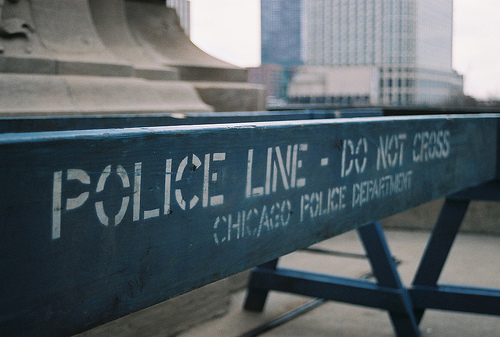
For those of you who followed the story here back in October and November, you’ll remember that Mike Anzaldi is the freelance photojournalist who was unjustly (some would say ridiculously) arrested twice in Chicago for trying to shoot footage at crime scenes. The conclusion to the story is that a judge finally ruled in his favor, but the path to that point was predictably convoluted and drawn out.

After several court dates over the past few months, and coverage by the Chicago Tribune, the city and state decided that they would indeed press forward and charge Anzaldi with breaking the law. (Anzaldi heard that the coverage by the Tribune was in part responsible for the decision to move forward.) He was charged with two ordinance violations by the city and three counts of obstruction by the state.

Anzaldi picks up the story here:

Several court appearances went by with no real clear indication of what I was being charged with. The judge agreed, but allowed the state to amend their charges so that they made sense. This happened a few times. If it sounds silly, believe me, it was better being there. Even after the judge held the state’s hand through these pre-trial follies, the state still didn’t satisfy the court. 

The day of the trial, my attorney made a few pre-trial motions to dismiss a couple of the charges. The state was arguing that I obstructed the commander by filming. My attorney argued that it was impossible to obstruct by filming. The judge agreed, and tossed out that charge. The problem for the state was that their whole case was based on that notion; they argued that my filming created a chilling effect to the people who were gathered around me when the commander came over to interview them about the shooting. Never mind that it never happened. There was no interviewing, and no one was chilled.

 But, that was their made-up story, and they were going with it. Again, the judge threw that out before the trial began, so it was like the whole day, and their whole strategy, was out the window by 10 a.m. The rest of the charges were equally hollow and ridiculous.

At the end of the day, the judge admonished the state for failing to defend their claims.  He also mentioned that the commander’s testimony was surprisingly different than what was recorded on tape. While stopping short of calling him a liar, he said he didn’t understand why he would testify something different from what we would see on tape.

That said, the judge also indicated that if the state had successfully argued that their case was based on me chilling potential witnesses due to my filming, that he would have likely accepted that claim. Again, that didn’t actually happen, nor did the state have that opportunity due to their own incompetence.

Anzaldi is contemplating his next move. And he still has his video of the first incident, which he says is fairly tame, but it does prove his innocence without question. He says he may or may not release it one day.

Off Topic: “Deece” Is Mine!

deece Graphic, Article, Sentences, Punctuation and Grammar by discarted

I realize that this is completely off topic, but in a world where many are giving themselves far too much credit than they deserve, or giving themselves credit where credit isn’t even due, I am marking my territory before some blogger stakes claim to what is not rightfully theirs.

So in order to claim ownership/inventorship/responsibleship of “deece,” a word that has been sweeping my little community ever since I invented it in my kitchen six months ago to describe something that is really good, I will say it right now, before “deece” begins sweeping the internet and invading other communities around this great country we call America…

Deece is mine!

For a complete definition of the word “deece” and an audio recording of how it can be used in a sentence, feel free to contact me via email.


Spam Blocked