Archive for the 'Photography' Category


Fan Photographer Axed For Being An Ex-Con

Philadelphia sports fan photographer John Green was fired just before the start of baseball season after his criminal past was discovered through a background check. This is crappy for a few reasons, as Philly.com reports.

Green was upfront about his past during the job interview and his crimes didn’t include sex or children — they were for non-violent burglary offenses, with the last conviction being in 1999. That’s 12 years ago, and since 2007, Green has proven himself to be a popular and successful photographer at Citizens Bank Park, where the Phillies play.

Even though he started with Fan Foto in 2007 as a novice, the very next year Green led the company in sales – meaning fans buying photos he shot – and has been in the top five of the 100-plus photographers used by the company, says manager Coyle.

Isn’t prison supposed to be for rehabilitation? Once you’ve paid your debt, aren’t you released into the world to do something with your life? A blanket rule like not employing convicts is harsh. People would prefer that ex-cons are forever unemployed so that their only option is crime? It just seems foolish.

Source: Philly.com

How To Credit

Source: Design Sponge (via A Photo Editor)

Long Island Town Installs Massive Surveillance Camera System

The Long Island town of Kings Point has decided everything within its limits will be recorded.

The 3.3-square mile North Shore community is home to 5,000 residents. The plan calls for 44 cameras to eventually be installed at the village’s 19 entrances. That’s about one camera for every 120 people.

Anyone who enters the town will have their license plate scanned and, if there is a match in a criminal database, the police will be notified. The mayor says it’s to protect residents because there are apparently many crimes in this upscale, exclusive community.

I’m all for catching criminals, but the invasion of privacy implications are just…whoa.

Source: CBS New York (via Gawker)

Reaction to Death of Photojournalists

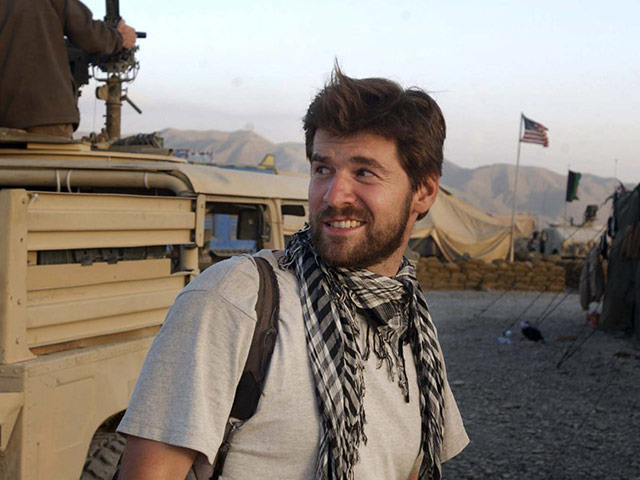
The LA Times’ James Rainey writes on the reaction of in the photojournalism community to the deaths this past week of two acclaimed and popular photographers, Chris Hondros and Tim Hetherington.

Some photographers pulled back from their work. Others vowed they would stay in the game but change their personal rules of engagement. Many revisited their worst misgiving — that no matter how many times they risk their lives, much of the public can’t be bothered with misery in far-off places.

Photographer Ashley Gilbertson talks of an experience he had after an Iraqi woman was killed by insurgents and how it changed his perspective:

“Standing there at her funeral,” Gilbertson said, “I thought nothing is going to bring her back. It all just became too much. I felt like I wasn’t helping anymore. Readers didn’t seem to be engaging. I felt like I had to find a different way to do this.”

It’s kind of hard to imagine the drive and passion one must have for such work to willingly travel into some of the scariest places on earth. Many escape one close call after the next, but as recent events remind us, you can only tempt fate so many times.

As a recent Newsweek piece says:

Anthony Feinstein, a professor of psychiatry at the University of Toronto, has plumbed the psyches of some 350 veteran combat journalists, finding that nearly a third suffer from posttraumatic stress disorder, sparked in part, he believes, by the tension between being an actor and an observer, seeing suffering but not helping. Many are burdened with a sense of alienation, unable to explain to friends in the “straight world” what they’ve seen and why it keeps drawing them back. Some have lost all perspective on what they’ve experienced. War reporters are unique, Feinstein concludes in his 2006 book Journalists Under Fire, because for them alone, “war is the catalyst, not the nemesis, to their creativity.”

Source: LA Times and Newsweek

Paparazzi Living It Up In DC

Photo by Marvin Joseph/The Washington Post

You wouldn’t think Washington, DC has enough sexy people to merit paparazzi. There isn’t really a big market for shots of Paul Ryan getting his haircut. But the Washington Post tells us that is, in fact, the case:

Yes, Washington now has its own homegrown pack of street photographers, a half-dozen or so who make their living selling photos and videos of visiting celebrities to gossip blogs, Web sites and magazines such as People and Us Weekly.

Local photographers have found they can make a great living hunting the haunts of celebrities that come to town to shoot movies or testify on the Hill. And the bonus is there is a lot less competition than in New York and LA, so photographers can make good money. Colin Drummond, the photographer they profiled, makes six figures — and made $50,000 (and counting) from a shot of a visiting Oprah. (OK, the photo also seemed to prove that she has six toes.)

The photographers who work this beat are more aggressive than the press corps Washington is used to, but so far they have not crossed the line into Britney Spears-type stalking. You’d probably get sent to Guantanamo for that, so it’s best not to push it.

“Everybody knows the rules, and to the extent anybody strays from them, we get them in line pretty quickly,” [Senate Sergeant at Arms Terrance W.] Gainer says. “The whole thing you see on television — what goes on in New York and L.A. — may occur on the street, but it’s not an issue up here.”

Source: Washington Post

“Home”

Happy Earth Day. They’re saying we have only 10 years to make some serious changes (eight, if you consider this movie was made two years ago), so it’s kind of important.

You can see the whole version here.

Photography Link Roundup

Photo by Patrick Hoelck

•  Polaroid photography doesn’t get enough love, or so it seemed to photographer Patrick Hoelck, who’s packaged a tribute in a book called “Polaroid Hotel.” [Patrick Hoelck]

•  The list of America’s most stressful jobs is out, and photojournalist made #4. And they only make on average $43K a year. At least a Senior Corporate Executive makes $167K. [CNBC]

•  David Hobby left the world of newspaper staff photography behind and changed the photography biz with his Strobist site. [Slate]

•  Eddie Adams didn’t want to be remembered for “Saigon Execution,” his photo of the Viet Cong prisoner with a gun to his head, and really actually wanted a Pulitzer for his photo of Jacqueline Kennedy holding the flag at her husband’s funeral. [Lens]

•  Google Video has bitten the dust. They recommend you move your videos over to YouTube and content will be removed after May 13. [The Register]

Two Photojournalists Killed in Libya

Chris Hondros  Photo: Getty Images

Two prominent journalists were killed covering fighting in Misrata, Libya yesterday, a sad reminder about how dangerous a job it is.

According to Framework:

The men were on the front lines covering fighting between rebels and forces loyal to Moammar Kadafi when an explosion occurred. The blast was believed to have been caused by a mortar round, according to a Los Angeles Times report.

Getty photographer Chris Hondros, 41, was nominated for a Pulitzer Prize and has covered most of the world’s major conflicts since the 1990s. The Washington Post has this slideshow of Hondras’ work. Bobby Ghosh at Time’s Global Spin blog wrote a nice post about him, and Framework has some great reactions from friends and colleagues. The day before his death, one of his photos ran on the front page of the LA Times.

On assignment for Vanity Fair at the time of his death, Tim Hetherington, 41, was just nominated for an Oscar, with Sebastian Junger, for their film Restrepo. His last documentary short called Diary, a personal reflection on his work and career, can be seen here. The New Yorker has a piece reflecting on his work here.

The Guardian has a video of reaction from a doctor, colleague and a Libyan official here.

Panos’ Guy Martin and Corbis’ Michael Christopher Brown were also injured in the attack but appear to be in stable condition.

Living Under Logan’s Flight Path

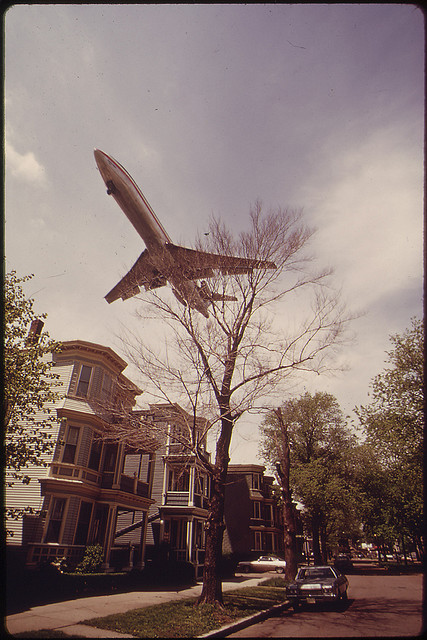
Photos by Michael Philip Manheim/U.S. National Archives

The National Archives has a Flickr account that’s a pretty hit-and-miss mix of photos and documents, but I’m really into this one collection called the Documerica Project, where freelance photographers across the country were commissioned by the government to document “environmental problems, EPA activities, and everyday life in the 1970s.” (Can you imagine such a project now in our cash-strapped times?)

A set from Michael Philip Manheim features photos he took in 1973. His assignment was “to document the noise pollution crises in the East Boston neighborhood around Neptune Road. Manheim captured powerful images of the deteriorating community, illustrating its uncomfortable proximity to one of the nation’s busiest airports and the plight of residents living under the landing path of jets on the approach to Logan’s busy runways.”

These photos of the planes above the neighborhood are eerie and cool. Having never that lived close to an airport before, I can’t imagine the noise and sight of planes constantly overhead. How completely jarring. They seem like they could almost just drop out of the sky.


Stoop Sitting

Will Hoffman and Daniel Mercadante’s sweet ode to hanging out on the porch: “It’s not a waste of time. I be waiting for mail.”


Spam Blocked