Archive Page 89

Customs Officer Threatens Photographer

Do the usual laws not apply to Customs and Border Protection officers? There’s one in Tampa who thinks so. When Jay Nolan, a Tampa Tribune photojournalist, arrived at the scene of a three-car crash today and took photos, he was detained for 15 minutes and his phone was confiscated. David Tipton, the Customs and Border officer involved in the crash, wanted Nolan to assure him the photos wouldn’t appear in the newspaper. When Nolan was unable to do that, he wasn’t pleased. As Nolan explains in the Tampa Tribune:

“He told me, ‘You don’t understand. We’re not local law enforcement here. We’re the federal government. We’ll take your gear right now,'” Nolan said. “He gave me two choices: either give my assurance or be placed under arrest.”

Nolan was detained for 15 minutes, and he smartly replaced his flash drive with a blank one and retained his photos. According to the article, Gary McClelland, the agency’s port director, later apologized to Nolan and explained the situation away by saying customs and border patrol “don’t permit photographs because of the nature of their jobs, but the agency doesn’t want to hinder the media.”

OK, I get there is a security issue with these agents working the border. But couldn’t you say the same thing then applies to all people who work with gangs and violent offenders (police officers, prison guards, judges, social workers…)? It seems like a very strange policy to “not permit” someone to take photos of you (when you’re in an accident in public, no less), because really, how do you enforce something like that without illegally throwing your weight around? Oh yeah, like Tipton did.

Article from the Tampa Tribune

Queen Wants to Limit Paparazzi


Photo of Buckingham Palace by madancer

The queen of England is saying off with their heads…that is, to the paparazzi who violate her family’s privacy. The Telegraph reports that Buckingham Palace is taking legal action to bar paparazzi from photographing the Royal family on their private estates. The Royal family grants public photo opportunities but want anything more to be deemed criminal harassment. Some say the Royals are just trying to prevent unflattering pictures from emerging – noting two particular photos where the queen was caught wringing a pheasant’s neck and an earl was hitting his hunting dogs. Paparazzi apparently station themselves on public roads and get intimate shots like these with their telephoto lenses. 

I am firmly not in the aggressive paparazzi camp, so I have a hard time siding with people who intimidate and intrude on their subjects to the point of being sleazy and dangerous. Though, on the other hand, it comes down to public people (in this case, very public) and their reasonable expectations of privacy. Do they have any? Not to mention that it also smacks of some hypocrisy, as the article points out, when members of the Royal family are happy to sell access to their private events for some serious cash to these same “intrusive” media outlets.

Articles via the Telegraph and Guardian

Marshall Responds to Photographer Harassment

The local Madison, Wisconsin, paper Isthmus picked up the story this week about an incident that happened in October where photographer Josh Zytkiewicz was questioned by a security guard outside the federal courthouse. The guard told Zytkiewicz “security procedures” prohibited him from taking photos of the building and said he was calling the Madison police (which never arrived, if he did).

In a nice bit of reporting, the paper talked to Chief Deputy U.S. Marshal Kirk Papenthien who admitted the courthouse is a popular landmark and not all people who shoot photos of it are stopped and questioned. When asked why the security guard told Zytkiewicz to stop taking photos and threatened to call the police, Papenthien says, in typically noncommittal law enforcement-speak, “I have no knowledge as to whether that is an accurate transcript.” Zytkiewicz recorded the conversation on his iPhone and you can listen to it here. Even so, Papenthien won’t admit that the guard was out of line because he said he didn’t know what Zytkiewicz was taking photos of.

But…if photography is legal at the courthouse, does it matter what the photos were of? So, is that to say, taking photos of windows are fine, but entryways are a different story? Of course not. It’s not a gray area, and shouldn’t be approached as one. When photography is legal in public, which it always is, then you can’t harass and threaten people for doing it.

Article via Isthmus

Found on Flickr: Tommy Ga-Ken Wan

This is another installment in our continuing series where we talk to photographers whose work we’ve appreciated on Flickr.   

This week we feature Tommy Ga-Ken Wan.

cinemafia: I believe, right away, most people would look at your photography and compare it to cinema. Not just films in general, but passionate art house, perhaps even noir cinema. There is a lot going on in your photographs that communicates this kind of intangible feeling, be it the rule-of-thirds composition, the available (often low-key) lighting, the telecine-like vignette. And, your images, especially those of people, always seem to tell a dramatic story – without words. Perhaps it’s the mood or expression of a single person, or the “slice of life” scenes you often encounter. Do you take any specific steps to evoke this kind of experience? Do you ever do any pre-visualization, often used in film production, before photographing your subjects?

Tommy Ga-Ken Wan: The films of Wong Kar-Wai have undoubtedly been the biggest influence on my visual style. I first discovered them when I was 15 – not long after I started to take photographs – and, although at that time I lacked the emotional intelligence to understand or appreciate their stories and characters, I fell in love with the images. It wasn’t until a few years later, when I discovered the photography of Eric Hands, which, although generally very different in style and content from my own work, brought the everyday alive for me and made me realize that the images I found beautiful, in Wong Kar-Wai and in general, were not just found in cinema but in the world around me, and that I could capture these. That said, I don’t take any steps to evoke or force them: I prefer to observe rather than direct, take pictures rather than make them. Pre-visualization, then, is something that I’ve never done either. I prefer my approach, anyway: It means that, unlike other, more imaginative creative pursuits like writing, I don’t satisfy my passion alone in a room, but am forced to throw myself into real life and the things that happen around me if I am to take the photos that please me. 

cinemafia: I know there are a few particular directors of photography whose work you follow. Could you tell us some of them, and what influence they may have had on your own work?

Tommy Ga-Ken Wan: The films of Michael Mann have been another important influence on my work, both in their visual style and in the depth of their characters. I once read somewhere that Mann doesn’t make films very often because he spends so much time researching and developing the characters. In my case the “characters” are real people, not fictional creations, but I hope that my photographs suggest all the same – a narrative, a psychological complexity, what a remarkable thing it is to be a human being. Although I can’t speak for Mann’s reasons for doing so, this is why I like to shoot at night: not only is it more visually interesting in its light and colour, people are different at night. During the day there is work to be done, but it is when the skies are dark that people become themselves. When the work is done, the self – what is going on in one’s heart and mind – is not so easily escaped or avoided.

cinemafia: On your website you note that your life with photography began and reached a critical level between the ages of 14 and 17. Having gone so far in such a short time, and at a such a young age, what are your feelings about having been able to tell these stories and share the ideas you have with so many people?

Tommy Ga-Ken Wan: In William McIlvanney’s novel Laidlaw, Detective Jack Laidlaw says (if memory serves, I’ve lost my copy) that there are two kinds of professionals: the first is the person who makes a career out of something and is competent enough at doing it that he gets by. The second has so much passion for what he does that a career in it came as a byproduct. I certainly belong to the second category. Before I started working as a photographer, it was more than a hobby, but a passion, even an obsession, and so it became inevitable that everyone thought of me as “the guy with the camera” which, at least from a professional point of view, was and is very beneficial. As for sharing my ideas and telling my stories with and to other people, I love it. I think that, while to create may fulfill some need in the artist, art is primarily created to be shown and shared. For me, at least, when I share a piece of art with somebody (not necessarily something I’ve made myself) it is to say “Do you understand me? Do you get me? Does this move you in the same way as it moves me?”

cinemafia: How did your work in photography affect your outside life with family and friends, your schooling? What were your experiences meeting other professional photographers, most of whom must have been much your senior?

Tommy Ga-Ken Wan: How has photography affected my outside life? I have struggled with this question. Although, as I’ve written, it means I throw myself into things more, do things I wouldn’t normally do, and it encourages me to embrace any new experience that comes my way, when I read in Peter Carey’s Oscar and Lucinda the line “This was his great strength. It was his great weakness, too, an excess of detachment from his own life,” it resonated with me, and I considered that perhaps photography was detrimental in that it detached me from reality, prevented me from making a real connection with the events that were happening around me, made me a spectator rather than a participant. I began to wonder whether people invited me to parties because they really wanted me there, or because they wanted me to take photographs. But I know who my real friends are, and, on the other hand, I’ve met so many wonderful people and seen and done so many interesting things because I am a photographer. And to be able to make a living out of this, I consider myself very lucky indeed.

cinemafia: One of the elements in your work I pick up on right away, and you even make a declaration of it in your Flickr profile, is your propensity for truth, observation, documentation. Your images certainly bring this sense of the real, the world as-is, held up for all to regard. Do you feel that, as a photographer, you have an obligation to tell your stories from life, uncolored? Is there any instance where you believe your own personal bias or attitude may have changed the way you photographed a subject, or how you presented those photographs?

Tommy Ga-Ken Wan: I love nature, being in nature: beaches, forests, hills and mountains, watching a sunset. But I’ve never been interested in photographs of these things. All art, whether a photograph, painting, novel or film, speaks to me primarily because it gets the human condition. Art is a human endeavor, and the art that gets me most concerns itself with what human beings do, what we have done and, as is especially important to science fiction and fantasy, what we could do.

“Obligation to tell your stories from life, uncoloured.” Obligation seems like too strong a word, but perhaps it is the right one. I think we as human beings have an obligation to be truthful to others and perhaps even more importantly to ourselves. This doesn’t necessarily have to manifest itself in our art – that’s a very personal thing – but in my case, yes, photography has been profoundly helpful to me in discovering the truth about myself and how I feel about the things that happen around me. To photograph a person is, for me, to consider more than light and lines, but the expressions on their faces and the way they think and feel. To photograph a person, and then to look at that photograph afterwards, is for me to think very hard about them, and about myself. But of course there is personal bias: cameras may be objective, but people aren’t, and it is a person who decides what is included in the frame and what is excluded, and the moment at which the shutter is pressed. The subjects of my photographs are often described as pensive, reflective, melancholy. A friend once told me I had a very romanticized view of life and the world. I’m not sure if he meant it with a capital R or not, but I think I know what he means, and perhaps that’s my bias, perhaps the old chestnut about the image revealing as much of the photographer as the subject is, in my case, true.

Continue reading ‘Found on Flickr: Tommy Ga-Ken Wan’

BBC Photographer Doubling as Terrorist?


Photo by bjoerncologne

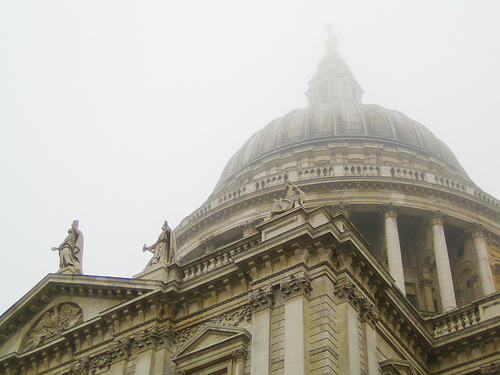
BBC staff photographer Jeff Overs was taking photos of London’s St. Paul’s Cathedral at sunset this past week when he was stopped under Section 44 of the Terrorism Act and questioned as a possible terrorist threat. For taking photos. Of a major architectural attraction. Sadly, the officer told Overs she’d been stopping people all day and he was the first to complain.

Just one more reason to be thankful we live in right-thinking democracies that value our rights…and allow us to take photos. Of major architectural attractions.

See Overs’ reaction to the harassment on The Andrew Marr Show here, where, among other things, he describes this new attitude as “all a bit Eastern Bloc, isn’t it?”

Articles via Boing Boing and  BBC

All Eyes on California Town


Photo by view-askew

The tiny town of Tiburon, Calif., wants to install almost $200,000 worth of security cameras so it can track all the cars coming into its city limits. Officials think it’s an effective measure against car theft. NPR says the “plan could effectively turn Tiburon into perhaps the nation’s first public gated community.”

Nevermind that crime, and car theft, is low in the town. This is another example of supporting the wrong solution to solve a big, tough problem. Nicole Ozer of the ACLU says instead of spending money on more law enforcement, they’re doing something that opens a can of worms – one that can lead to charges of spying and discrimination.

Jennifer King, a Berkeley professor of technology and public policy, goes even further to say privacy protections are a risk here – and can ultimately be used against the residents. She says these this type of data is always used for more than its original intent, citing toll records that have been subpoenaed in divorce cases.  

At a city council meeting, Tiburon resident Terry Graham said, “I’m horrified this is before us. We shouldn’t be surveiled every moment of the day. Why do we need to spend money to surveil residents who are innocent?”

Article via NPR and the Marin Independent Journal

Nat Geo Photographer Meets Solicitous Seal

Check out this video of National Geographic photographer Paul Nicklen‘s recounting of his trip to Antarctica to photograph the dangerous leopard seal. Besides the photos being pretty amazing, it did not go down as you would expect.

Found on Flickr: Claire Martin

Dave_and_Liz_at_Home

This is another installment in our continuing series where we talk to photographers whose work we’ve appreciated on Flickr.

This week we feature Claire Martin.

cinemafia: In your artist’s statement you indicate that you moved into photography from the field of social work because of its ability to affect change. Could you elaborate on the qualities of photography that give it a greater power over other forms of social work?

Claire Martin: Well, I wouldn’t say it has greater power, just that it also has power to create change. An image can’t create change all on its own; it needs the momentum of people in other industries like social work, politics and law, etc. to put the feelings that a photo incites into practice, so they work together.  An image only has to be seen to be understood, so there is potential to reach a very large audience with photography. That said, if an image strikes a chord with people, it can change the way they think about certain things and in turn their actions may reflect this change.

cinemafia: Is the end result, the images themselves, of a greater importance than the process of taking them? Why or why not?

Claire Martin: The process of taking the image is about changing and challenging my own ideas and perceptions, a fairly self-indulgent process. The end result, hopefully, if it’s any good, is about changing and challenging a broader group of people – and if you can do this, it is invariably more important. Personally though, I don’t know what I would do if I couldn’t express myself with photography.

cinemafia: How does having a camera in your hand change the outcome of what you do?

Claire Martin: Hmmmm, this is a difficult question. I guess it means I want something from the person I am photographing. I need to be clear in my intent because I am going to make public our encounter and hence certain aspects of their life. If you mean with regard to my social work background and creating change, this often means photographing people in unfortunate circumstances, so I need to be sensitive to their needs and the repercussions the photo may have on their lives. Mostly people don’t care, but it is worth considering. On a more literal level, having a camera definitely changes the outcome of events. Most people behave differently in front of a camera. It is a blessing when you find a person who is unaffected by the lens.

cinemafia: Have you personally seen any instances where the power of one photographer’s images was used to affect society in a negative way?

Claire Martin: I can’t think of any offhand. I tend to think of all the images that created change for the good, like Mary Ellen Mark’s pictures of Mother Theresa’s plight, the naked girl in a napalm attack in Vietnam by Nick Ut – countless pictures. But of course I am sure there are many examples of photography images used to affect society in a negative way. Recently, I saw a photo of John McCain having Thanksgiving dinner with his family, and the editor cropped it down to him sawing at the turkey with a maniacal grin on his face and published it this way. Uncropped, it was his whole family at the table with him carving for them. It’s definitely easy to manipulate the truth.

cinemafia: One of the running themes I see in your work is the sense of an anthropological pursuit. You seem to have a strong desire to arrive at unique faces of humanity that show themselves in the corners and niches of our world. You seek out the odd and quirky, the isolated, the disenfranchised. Could you describe how you go about finding your subjects, and why you choose them?

Claire Martin: You are right, I have always loved anthropology and studied it alongside my social work degree. Culture fascinates me. I seek out things I am interested in shooting, and I am interested in issues of social justice and quirky cultural niches, so when I hear about something odd or interesting to me, I do my best to explore those avenues. If this means financing a holiday to get there, I’ll do my best to do just that. If it’s in my area, I spend my spare time searching around trying to meet people who will let me photograph them.

cinemafia: Have there been any instances where a particularly interesting, potential subject turned you down?

Claire Martin: There are images that stay in my mind as vividly as photographs, but I never was able to take the picture – in particular, when I was in the Downtown Eastside in Vancouver. One huge, strong young man was dressed up as some kind of grizzly bear king with an Indian feather headpiece and a fur blanket wrapped around him – and it was so perfectly executed. The guy was an absolute vision. I crossed the road and initiated conversation, and I had my camera out, but he was so intense and aggressive and out of touch with reality. He started talking about all the nice young girls who had gone missing in the area and I freaked out and kindly excused myself and left. He didn’t want his photo taken and he was tapped. I wasn’t going to push it, although to this day I still think about what a perfectly amazing image it would have been.

Continue reading ‘Found on Flickr: Claire Martin’

“Security Theater” – We’ve Got a Front Row Seat

64365384_0c98675fed
Photo by Thomas Hawk

Bruce Schneier is a cool head and a voice of reason when it comes to security and terrorism, and he has been outspoken on the issue of photographers’ rights. In his recent essay for the NewInternationalist, Schneier makes some salient points as usual. 

“Security theater” is the term Schneier uses to refer to measures that essentially make the public and government feel good but do little to actually prevent an incident. He writes:

An example: the photo ID checks that have sprung up in office buildings. No-one has ever explained why verifying that someone has a photo ID provides any actual security, but it looks like security to have a uniformed guard-for-hire looking at ID cards. Airport-security examples include the National Guard troops stationed at US airports in the months after 9/11 — their guns had no bullets. The US colour-coded system of threat levels, the pervasive harassment of photographers, and the metal detectors that are increasingly common in hotels and office buildings since the Mumbai terrorist attacks, are additional examples.

That makes perfect sense. When law enforcement and security guards harass photographers shooting in public places, it’s not like they’re really deterring terrorists or uncovering any plots, it just makes them feel like they’re doing their part in fighting a very intangible, nebulous enemy. 

And in a larger, big-picture sense, these misguided tactics work toward eroding our civil liberties and making us all feel a little less free than we were before. So in essence, this decision to criminalize very mundane, previously acceptable things (street photography, shampoo bottles on airplanes, etc.), it is us, the American people, who bear the brunt of the war on terror and find our lives are less pleasant and free than they were before. Joe Schmo Terrorist in Syria or wherever? He’s doing just fine.

And by the way, the best way to combat terrorism? Schneier says the most effective defenses are those you won’t even see in your day-to-day life: “investigation, intelligence, and emergency response,” and beyond that, it’s really about “our social and political policies, both at home and abroad.”

Schneier reminds us that the best way to deal with our new way of life, this all-consuming fear of terror, is not to overreact. As he says, terrorism is actually very rare. Don’t give into the hype, the hysteria, the suspicion lurking around the corner. It’s just not worth it and does nothing toward keeping us safe.

Read the whole piece on his blog: Schneier on Security.

Rick “Dirty” Sanchez Ignores Facts, Spins Story

Picture 21

In a desperate attempt to spin a story to his liking, Rick “Dirty” Sanchez (a man known for hitting Jeffrey Smuzinick with his car during a drunk driving accident and fleeing the scene, as well as publicly attacking Fox News for their lies) decided to ignore some very important facts regarding my detainment during his broadcast yesterday. However, even though his three-minute smear campaign against me was an honest and accurate report in his delusional mind, it’s too bad that others saw right through Sanchez’s gutter journalism report and have started calling him on it.

If you would like to voice your disgust at Rick Sanchez and his producer, Janelle Griffin, for spinning this story and running such a lopsided and biased segment (which intentionally and egregiously did not air Sheriff Gylfie’s lies, false claims, and threats), you can contact Janelle at (404) 827-1500. I’m sure she’ll appreciate your call, and make sure to ask her the following questions:

  • Why did you cut out Richard Gylfie saying, “It’s against MTA rules,” when photography is allowed on the Metro? More important, why did you include the entire beginning, but removed only this section of the video?
  • Why did you cut out Richard Gylfie threatening Shawn when he said, “You know what, I’ll just submit your name to ah…(chuckles)…T.L.O.”
  • Why did you cut out Richard Gylfie threatening Shawn when he said, “You’ll be on the FBI’s hit list. Is that what you want? That’s the direction you’re heading.”
  • Why did you cut out Richard Gylfie threatening Shawn when he said, “We’ll just put your name on the hit list, dude…that’s fine.”
  • Why did you cut out Richard Gylfie’s inaccurate claims about bombs being planted in the London subway bombings, when the explosions were caused by suicide bombers?
  • Why did you cut out Richard Gylfie’s inaccurate claims that photos were taken by the 7/7 terrorists prior to the attack being carried out when, in fact, photos were not taken? The four men involved in the attack did a trial run, which did not include taking photos.
  • Why did Rick claim in the segment that Shawn “is clearly out to provoke the officer, it seems, to try to make him look like a jerk” when that is absolutely not true? Do you have actual evidence to back up this claim?
  • Did Rick intentionally try to publicly smear Shawn by purposely leaving out very important facts involving his detainment?
  • Why did Janelle Griffin call Shawn on Wednesday morning to berate him, demand to know his attorneys’ names, and threatened to make him look bad on the show after he told her he was not going to participate?

Finally, if you’re going to call Janelle, make sure you do it during normal business hours, because as the producer of “Dirty” Sanchez’s show she apparently only checks her messages during that time.


Spam Blocked