Archive Page 104

No Photos in Long Beach Port

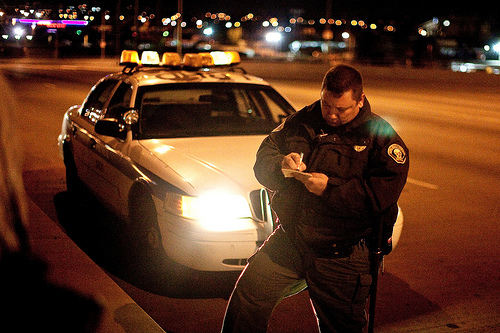
cop-long-beach

Photo by Thomas Hawk

Thomas Hawk, a blogger and photographer from San Francisco, was stopped by police for shooting photos in Long Beach Harbor this past weekend. He writes about the incident here. Since he was approached two times by security, and a third time by law enforcement who told him he needed a permit to photograph the harbor, Hawk sought clarification from the Port of Long Beach. And today he posts the response, from spokesperson Art Wong.

In the [sic] Sunday night it seems that the officer thought you were trying to enter a private area and you were a commercial photographer. You, and other photographers, have a right a take pictures from public right-aways. But for your own safety, and for the security of the Port, we have asked our officers to be as vigilant as possible.

Hawk takes issue with Wong’s explanation that the officer claimed Hawk and his friend were trying to enter a restricted private area. Hawk is insistent, and has the photos to prove it, that he was on an overpass, on a public sidewalk.

This is typical of officers who err on the side of overzealous enforcement; they always claim a restricted area – totally irregardless of the law – was being breached when they’re called out.

To voice your complaints contact:

Art Wong, Assistant Director of Communications/PIO, (562) 590-4123, (562) 619-5665 (cell) or wong@polb.com

For Photojournalist, Pen a Concealed Weapon

Also in London, also from Dec. 10, a photojournalist named Jesse Oldershaw was stopped and searched while covering protests in front of the Greek Embassy where people had gathered in reaction to the unrest in Greece.

At 4:25 of the video, a police officer, rather preposterously, asks if Oldershaw has a knife in his back pocket. As he is being directed off to the side, Oldershaw is screaming out, “Why am I being stopped and searched by the police for a yellow pen in my bag? Everybody can see the yellow pen!” and “I’m press, why am I being stopped and searched by the police at a demonstration?”

Oldershaw continues to give a play-by-play of the incident and at one point asks the police straight out their reasoning when he is protected by law to be doing what he’s doing. They largely ignore him, but one does seem to give him a ticket.

Wedding Photographer Threat to National Security?

Jess Hurd, a photographer for the Guardian, was detained for 45 minutes by Metropolitan police Dec. 10 for taking video and stills at a Ramada Hotel in east London. Hurd was working on a story about weddings within an itinerent community known as travellers, but police felt she might be doing reconnaissance as a terrorist.

The police justified their actions by saying they are within their rights if they see suspicious activity, especially if it’s in close proximity to a sensitive sight. Apparently the Ramada was close to both the airport and a wharf. It is unclear what is suspicious about a credentialed press photographer outside a wedding reception.

The National Union of Journalists released a statement today that says, in part, “This is yet another absurd misuse of the s44 powers which are designed to allow the police to detain those actively involved in carrying out a terrorist activity not to stop press photographers carrying out their legitimate business.”

The Amateur Photograher blog says Hurd is considering legal action.

Found on Flickr: Gumanow

gumanow_2

This is another installment in our continuing series where we talk to photographers whose work we’ve appreciated on Flickr.

This week we feature gumanow.

cinemafia: Many of your photographs are done in the street photography vein and are taken in public at close proximity to strangers, often with them obviously aware that you are photographing them. Many people would find this kind of photography uncomfortable or impossible, yet others seem to thrive on it. What does this overt process mean to you, and how do you think it affects the people who see the end product?

gumanow: First off, let me say that I am honored that you and discarted have selected me for this interview. Thanks!

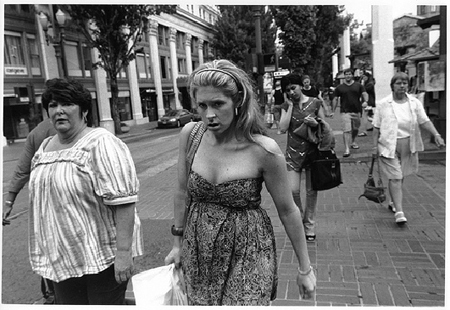
I would have to say that I thrive on getting close. Sometimes now I wish I could get even closer. Yeah, many photographers find it uncomfortable to shoot close. A lot of the time my subjects think I’m shooting behind them or they got in my way and are sorry. If they do see me, I usually give them a nod or smile. Most of the time this disarms them – I did say “most” of the time!

When I first started out shooting street I was uncomfortable with getting close to people. I started out shooting from the chest without the camera to my eye, however, this lead to a lot of very poor results. This was one of my first street shots of people. You can see in this shot by the position of my shadow that I don’t have the camera up to my eye. I shot this from my chest and you can tell by the level of the perspective. Now I shoot exclusively with the viewfinder to my eye. I still feel nervous, uncomfortable, scared, and my heart races. But after the first few shutter clicks I feel right at home and energized.

gumanow_11

I’ve heard from a lot of beginning street shooters that say if you get close you are interfering with the “slice” of life you are trying to capture. And while I’m striving for that slice, sometimes being a character in the shot is interesting as well – and that interaction with people. By putting the viewfinder to my eye I am in effect saying, “I’m taking your picture!” I’m not going to hide or pretend that I’m not. How they react to me is just as much part of the “slice” as anything else.

I’ve also seen a lot of shots using a telephoto lens from far away and the photographer still gets noticed. My approach is to get into the action, be a part of the street scene. Most of the time people don’t notice me and when they do, I try to get the shot in that split second between when they first notice me and when they react. Sometimes a glance your way can really make the shot.

Continue reading ‘Found on Flickr: Gumanow’

Just Another Day “At Work”

rolling-stone-cover

Annie Leibovitz/Rolling Stone – January 22, 1981

If you haven’t seen it, Annie Leibovitz’s latest book “At Work” is a good read and an interesting look behind the scenes with one of the world’s most famous photographers. In it, she tells the stories of some of her iconic shots, including Rolling Stone covers of John and Yoko and the Blues Brothers, as well as Vanity Fair portraits of everyone from Arnold Schwarzenegger to George W. Bush’s cabinet (a classic mafioso family shot if there ever was one).   

What’s amazing about her story is, her talent notwithstanding, she was also fortunate enough to start out in a much simpler era – when a novice photographer could just call up Rolling Stone’s art director and show him her shots of anti-war rallies in San Francisco. (Granted, Rolling Stone was truly a fringe, counter-culture magazine back then.) She describes getting the plum assignment of tagging alongside notorious gonzo journalist Hunter S. Thompson this way: “So I just jumped in the car and went along with him for a while.” That just doesn’t happen anymore.

Leibovitz is also the subject of this week’s Time magazine’s reader-generated feature “10 Questions.”

Girl of Famed Photo Speaks

depression-photo2

Library of Congress

It’s probably one of the most famous images of the American Depression – known as “Migrant Mother,” it was taken of 32-year-old Florence Owens Thompson by photographer Dorothea Lange in Nipomo, CA in 1936. Today CNN.com has an interview with Thompson’s daughter, Katherine McIntosh, now 77, who is on the left of the photo. Rather than help the family, bringing light to their plight, McIntosh says, “We were ashamed of it. We didn’t want no one to know who we were.”

Read the full article here.

In the Blink of an Eye: Mark Rebilas

ea12d_8985

Ever since I witnessed Michael Jordan launching himself from the foul line to slam home the NBA’s 1988 dunk contest, I’ve been a huge fan of sports photography – and this is way before I figured out that I had even the slightest bit of passion for photography.

As a child I collected every Sports Illustrated that featured MJ’s high-flying escapades, fixated by the beauty of these images while wondering where they had come from and wishing I could dunk like my idol. With the ability to touch a 10-foot rim by age 14, but unable to draw all that well, I had my mother buy me some tracing paper and colored pencils to create my own images of MJ posterizing some flat-footed sixth man. For hours I would hover over my desk, palms stained with lead and meticulously copy the SI covers, patiently and carefully following each meandering line as though I were a surgeon.

picture-1

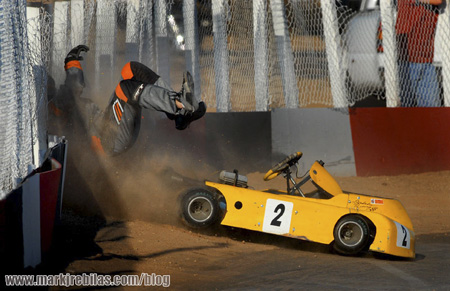
This week I was in childlike awe once again as I discovered Mark J. Rebilas’ website. As a professional sports photographer and son of motorsports photography legend Gil Rebilas, Mark’s images have appeared in ESPN Magazine, USA Today, the Los Angeles Times and on the top sports websites in the country.

What I find most fascinating about Mark is not the fact that he’s funny, self-deprecating and able to capture such beautiful images in the blink of an eye, but that he’s so willing to share his experiences with others while working in one of the most competitive fields in photography. Finally, I no longer have to wonder where images like the ones I worshiped as kid come from.

They come from Mark Rebilas.

Found on Flickr: Smalldogs

pastedgraphic

Here is the first interview in our occasional series where we talk to photographers whose work we’ve appreciated on Flickr.

This week we feature an image by smalldogs.

cinemafia: One of your photographs features a bathroom stall in a public restroom that is in a particularly beautiful state of disrepair. Where and how did you come to find this scene?

smalldogs: I was in New York to see friends and for a job, and a good friend of mine took me exploring to one of the many abandonments she knows. This was shot at an abandoned resort in the Catskills. We started walking in, and I immediately noticed the light in this building. It was amazing.

cinemafia: For many this photograph might fall under the genre of urban exploration, or urban decay. These are both very popular areas of photography on and off Flickr, and also ones that have a classical and historical context. Do you think the rise in this genre of photography will help enrich the work of the new generation of shooters, or will it just be eye candy?

smalldogs: Well, I guess it depends on what you’re going to do with the work, or what you’re trying to say with it. This shot is purely eye candy for me. I saw the light and the ground covering, which, as a Los Angelino, I mistook for flower petals (shows you how much we know about the four seasons out here). But, there are several photographers I know who shoot this sort of decay very well and with a particular point to make. There’s a group who call themselves the Rustafarians, in New York, who go out on expeditions regularly to shoot these kinds of scenes. They, I think, are producing work that to me is historical and beautiful at the same time. The work of Michael Bowman, in particular, evokes some interesting discussion and reflection on the progression, and state of, society. His work is especially moving to me and many others, probably because he seems to have an intent in his shooting that I did not when I was shooting this scene.

There is absolutely a need for work like Michael’s. Unfortunately, here in LA, it’s very difficult to document urban decay because abandoned buildings out here are usually shuttered up and guarded. If you get past the security, you’ll find squatters and kids just hanging out. The buildings are usually vandalized to the point where it’s hard to even see the building in its original context. And it can be very dangerous. I would never go exploring for a shot like this in LA without lots of people with me. In other cities around the country, these buildings are open and accessible. I think that’s a good thing, but I can see why it wouldn’t work in LA.

But again, even if it were accessible, I probably wouldn’t shoot it. This shot doesn’t say anything to me, it has no context that I can appreciate. Now, if I could have gotten a person into that shot, that would have made me happy. I’m very into conceptual photography and environmental portraiture. I would love to have the day to shoot some people in that location.

Continue reading ‘Found on Flickr: Smalldogs’
And the Chicago Tribune Is Now Onboard

Looks like the hometown paper finally picked up the Mike Anzaldi story. Now we’ll likely see some results.

(As much as certain people decry it – i.e., politicians, cops, Fox News – when a major news outlet covers a story, it matters. It’ll be a sad day when newspapers are officially dead.)

Chicago Photographer Arrested Again – CPD on the Warpath

bond2Monique Bond, CPD Spokesperson

UPDATE: Mike Anzaldi has been cleared of all charges. Read the post here.

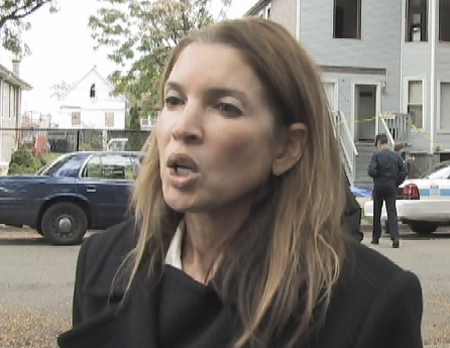
We checked back in with Mike Anzaldi, the freelance photojournalist who was arrested by the Chicago Police Department October 22 at a crime scene. Thinking we’d hear about the status of his arrest, we were shocked to learn he’d been arrested again – and the second offense is even more outlandish than the first!

As we posted before, Anzaldi was arrested and his equipment was confiscated, and about 500 images were deleted from his memory card, when the Chicago police decided that he wasn’t allowed to film a crime scene from a neighbor’s private property. He was charged with obstruction and resisting arrest and his status hearing is set for November 19.

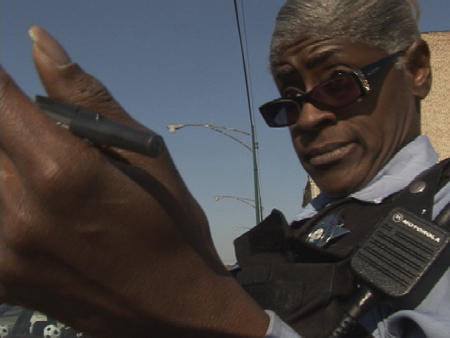
On November 3, Anzaldi responded to a report of shots fired at a church. When he got there, it turned out a man had brought a plastic gun into a shelter and there was no crime after all, but Anzaldi decided to shoot a few minutes of footage just in case. As he was doing this, he was approached by an officer who told him he couldn’t stand where he was standing and then asked to see his credentials.

2nd_03

This officer called his name into the dispatcher – here’s where it gets weird – and the dispatcher apparently told her to detain him. The officers on the scene were confused and clearly not in the loop, but nonetheless were following orders from above. After some back and forth with higher-ups, the officer told Anzaldi that there was some sort of problem with his ID but the computer in her car was broken, so she asked him to come to the station to clear things up. They promised it would take 15 minutes and they’d return him to his car. Anzaldi admits it was foolish of him to willingly go with them, but understand it from his point of view – it was not a crime scene, he had done nothing wrong, it was not a confrontational situation, and he never imagined anything would come of it.

Continue reading ‘Chicago Photographer Arrested Again – CPD on the Warpath’


Spam Blocked