Archive for the 'Security Guard Harassment' Category


Pittsburgh’s PNC Tower’s Bogus Claims

Photo by J. Lawrence

In April we posted on the strict (some might call asinine) photography policy at PPG Plaza in downtown Pittsburgh. This past weekend, photographer J. Lawrence was in the area and had this confrontation with some less-than-knowledgeable security personnel at Two PNC Plaza.

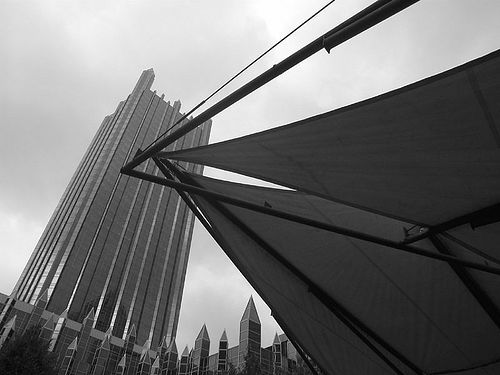
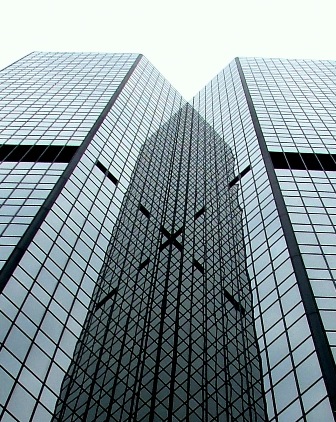
Memorial Day I was walking down Liberty Avenue shooting pictures.  Because of the impending storms, there were some really cool reflections of Midtown Towers and EQT on the surface of Two PNC.

I’m on the sidewalk, and this security guard comes running out of Two PNC.  “You’re not allowed to take pictures of the building.”  “I’m not?”  “No.”  “Why not?”  “Because of 9/11.”  “This is still America.”  “Just leave.  And no more pictures of the building.”  So she goes back into the building.  I lift my camera and take a pic of her.

The old woman’s eyes flare.  She comes running back towards me, screaming behind her “Call 9-1-1!”  I stand there.  “I told you not to take any pictures. Now I’m calling the police.”  “Fine.”  She whips out her cell phone and points the lens at my face.  I smile.  She takes two pictures.  “What’s your name?”  I defiantly tell her.  “Your address.”  Gave my address.  Because that’s how I get when I’m angry.  “You wait here for the police.”

I sat, and waited.  Some kid came out in a security guard uniform (I’m becoming an ornery old man at 42).  “You’re not allowed to take pictures of financial institutions. You have to get permission first.”  “I’m on the public right-of-way.”  He had NO clue what I was talking about.  Idiot.  “You’re not allowed to take pictures of financial institutions.”  I explain that I am.  It’s like talking to a very disinterested wall.  “Don’t take any more pictures.”  “Pray tell, who do I need permission from?”  “The PR Department.”

That about says it all.  If I didn’t have an appointment I was late for in Highland Park, I might have just been a little more defiant and kept on snapping.  Unfortunately my picture of the old witch didn’t come out.  Now I need to find out what security firm they work for so I can inform them that they need to provide their workers with some training.

It sounds like PNC may need to retrain its security staff. Private property restrictions are valid; it is not, however, illegal to take photos of a financial institution. And it is not illegal to take photos of anything on a public sidewalk.
Photographer Roughed Up in iPad Fray

Alan Pryke, a news photographer with The Australian newspaper, arrived at Sydney’s flagship Apple store today to document the much-anticipated launch of the iPad. But when the Apple crew showed up, they set up front and center, ignoring the protocol that the first media outlets there are the ones that get the best position. Pryke protested and tried to reclaim his spot, when security intervened and grabbed him by the shirt and shoved him. The situation was soon resolved, and the security firm apologized later for the incident.

Pryke plans to write a letter to a letter to Apple, which I’m sure will go straight to the top and be addressed immediately.

Article from The Australian

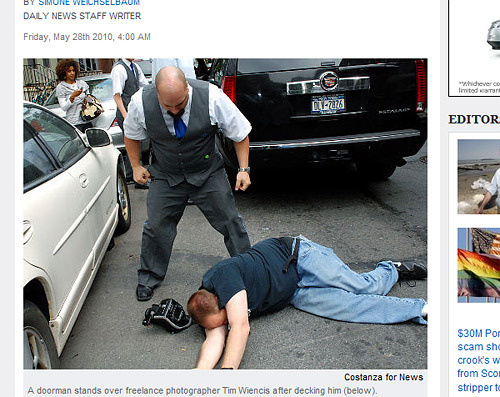
NYC Doorman K.O.’s Photographer

Screen grab: Gawker

One New York City doorman takes his job really seriously — so seriously he punched out photographer Tim Wiencis outside an Upper East Side building for trying to get a shot of  the wife of latest Ponzi scheme mastermind Ken Starr. The doorman was arrested for assault.

It should be noted that Wiencis was on a public sidewalk covering a news event as part of his job, and the doorman was certainly out of line — inexplicably resorting to violence to protect…what? A very possible criminal who lives in his building. It doesn’t seem worth it.

Article from New York Daily News (via Gawker)

AP Reporter Slammed for Collapsed Pol Shots

Photo by Erik Schelzig

UPDATE: Tennessee Report is reporting that Speaker Kent Williams will not support the measure to strip Erik Schelzig of his press credentials and Rep. Joe Towns has withdrawn it. Williams said, “He was just doing his job.” 

When Tennessee House Speaker Kent Williams collapsed on the floor of the general assembly on Thursday, AP reporter Erik Schelzig did his job and took photos of the incident with his cell phone. But that irked other members of the assembly who called it “despicable” and “distasteful” behavior — because they apparently felt that a journalist shouldn’t cover breaking news but should instead…I don’t know, say a prayer?

Well, yeah. As the Bristol Herald Courier reported, while Williams was getting medical attention the other state senators actually gathered for an “impromptu prayer.”

Some members even tried to prevent Schelzig from doing his job by blocking his shots. Then some state troopers came to threaten him with removal if he didn’t stop taking photos. Even though Schelzig agreed to leave, at least one legislator wants to strip him of his press credentials for the rest of the  legislative session.

As the Tennessee/Kentucky/Mississippi AP bureau chief said in a statement:

“…Erik Schelzig was doing his job covering breaking news at the General Assembly when House Speaker Kent Williams collapsed. The legislative sessions are open to the public, and members of the news media routinely record what happens there in words, photographs, audio and video. Though we believe Schelzig had the right to continue his reporting, he complied immediately with officials’ order to leave the chamber.”

Really — what a bunch of self-important blowhards. These people are public figures in a public building. Are they really that naive? I can’t stand this self-righteous faux dignity that comes from politicians, as if they should only be covered for certain things at certain times but not for others. You are a public servant. Deal with it.

And quit with the praying on taxpayers’ time.

Article from the Knoxville News Sentinel

WaPo Photog Breaks Rules for Hinckley Shot


Photo by erin m

In his column this week, Washington Post ombudsman Andrew Alexander took on an incident of staff photographer Gerald Martineau, who snapped a surreptitious photo of John Hinckley at St. Elizabeths Hospital in southeast DC. Hinckley is the would-be assassin of President Ronald Reagan, who not only shot Reagan, but two law enforcement officers and Press Secretary Jim Brady in 1981. He has been living at the mental hospital since 1982 and preparations are being made for his release sometime in the near future.

For a front-page story in the paper that ran April 26, Martineau entered the St. Elizabeths grounds and found Hinckley feeding some cats, whereupon he took photos from his car. Security was alerted and the guards detained Martineau upon his exit. After some back and forth, in which Martineau refused to allow security to view his photos, DC police were called and they threatened to arrest him if he didn’t hand over his memory card. After consulting with his bosses at the Post, that’s what he did.

Alexander goes over the points of the case and debates the merits of the two arguments — on one hand, that Martineau was in violation of the hospital’s no cameras policy and, as the hospital alleges, violated Hinckley’s dignity, and on the other, that  journalists have been known to flout such restrictions if it means getting a story, especially for the public good. Further, Hinckley is a public figure to an extent, and he’s certainly at a public facility. (St. Elizabeths is run by the DC Department of Mental Health.)

This is a sticky situation, and dare I say that Martineau’s explanation that he didn’t see the two “No Cameras” signs on his way in seems suspect as he was shooting from his car — meaning he was prepared to make a quick getaway. However, calling the police over a photography violation and then confiscating the memory card is a gross overreaction and right in line with many of the photographers’ rights abuses we report on all the time. Any time a photographer’s equipment is seized it’s almost certainly illegal and an overstep of the law.

Alexander brought up a good point, and that is that the photo could have been taken outside the institution on one of Hinckley’s many trips to a local store or to visit his mother in Virginia. It may have taken more time to stake Hinckley out, but there is no gray area there.

So, was the photographer taking a shortcut? Was he being arrogant, thinking he’s above the established rules? Or was he thinking it’s a harmless photo of a well-known individual out in the open, if not for the gates surrounding him?

(Incidentally, there is no trace of the photo on the paper’s web site as far as I can find.)

Article from the Washington Post

The No Photo Policy of Pittsburgh’s PPG


Photo by JP.Harron

PPG Place in Pittsburgh is a dazzling skyscraper and plaza complex that houses shops, restaurants, a glass-enclosed event space and ice rink. It also has a stringent no photography policy. After hearing numerous complaints over the years, a couple of writers from The Globe, the paper of Point Park University, decided to challenge that and brought their cameras to the plaza.

They were indeed approached by security and asked to leave. Puzzlingly, they were even told they could only take photos at eye level, not looking up. When they asked why, another guard gave the usual: ““Since 9/11, they don’t want people taking pictures here. You know what 9/11 is, right?” Right.

The thing is, even though the complex is privately owned, it’s an odd policy to enforce given its many public uses — and the fact that one could legally take photos of anything visible from a public sidewalk. The policy seems not only counter-intuitive but futile. Said photojournalism professor Chris Rolinson:

It’s a public space. They treat it as such,” Rolinson said. “The Constitution says there is no expectation of privacy in public because it is a public place, and people should be allowed to take pictures there.

And then the real head-scratcher was the statement from PPG’s owner, Grubb & Ellis, which said in part:

We will not prohibit that Kodak moment; we have never prohibited that at PPG. … We have eased up on photography, but not to the point where we would allow it.

Come again?

Article from The Globe

Mallgoers Get Into It With Security

This incident took place at the Citadel Mall in Charleston, SC. Even though the two guys with the camera turned around immediately and walked to the exit when they were told they couldn’t film, the reaction of the mall security guards was really in the extreme. At one point a guard comes after them, yelling out orders for them to stop, even putting his hand on one’s shoulder.

Which I can’t help but think, what’s the point of getting that hot and bothered? What is about malls and harassment? Understandably, it’s private property, but what is the big deal about taking a photo inside one?

Magic Kingdom’s Totalitarian Rule


Photo by Express Monorail

Photographer William Beem found himself on the wrong side of the House of Mouse this past Sunday when he was taking photos at Disney World’s House of Blues. He was approached four times by security who wanted to know what he was doing — I know what you’re thinking, taking photos at Disney IS highly unusual and suspicious! But, read on.

The fourth time Beem was approached, a manager named Don came along to report there had been complaints about him. Beem was puzzled. He was taking photos of buildings, not people, and he hadn’t even had interactions with anyone around him. Who would complain?

Manager Don requested Beem’s personal details, which Beem provided in the interest of being cooperative, and ultimately Don admitted that he felt Beem’s architectural photos were suspicious, insinuating a terrorist connection. At one point Don threatened to call the sheriff if Beem didn’t provide his ID. This made Beem uncomfortable and so he decided to leave. Don and a guard escorted him to his car and a few more showed up to watch him pack up and leave. Don was even on the phone, presumably to the sheriff’s office, reporting that Beem was unresponsive and wouldn’t give over his identification. Beem was alarmed that Don was telling blatant lies to bolster his “case.” Then he ordered the guards to take photos of Beem and his car and belongings. Finally, a Disney security car followed him out of the park.

Now this is just bizarre behavior from a very misguided park manager. Certainly there are better ways to handle photographers in the park that satisfies security concerns but also allows tourists to enjoy themselves, which is the whole point of the place. If photographers are treated this way in the happiest place on earth, what can we expect in the rough-and-tumble real world? Oh yeah, we already know.

Here are Beem’s lessons from the encounter, from his blog:

• Appeasement doesn’t work. You don’t know what is going to set them off, so it’s best to just stay quiet.
• Remain calm & polite. I could’ve become as indignant as I felt, but I think that would’ve just taken me down a more annoying path and I didn’t want to continue ruining what started out as a lovely evening.
• Follow-up. I’ll be writing to Disney management to learn and understand why I was singled-out for harassment and if I should expect such behavior in the future.
• Listen. Better to let them reveal information and intent than for me to share information.  See #1.
• Share. Ultimately, we need to keep this message alive.  Harassment of photographers is not providing any security.  If there’s someone out there with ill intent toward Disney, they aren’t going to go out with an expensive camera and a tripod to draw attention to themselves.  They’ll show up with some buddies or a family to look things over.  There’s no indication at all photography was used in any other high profile attack, so they probably won’t even have a camera.  If we’re going to stop this asinine behavior from the security industry, we need to continue communicating about the stupidity of their actions.

Read about the whole encounter on Beem’s blog here (via Thomas Hawk).

Harassed Photographer Speaks Out

Newspaper editor/photographer Kai Eiselein wrote an excellent editorial in The Eagle & Boomerang addressing his experience with law enforcement at the Thomas S. Foley federal courthouse in Spokane last week.

Eiselein admits he was a skeptic before his own incident, thinking somehow photographers must be provoking authorities. But after his experience, he understands how photography has been demonized in a way that is unnecessary, unfair and scary.

My test at the Spokane courthouse proved without a doubt that what some other photographers were claiming was happening was true.

And he also addresses those commenters, those wonderfully strident, angry commenters, who automatically accuse the photographer in these situations:

The comments were the most interesting part of the post, a large number of people praised my actions, but an equally large number, also photographers, vehemently decried what I did. Many of them stated I should have just backed down and apologized for taking photos, others called my actions underhanded, a set up, and that no real journalist would do what I did.

And on the practices of law enforcement:

Done often enough, to enough people, it can become a de facto change in the law, all without any public input or open debate. It runs directly counter to the tenets upon which this country was founded.

And some final thoughts:

Do we ban the photographing of children, buildings, aircraft, trains, bridges or anything else that might be used for some nefarious purpose?

Do we slice large chunks from the 1st Amendment in the name of safety and security?

Have we become so afraid as a nation that we see danger in every corner and shadow?

The fact is, bad people will do bad things no matter what kind laws or security procedures are put in place.

Article from The Eagle & Boomerang

Spokane Courthouse – Level 4 Nonsense

ICE man

Photo by Kai Eiselein

On his Flickr page newspaper editor/photographer Kai Eiselein details his run-in with the authorities at the Thomas S. Foley Federal Courthouse in Spokane, Washington. As is typical in these situations, a lot of fuss was made out of a lot of nothing.

Three security guards, two federal cops from the Department of Hopeless Stupidity, lights and sirens, all for one lone photographer.

Eiselein was harassed by security and police and told he couldn’t take photos of the building or the guards’ faces. Then they ran his ID and tried to intimidate him with some nonsense about what he couldn’t do on this “level 4”-ranked federal property. Eiselein stood his ground, explaining he was “standing up for my rights, because if I don’t no one else will.”

It’s unfortunate when our federal authorities don’t respect or understand constitutional rights (or public vs. federal property). How can we expect them to defeat real terrorism threats when this basic information goes ignored?

Read Eiselein’s account and see the photos here.


Spam Blocked