A few weeks back the lovely story of a lost roll of film in Brooklyn’s Prospect Park swept the internet. After breathless media stories from Time to “The Today Show,” 1.2 million hits on YouTube and thousands of proffered theories, there’s an update … of sorts.
Archive for the 'Photography' Category
Found in a Brooklyn Blizzard: Update
Published February 11, 2011 Photography Leave a CommentTags: Brooklyn, Prospect Park, Todd Bieber, undeveloped film, update, YouTube
Phil Stern Gallery Opens in LA
Published February 11, 2011 Photography Leave a CommentTags: gallery, hollywood, James Dean, John F. Kennedy, Los Angeles, Phil Stern
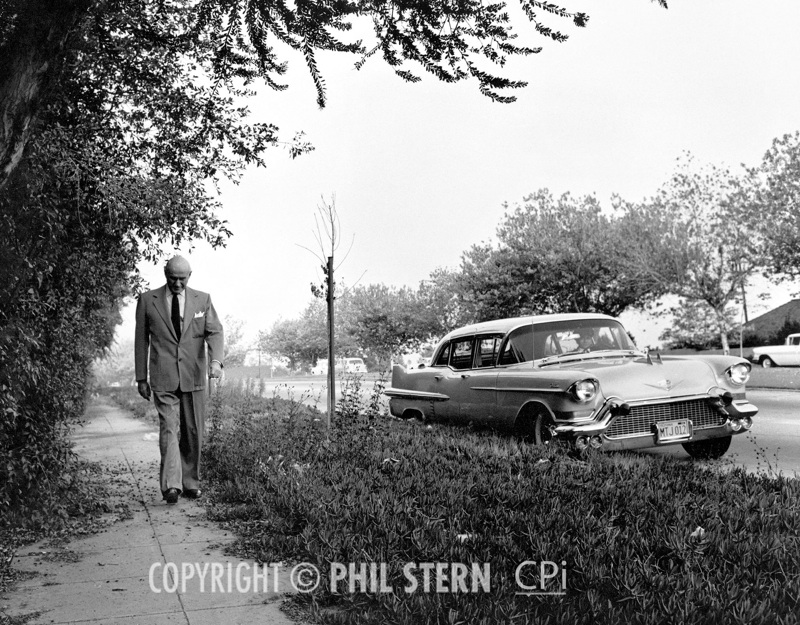
At 92 years old, photographer Phil Stern has seen and photographed a lot. So why not open a gallery in downtown Los Angeles? Located next to the famed restaurant Cole’s, the gallery’s first exhibit is on John F. Kennedy’s inauguration.
If you don’t know Phil Stern, just click through his archives. “Oh that’s him?” Sammy Davis Jr. mid-air, Marilyn Monroe looking startled and sad, James Dean popping out of a sweater.
Here’s what he said about that iconic Dean shot to americanlegends.com:
There are some people who you don’t have to do anything with. And Jimmy was one of them: He was totally whimsical. There’s one shot where Dean peeks out of a sweater. I didn’t use a tripod or Strobe lights. I had a hand held Nikon. We broke all the rules that day.
Despite getting shots of pretty much every major star of Hollywood’s Golden Age and beyond, Stern downplayed his abilities to the Los Angeles Daily News: “Matisse I ain’t.”
The Phil Stern Gallery is open Tuesday-Saturday, and admission is free. 601 S. Los Angeles Street, Los Angeles, CA 90014
Over the Atlantic, 1996
Published February 10, 2011 Photography Leave a CommentTags: 1984, Big Brother, Chicago, corruption, George Orwell, Hate Week, Joel Wanek, Thought Police
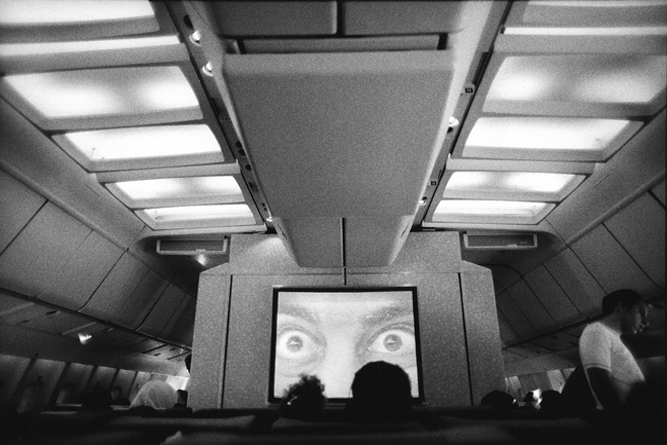
I discovered Joel Wanek and his website via a Google alert earlier this week and was immediately transfixed by this very Orwellian photo. Almost instantly, images of giant telescreens, the Thought Police, Hate Week, and “Big Brother is Watching You,” whipped through my brain.
“There was of course no way of knowing whether you were being watched at any given moment. How often, or on what system, the Thought Police plugged in on any individual wire was guesswork. It was even conceivable that they watched everybody all the time. But at any rate they could plug in your wire whenever they wanted to. You had to live—did live, from habit that became instinct—in the assumption that every sound you made was overheard, and, except in darkness, every movement scrutinized.”
But what is also rather fortuitous about this photo and Wanek’s other work, is the fact that a good portion of Wanek’s street photography is based in Chicago, IL. Which, as you should all know, is a state that has made it a Class 1 felony (punishable up to 15 years in prison) for anybody caught using an audio recording device to document encounters with law enforcement and other government officials without their consent.
“The Party seeks power entirely for its own sake. We are not interested in the good of others; we are interested solely in power. Not wealth or luxury or long life or happiness: only power, pure power…Power is not a means; it is an end…The object of power is power.”
This photo is great, but it would have been even better if it was captured over the Atlantic in 1984.
Photography Link Roundup
Published February 10, 2011 Photography Leave a CommentTags: Dennis Hopper, future of photojournalism, Jason Lee, Joao Silva, Larry Luckham, links, NPR, Pictory, roundup
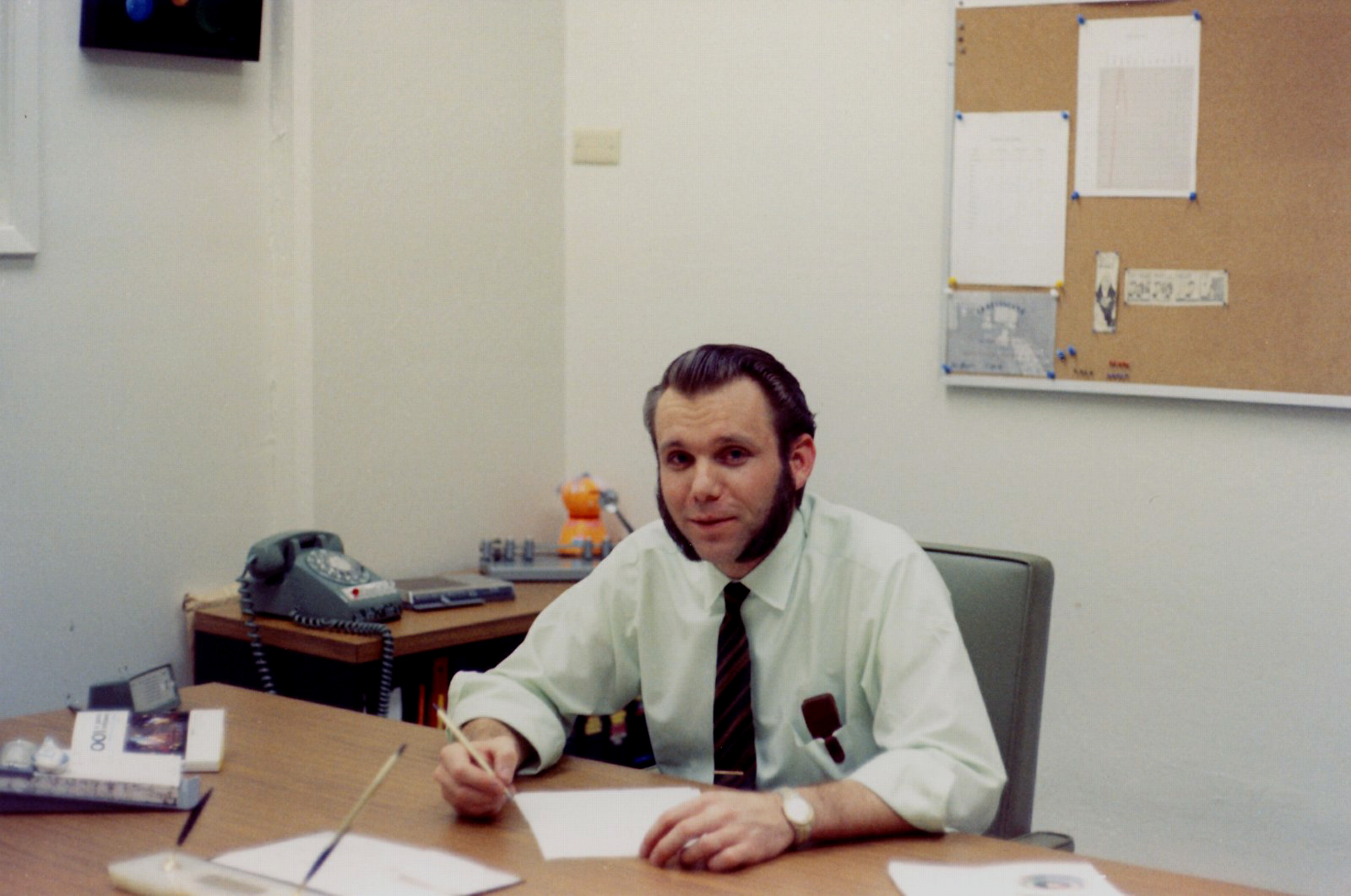 Photo: Larry Luckham
• Larry Luckham catalogs photos from all the periods in his life on his personal web site, and he’s got a great set from his time at Bell Labs in the late 60s. Two words: mutton chops. [luckham.org via Lost at E Minor]
• NPR and Pictory magazine are collaborating to find “local legends” across the country. Submit a photo of your own on Pictory’s site here. [NPR]
• Someone stole Jason Lee’s Polaroid of Dennis Hopper at the This Los Angeles show last weekend and they desperately want it back. C’mon scumbag, do the right thing. [Pix Feed LA]
• Longtime photojournalist Jim Pickerell writes an open letter to a student on pursuing photography as a career, and it’s kind of bleak but also kind of helpful. [Black Star Rising]
• Joao Silva, the New York Times photographer who lost his legs in a mine blast in Afghanistan last October, walks. [Lens]

Patriot Act Extension Doesn’t Get Enough Votes
Published February 9, 2011 Photographers' Rights , Photography Leave a CommentTags: civil liberties, Congress, extension, Patriot Act, Republicans
Yesterday House Republicans were not able to get the seven votes needed to extend the Patriot Act. The failure is being chalked up to resistence from the new so-called Tea Party Republicans.
As we all know, the Patriot Act has been used as a catchall justification for abuses of power and the stripping of many of our basic rights, including photographer’s rights. (How many times have we heard authorities throwing it around and around when faced with a “dangerous” photographer?) It’s expected if Democrats don’t like it (as Rep. Dennis Kucinich said, “it represents the undermining of civil liberties”), but with the Republicans’ opposition, could this mean our leaders in Washington actually recognize what a dangerous law this is?
The Washington Post reports:
Rep. Steve Southerland (R-Fla.), a freshman who voted yes, said the measure is “going to need some examination going forward, so all I did today is just, hey, instead of making a wrong decision, we’re just going to do a little more due diligence to make the very right decision to both protect our security as well as protect the civil liberties of the American people.”
It’s not like I want to come down in favor of any of our political parties because I think they’re all self-serving and corrupt. But one thing I can say for the Tea Party movement is that if it is really for less government intrusion and a more faithful following of our founding documents, then I agree that the Patriot Act does not fit into either concept.
Source: Washington Post
MOPLA: Enter Now
Published February 9, 2011 Photography Leave a CommentTags: Los Angeles, MOPLA, show, Smashbox, submissions
MOPLA, which is Month of Photography Los Angeles, is accepting submissions for its annual April shows — for both a general show and the Smashbox Group Show. Their aim is to celebrate photography in all its forms in the great, creative city of LA. (Last year our own Shawn Nee participated in the group show.)
Deadlines are in February and March. Find out about submissions here and here.
Interview: Ara Oshagan’s “Juvies”
Published February 8, 2011 Documentary , Photography 52 CommentsTags: Ara Oshagan, California, incarceration, juvenile criminal justice, Juvies, Leslie Neale, prison photography
Interview by Shawn Nee and Julie Haire
Ara Oshagan is a Los Angeles-based documentary photographer who delved into the world of the juvenile criminal justice to make “Juvies,” a moving series about the bleakness and despair of kids who are caught up in a broken system that has nothing to do with rehabilitation.
The project was developed in tandem with filmmaker Leslie Neale, who created her own documentary on the subject. Oshagan graciously submitted to a long interview with us, and he has a lot of good insights on getting access, his process and the state of documentary photography today.
Leslie Neale’s documentary Juvies focuses on juvenile offenders in an LA County detention center. Can you tell us how you became the set photographer for the film?
Leslie had seen some of my work from Armenia and she invited me to shoot with her. From very early on in the project, I did not consider myself to be a set photographer but in a sense a collaborator, a documentary photographer working in parallel with the aim of developing a parallel project, a book that would be about the same kids and same topic.
For a project like “Juvies,” we’re always interested to know how the photographer was able get to permission to photograph such a difficult subject that involves state government and the prison system. It seems like you must have jump through a lot of hoops while cutting endless strands of red tape. Can you explain how you were able to gain access?
Leslie Neale was a magician when it came to access. She was politically very well-connected in high places (for instance she knew the DA well), and she had some very key people in Corrections supporting her work. She also had an assistant who dealt with access on a continual basis. Often we would get shut down during a shoot and then we would have to wait in a waiting area until Leslie or her assistant made some calls and then we got clearance to shoot again. It was a HUGE and tireless effort on her part because, as you know, no one wants to give you access. I was supremely fortunate to be part of her crew.

What was the routine like that you went through each time you entered the prison?
We came with a cart-load of equipment—camera man’s equipment, sound person’s equipment, myself with my camera gear. A list of all our equipment would have to be sent in ahead of time and then at the entrance to the prison, our equipment would be checked against that list. Then we would be allowed in. Always one or two corrections officers would be with us the whole time we were there.
Photographers are artists who are generally allowed to be creative and free-flowing, so was it at all challenging to photograph inside a place where there are many rules and restrictions?
This was the most challenging part of the work for me. My usual process is to wander and photograph whatever interests me in, for instance, a certain region or around a topic. And I tend to spend a lot of time with people until they are comfortable with my camera and myself. To make the kind of images I am interested in, I need people to be in their natural way of life and ignore my presence. My book Father Land is based on this process. And I always work alone. So, in prison, not only are you not allowed to wander too far away from the two corrections officers who are accompanying you, but you also have to deal with a film crew shooting at the same time and basically shooting the same thing you are shooting. And when you are in the yard for instance, all the prisoners are interested in you and looking at you and want to speak to you. Plus to be able to shoot anyone besides the youths who were in the film, we needed to get signed releases. So, the whole process was very cumbersome and not at all intuitive.
Did ever you feel as though your access was being limited, or that you were being censored regarding the people and things you could photograph?
Due to Leslie’s magic, we went in as a documentary crew and were able to shoot in places very, very few people can—in the yard, in the dorms, in the eating areas, pretty much everywhere. But every once in a while we would get shut down as I wrote above. I personally was not censored on any specific occasion—like someone never told me “Do not photograph this.” But there were ground rules, which were: do not wander away from the officers who were accompanying us and no photos without releases. As long as we stuck to those rules, we were fine. If they felt you respected their ground rules, they respected us in doing our work. This was in the state prisons.
In juvenile hall, it was totally different story. The same respect was there, but you absolutely could not photograph anyone’s face besides the kids who were in the film. And there the corrections officers did not want to be photographed either. And in juvenile hall, we met the kids in the film in a “video production” classroom and rarely went anywhere else. When we did go to shoot their “dorms,” for instance, it was just us and our kids, no others.
Katy Perry Gets Fixed In Post
Published February 7, 2011 Photography Leave a CommentTags: Katy Perry, magazine cover, photoshop, Rolling Stone
Photoshopping magazine covers is not news, but still, one can never get enough of a side-by-side comparison, as in this shot of Katy Perry’s Rolling Stone cover from last year. Turns out that awe-inspiring cleavage is not entirely natural … what can we believe in anymore?!
 boywithgrenade.org