Archive for the 'Photographers’ Rights' Category


Oregon Officer Crashes Car, Harasses Witness for Snapping Photos

When Hillsboro, Oregon, resident David Emerson witnessed an officer-involved car crash he did what a lot of people do nowadays – he pulled out his cell phone to take photos. The unnamed Hillsboro officer objected (naturally) and told Emerson he had to delete the photos or he would confiscate the phone.

Emerson thinks the officer’s behavior was due to the fact that he was speeding through an intersection without his lights and siren on when he crashed into a Buick and then (to save his own butt) tried to convince Emerson otherwise.

Sorry, officer, but if you weren’t doing anything wrong and have nothing to hide why the paranoia over someone taking pictures of a public and newsworthy event? Is it because you really didn’t have your lights and sirens on when you caused that collision and sent yourself and the other driver to the hospital?

On the other hand, the Hillsboro cops are now trying to say that the unknown officer  never told Emerson to delete his pictures, that the Buick driver “failed to yield” to the officer, and that the cop was only trying to tell Emerson that investigators could confiscate his phone for evidence.

Sure, fellas, keep telling yourself that. But why hasn’t the Buick driver been cited yet for “failing to yield”? And why haven’t investigators asked Emerson to see his photos? Seems like the photos would be very important and useful in determining what really occurred. However, that’s probably not what they’re trying to find out—cover-ups generally don’t involve getting to the truth.

Personally, I’m more inclined to believe a guy on the street who has nothing to gain or lose from this incident than a cop clearly trying to protect himself.

As KATU reported:

“…the officer never told Emerson to delete his photos. After all, they say, that would be completely against protocol.”

Indeed.

Article from KATU

Driving While Reading – Bus Driver Caught With Kindle on Dashboard

Lahcen Qouchbane, a 40-year-old TriMet bus driver, was caught on video reading a Kindle while driving a bus full of passengers during rush hour along a part of I-5 in Portland, Oregon.

In the video that was captured via a man’s cell phone, you can clearly see Qouchbane reading his Kindle and turning the page while driving with his elbow—actions that could have led to an accident and injuries to passengers and other drivers as Qouchbane travelled through Terwilliger Curves—a stretch of Interstate 5 that is known for its accidents and traffic jams. However, Jonah Paisner, an attorney representing Qouchbane, is claiming that his client was not reading the Kindle that was in front of him sitting on the dashboard. I’m guessing Paisner hasn’t watched the video.

And according to various reports, Qouchbane (who likely would’ve avoided administrative leave if this video didn’t exist) told the man who was recording him that he was not allowed to take his picture. Well, of course Qouchbane said that! It’s like law enforcement telling everybody on the face of the earth that we can not record them, but they can record us and do whatever the hell else they would like to do to us. Are we not used to this kind of behavior yet from public workers? Is this not the norm nowadays?

As far as Qouchbane’s claims that taking pictures is not allowed on moving buses: Well, TriMet’s Rules Governing Conduct on District Property don’t even mention photography. And according to Bekki Witt, a TriMet public information officer whose correspondence with a rail fan was posted on RailroadForums.com in March 2009, wrote that photography is allowed in public places and on trains. So does that mean we can take pictures on moving buses too, and then submit them to TriMet’s flickr page? A request was submitted to TriMet to clarify their photography policy.

This video is the perfect example showing us why the use of cameras by members of the public should always be allowed on all public transportation, including when the doors are shut and the vehicle or train is moving. Policies that prohibit using cameras while the vehicle is moving are solely there to protect their employees, drivers and operators from getting caught doing something they shouldn’t be doing. Such as, reading a Kindle.

On the other hand, let’s hope that this isn’t some kind of bizarre viral campaign for Amazon’s Kindle. I sure don’t want to be duped into covering a fabricated story like Time magazine was regarding their recent post on a tornado that touched down in NYC—but in 1976.

DEA Harasses Storm Photographer – and His Wife


Photo by Michael Petty

Michael Petty likes to shoot thunderstorms and lightning. On the evening of August 31, Petty was taking photos in a church parking lot of a storm that was gathering over Omaha, Nebraska. After taking a few sequence shots, he went home.

The next day he got a call at work from the Iowa Department of Criminal Investigation asking him to come to their offices. He works for a casino in Iowa, so a call from the DCI wasn’t unusual; he did deal with them professionally. But the fact that they asked him to come in was.

A couple DEA agents at the DCI office started off asking him where he was on the night of August 31. He was dumbfounded, he says, and told them he was taking photos of clouds. They replied that DEA offices were over the hill and he was taking photos in that direction — and they wanted to see his photos. He told them he had photos up on Flickr and Photobucket and they asked for his password, which he gave them. (Which the agent was not able to access because of his own computer skills.)

The DEA released Petty a short time later, but not before explaining how they’d tracked him down: they traced his license plate number, staked out his house, talked to a neighbor to find out where his wife worked, visited his wife at work, and, finally, found out where Petty worked.

To recap (in case you haven’t fully digested the preposterousness yet): Federal agents harassed a man’s wife at her workplace so they could get to the bottom of some super sensitive photos…of CLOUDS.

When Petty got home, he did some research to figure out what he had done wrong. He realized he hadn’t done anything:

I then sent an e-mail to my congressman demanding a full apology from the head of the DEA.  I did get a call from an aid and I had to explain how my rights were trampled upon.   Then I got a follow-up letter from my congressman but I have not received an apology as of yet.

Are Iowa DEA agents just hankering to investigate someone, something, anything?! You have to wonder if these guys just don’t have anything better to do?

As we’ve noted countless times, these “cases” could be approached with more common sense and deliberation. Like, perhaps before going all post-9/11 righteous on an innocent photographer, authorities could ask themselves a few questions. Like, what are the odds a terrorist is casing the Omaha DEA building? From a church parking lot beyond a hill, no less? Do we need to pay his wife a visit at work, or could we just call him on the phone?

It’s also important to note that authorities take full advantage of people who don’t know their rights. In fact, they’re counting on it. An uninformed citizenry is a complacent citizenry.

If you would like to see Petty’s highly suspicious photos (at your own risk of course!), go here (and see more of his storm work here).

San Bruno Fire’s “Crime Scene” Designation Keeps Media Out


Photo by yipe

San Bruno police had a massive incident on their hands with the gas pipeline explosion and subsequent fire in the San Francisco suburb on Sept. 9, killing at least six people and destroying dozens of homes. But instead of designating it a disaster scene as you might expect, the police termed the 10-acre fire zone a crime scene, therefore prohibiting any media from entering, or really accurately covering, the scene. (And incidentally San Francisco Chronicle reporter Michael Cabanatuan says he was ordered out of the neighborhood before the crime scene declaration was even made.)

As the SFWeekly blog reports, this designation was unusual. Sure, police need to keep curiosity seekers, looters and anyone who would impede the recovery effort/investigation out of the area, but the press shouldn’t have been lumped in with that group. And at any scene, no matter the designation, police are allowed to restrict sensitive areas from press if they are worried it could be compromised — meaning, they could have let the press enter at least some parts of the 10-acre zone.

So what gives? Why is a gas pipeline explosion a crime? (PG&E will not be happy about that as they enter the litigation phase….) Was it just about control, as the Chronicle’s Cabanatuan said? SFWeekly inquired with the San Bruno Police Department but has yet to receive a response.

Article from SFWeekly

52 Journalists Died At Work This Year

The International Press Institute has released some sobering numbers: In 2010 so far, 52 journalists have died while on the job or targeted because of their job. And while you’d think the Middle East would lead the list because of the various wars, it’s actually at the bottom, with only two deaths.

The fatalities list is as follows:
– The Americas: 20
– Asia: 18
– Africa: 8
– Middle East: 2
– Europe: 2

“Journalists continue to systematically lose their lives to conflict, militants, paid thugs, governments, drug dealers, corrupt politicians, unscrupulous security officers, and others,” the group’s interim director, Alison Bethel McKenzie said.”

Article from AP

Regular People Do the Reporting at Brady Crash Site

Tom Brady busted up his Audi this morning in a crash in Boston’s Back Bay. It was of course a huge deal for a few hours today as every site from ESPN to TMZ to Cars.com reported on the non-event.

Anyhow, all of the photos (which are mediocre) of the actual accident while Brady is still there were taken by bystanders with their cell phones. As you go deeper into the photos on the Boston Globe’s site, you start seeing AP, Reuters, etc., but none of their photos are of the actual accident — Brady and the cars are already gone. The professionals’ photos just consist of nicely composed shots of car pieces on the ground with a cop in the background.

This an interesting example showing how journalism has changed, especially regarding citizen journalism (a phrase I can’t stand because the Constitution doesn’t distinguish between credentialed journalists and non-credentialed journalists). So, unless the Globe paid these “photographers” a licensing fee, the news and traditional media are now getting their images for free, which seems like a great deal for them.

Article from Boston Globe


Bill Means Harsher Penalties for Paparazzi

Assembly Bill 2479, or the “anti-paparazzi bill,” was approved by the California legislature at the end of August. If it’s signed by Gov. Arnold Schwarzenegger, a paparazzi photographer could face more serious criminal charges than current laws allow, including jail time.

Here at the blog, we are split on this very thorny issue, as you’ll read in this “point-counterpoint”….

A: I say it’s about time.

B: It’s NONSENSE. They’re gonna waste taxpayers’ money debating Assembly Bill 2479 when they already know it’s illegal. The article even says that. And there are laws that exist that address the driving. “False imprisonment,” that’s a joke. Celebrities are not being held against their will, AND THEY CAN LEAVE WHENEVER THEY WANT. This won’t hold up.

A: You have a right to take photos in public up to a point. I’m not arguing that. When it crosses the line into harassment, aggression, stalking, literally hunting people down, it’s not OK anymore. I don’t think bands of reckless thugs who drive the wrong way down Laurel Canyon to get a shot of Britney Spears should be protected under the law as if that’s somehow a legitimate “right” we all have.

B: Again, there are already laws that exist to combat harassment, aggression, stalking. How is AB 2479 any different from the existing law that was used to charge the guy who drove cross-country to stalk Jennifer Aniston? “Literally hunting people down” is a catchphrase used by AB 2479 advocates to garner support for this illegal bill. It’s all about wording and manipulation to trick the public into believing that there is an actual threat that can’t be dealt with by using existing laws. It’s about creating fear, which is the first tactic used by government officials to get what they want.

Finally, we can’t penalize someone because they’re holding a camera in public while following a celebrity. It’s a slippery slope that will potentially lead to the erosion of more of our First Amendment rights. What’s next? Locking up photojournalists who continually photograph corrupt politicians while they’re in public?

A: That’s a huge leap. I am the biggest supporter of First Amendment rights there is (uh, hello?), and I’m all for photographing corrupt politicians. There isn’t a multi-million dollar industry for corrupt politician photos so the level of stalking doesn’t even come close.

B: Continually taking pictures of someone in public is not a crime. And let’s not forget that it’s a fact that celebrities and their “people” tip off paparazzi to get publicity. Without paparazzi, celebrities would fade away much quicker than they already do. Where would Bristol Palin and Levi Johnston be without paps? I’m all for never seeing them (or their mother) ever again, however, if it means destroying the First Amendment, then I’ll happily deal with that dysfunctional family.

A: How many times do we have to go over this? I am not for outlawing paparazzi! And I fully realize many, many celebrities tip them off. Bristol Palin and Levi Johnston aren’t even relevant to this discussion because they’re desperate for press and continually sell their stories. We’re talking about paparazzi who pursue celebs in cars (ever hear of Princess Diana?), camping outside kids’ schools every day, screaming out inflammatory and obscene things to get a reaction, literally provoking the subject to get a “good” shot?

B: Then stop reading Popsugar if you don’t like it!!! Obviously, you have not done your research into Diana’s death, which goes much deeper than paps following her in a car. Camping outside schools? Big deal, it’s a public sidewalk. These rich celebrities should send their kids to gated private schools that are on private property if they don’t want their picture taken. And please provide video evidence of paps “screaming out inflammatory and obscene things to get a reaction, literally provoking the subject to get a “good” shot”? As far as I know, Sean Penn attacks paps just for taking his picture, and if you watch TMZ, the camera operators actually engage the celebrities in consensual conversations. Maybe Harvey Levin should mediate this debate.

A: Popsugar publishes friendly paparazzi photos. Celebrities know that’s what they’re in for by being public figures. THOSE are not the issue. The issue is situations like dozens of photographers surrounding Sandra Bullock’s car in what amounts to a scary feeding frenzy. And Sandra, I might add, is not the sort of celebrity who ever asks for attention.

B: First, what the hell is a “friendly” paparazzi photo? Is a picture from a public beach of a topless celebrity not “friendly?” If so, why not? Is a picture of Jennifer Love Hewitt’s big fat ass on a public sidewalk not “friendly?” Mischa Barton picking her nose on a public bench while showcasing her cellulite thighs? All of which, let me remind you, were obtained legally. Again, if the photos were obtained illegally, there are already laws that exist to prosecute the individual. More importantly, and fortunately for all of us, laws in the US can’t be created to criminalize a select group of individuals—it’s unconstitutional.

A: Yes, they can. Ever hear of a select group of people called murderers?

B: Really? You just accused me of taking a “huge leap” and then use that senseless analogy. A non-pap and a pap who commits murder will be charged with the same crime. Just like any other crime. AB 2479 is a law that was clearly created to punish paparazzi for working as paparazzi and nobody else. Be thankful that the founding fathers were smart enough to create the First and Fourteenth Amendments. And, by the way, for all you paparazzi haters, if TMZ didn’t exist, then we wouldn’t know the evil truth about Mel Gibson, which Sheriff Lee Baca tried to cover up and the rest of the media ignored until TMZ broke the story.

A: I don’t disagree with that. TMZ has done this country a great service.

Article from Sacramento Bee and Malibu Times

Photography Link Roundup


Photo by Richard Misrach

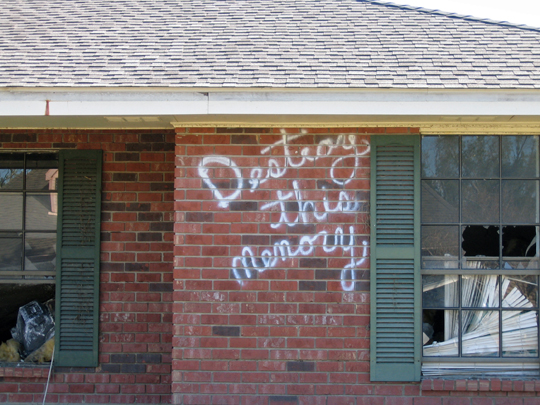
• There’s something poetic about the post-Katrina graffiti, so it makes sense that photographer Richard Misrach compiled his findings in the book “Destroy This Memory.”  [Good]

• Do you have to be young and beautiful to get attention even as a victim of war? Writer Liz Jones opines on the controversial Time magazine cover girl.  [Daily Mail]

• After two tours in Iraq, a veteran finds photography helps ease his PTSD. [Newark Advocate]

• Photo editor/photographer Stella Kramer reviews the Afghanistan war documentary Restrepo. [StellaZine]

• This is cool: Vote for the Best Covers of the Year in American magazines. [Amazon.com]

Filming Chicago Police OK, Audio Not

NPR did a piece this morning on Chicago artist Chris Drew, who’s made it his mission to make sure the First Amendment works. What started as an act of civil disobedience — Drew is a crusader for free speech and wanted to test laws regarding where artists can sell their work — turned into a felony charge for illegal eavesdropping. It turns out he had recorded his arrest and in Illinois it’s illegal to record conversations without consent of all parties.

The Chicago police union claims, if you can believe this, that recordings like these could inhibit officers from doing their jobs. Or…if they do their jobs professionally and competently, if they happen to be recorded, an audio recording would make absolutely. No. Difference.

“The general theme that drifts through these cases is very clear,” [Illinois ACLU lawyer Harvey] Grossman says. “Law enforcement, in these instances, is rebelling and is refusing to allow public scrutiny of their behavior. And they are using the eavesdropping statute as a weapon against civilians.”

On August 18, the Illinois ACLU filed a federal lawsuit challenging this law.

Story from NPR

You a Sneakin’ Mutha…

discarted

I sit in the driver’s seat of William’s truck as rush hour traffic collects just below us on the 101 freeway. It’s August and sweat collects on the back of my neck and arms as the first significant heat wave brings triple digits to Los Angeles. It’s so hot out that if you look at the pavement long enough, you can see the shadows of invisible nuclear vapors slithering across the sidewalk.

I’m bored and even more depressed, but can’t stop myself from coming here. I think about all of the things I’ve fucked up in my life. I think about my family that I’ve been away from for almost a decade. I think about my ex-girlfriend. I think about leaving L.A., so I can see my family and ex-girlfriend. I think about this prostitute I wanna photograph.

And then a cockroach pokes its body out from in between the bent pages of an 18 magazine that’s been dumped on the dashboard. It’s female and carrying eggs. I think about crushing it with my hand, but it zigzags across a collection of odd items and junk and then crawls into an empty Shasta can before I can make a decision. Growing up people would often say that a cockroach could survive the aftermath of an atomic bomb, but in Los Angeles, when you wake up in morning you can find dozens of them dead on the sidewalk.

I sit in the driver’s seat of William’s truck watching them, waiting for something to happen.

Me: That doesn’t hurt?

William: Fifteen yars locked up, whadda you think?

CLICK.

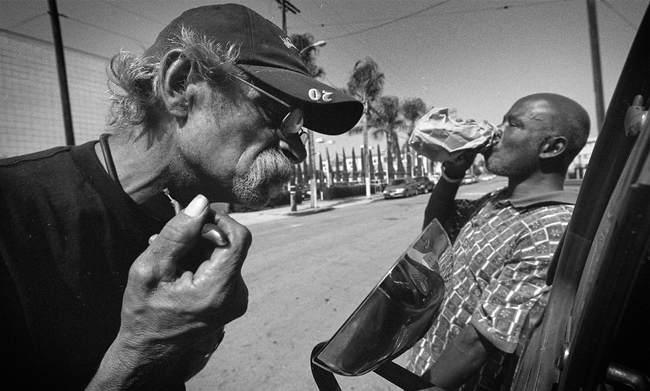
Joe: Ooh there he go again with that camera…sneakin’ mutha fucka takin’ my picture! Right when I’m takin’ a drink too! You a sneakin’ MUTHA FUCKA!

Williams shitty plastic razor scrapes across his neck. A drop of blood pokes through his skin.

Joe: WILLIAM! How come you don’t ever let me sit in the truck, but you let h-i-m?

Joe takes another big drink, consuming what’s left of his 211. He looks at me.

Joe: You still my boy.

Joe raises a tightened fist and pushes his arm through the driver’s window. I reciprocate and press my knuckles against a collection of open sores and wonder what diseases he might have.

The thought passes and the day drags on.


Spam Blocked