Archive for the 'Photographers’ Rights' Category


NPRO Rally: Free State vs. Police State

Here’s the second installment of a series of our NPRO Rally videos that will be posted throughout the week, culminating on Friday with a recap of the whole weekend rally. 

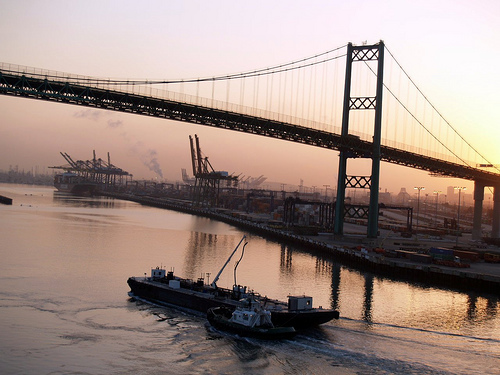
As you see, this encounter at the Port of Long Beach was drama-free. The Harbor Patrol were friendly and civil and took the appropriate tone, as opposed to many law enforcement officers who see a camera and immediately get suspicious, aggressive and condescending. The main officer seen here is probably an amiable guy in general, but I think he was also playing the game differently, being funny and congenial and conciliatory in order to get the same information they all want – names, addresses, social security numbers. I called him on this and he played it off like I was crazy to even suggest a thing – who me?! He must have thought he was being pretty clever asking where we were parked (“Do you guys have a car or something?”), assuming he would ID us through our license plates. He knew that when you’re not breaking any laws you can refuse to identify yourself – as we did.

So, it was fine enough, but a few things still bothered me. 1) The call the refinery security guard put out after speaking with us was that it was a physical altercation, and that’s just a complete fabrication. How did this conversation get blown into a physical altercation, necessitating the need for four patrol cars? And 2) The female officer at the end of the video said we should have informed them of our plans to shoot at the port, framing it as a “common courtesy.” 

Yes, sure. We could also notify the police when we’re going grocery shopping and jogging in the park. That’s what you do in a police state.
Aerial Photography Tool for Terror – or Paranoia?

BankTower
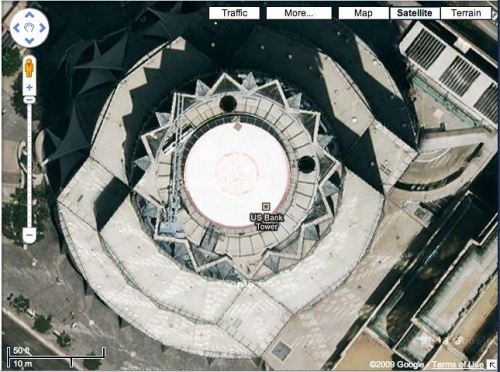
US Bank Tower, Downtown Los Angeles, via Google Maps

Aerial photography and Google maps have become a flash point for people who need a tangible target for their terrorism-related paranoia and fear. In March, we posted on Joel Anderson, the California State Assemblyman who is trying to get a law on the books that would blur out images of medical facilities, schools and government institutions in online mapping tools. Now, there’s another outspoken critic to add to the mix.

CNN.com reports that Pennsylvania piano tuner Scott Portzline is lobbying the Nuclear Regulatory Commission and the Homeland Security Secretary for the same cause. Portzline has apparently spent a lot of time figuring out how he’d attack a nuclear plant, so he thinks it’s fairly easy to do with information gathered on the internet. From the article:

“What we’re seeing here is a guard shack,” Portzline said, pointing to a rooftop structure. “This is a communications device for the nuclear plant.”

He added, “This particular building is the air intake for the control room. And there’s some nasty thing you could do to disable the people in the control room. So this type of information should not be available. I look at this and just say, ‘Wow.’ “

Interestingly, operators of the Three Mile Island nuclear power plant that is close to Portzline’s home aren’t as worried as he is: “Our security programs are designed and tested to defend against (an attacker) that has insider information — even more information then is available on the Internet,” said Ralph DeSantis, spokesman for AmerGen, which operates the plant. “In addition to that, our physical security is constantly changing… so what you see one day won’t be the same as the next day.”

As noted security consultant and hysteria debunker, Bruce Schneier (read Refuse to be Terrorized), writes on his blog in response to this story:

Yes, and the same technology that allows people to call their friends can be used by terrorists to choose targets and plan attacks. And the same technology that allows people to commute to work can be used by terrorists to plan and execute attacks. And the same technology that allows you to read this blog post…repeat until tired.

Article via CNN.com

Read Bruce Schneier’s “Fear of Aerial Images” here.

Port Security: “I Don’t Care About the Law”

The NPRO weekend rally started off Saturday evening in the Port of Long Beach – not only an amazing landscape for photos, but a place known to regularly trample on photographers’ civil rights. So we were shooting for about five minutes when a security guard drove up and immediately yelled out, “You can’t take pictures of the refinery!” When pressed why not, she was clearly stumped. There was some back and forth. Eventually she said, “I don’t care about the law…I care about me doing my job working for that refinery.”

After an exasperated “Fine, whatever,” she left and apparently called Harbor Patrol. Four units arrived on the scene, saying they’d been told there was a physical altercation. You can watch the video; how is that defined as a physical altercation? (More on the Harbor Patrol encounter to be posted later.)

Now, truth be told, this security guard tried very hard to ultimately keep it civil – and she’s just doing her job, granted – but this video is a perfect example of how woefully untrained security personnel are. Instead of having any laws, or even company policy, to bolster her argument, she’s just regurgitating a very vague rule handed down by higher-ups.

Doesn’t the refinery owe it to their employees to give them more training? What if there were actual terrorists out there? You can’t tell me they’re legitimately worried about terrorism if this is how they’re protecting themselves.

Photographers Effect Change at US Bank Tower

NPRO Creates Change at US Bank Tower

In January a small group of photographers went to shoot photos in downtown Los Angeles and at the US Bank Tower, a building notorious for its aggressive, overzealous security staff. At the time, we were threatened and bullied by six security personnel – and told by Patrick Silver, the supervisor on duty, that we were on a private sidewalk (we weren’t) and he was going to call the police (he was bluffing). It was an unpleasant encounter, not to mention a certain violation of our rights. (See the video here.)

This time though, someone higher up in the food chain had clearly reviewed their policy. During the NPRO Photographers’ Rights Rally today, we stopped at the Bank Tower, and after about 10 minutes of freely shooting, a friendly guard came out to tell us we were allowed to continue but he had to give us the above notecard. 

So, it seems, the questions, posts, calls and letters may have indeed been effective in changing the way UPS patrols its buildings. Interesting how that works.

Stay tuned for more videos and updates throughout the week of this year’s NPRO weekend  rally.

Photographers’ Rights Rally Weekend 2009

nprd_blog


It’s been a year since we held our first National Photographers’ Rights Organization (NPRO) rally in Los Angeles, and a lot has happened since then. Over the past 12 months, hundreds of us have been harassed by security guards and law enforcement for practicing a perfectly legal activity while in public. Some of us have even witnessed or personally experienced an unlawful arrest by an out-of-control cop. But with the help of our cameras, the grassroots mobilization of the internet and our lobbying of companies and public officials, we have stood up to this abuse and forced change.

For instance, Amtrak finally released a policy on photography and the NYPD’s leaked policy document says to stop the harassment of photographers shooting in public. So in order to progress even further, promote even more awareness and stand up for our rights, NPRO is holding a Photographers’ Rights Rally Weekend this year that will kick off in the Los Angeles Harbor/Port of Long Beach on Saturday June 6th, and end on June 7th in Downtown Los Angeles.

Before attending this event, it is important that we all educate ourselves about the law and photography. To learn the essentials it’s best to start with Bert Krages’ ubiquitous “The Photographer’s Right.” Read it. Memorize it. Print it. The knowledge you obtain from this document will help protect yourself when confronted by law enforcement or security staff when taking pictures in public.

You can also check out the numerous links in section 9 of this blog’s sidebar, which provide you with even more information regarding the law and photography.

Most importantly though, no matter what we are told by law enforcement, California Wiretapping Law legally permits us to secretly record police, or anybody for that matter, when they are in public and there is no expectation of privacy. We do not need a cop’s acknowledgment or permission to record their threats.

It’s extremely important that we bring video cameras and/or audio recording devices to document the unlawful actions of  cops and security guards.

So put on your rally lens caps and clear your schedules for the first weekend in June.

NPRO Rally – Saturday, June 6th
Location: Los Angeles Harbor/Port of Long Beach
Time: 6:30 p.m.
Directions From Downtown Los Angeles: 110 S to Anaheim St Exit, Turn Left on Figueroa Place, Turn Left on W Anaheim St, W Anaheim St Turns Into E Anaheim St, End At N Henry Ford Ave, Park On Street
Directions From the 405 N/S: Exit 33B S Wilmington Ave, Travel West on S Wilmington Ave, Take First Left at E 223rd St, Right on S Alameda St, Continue on S Alameda St, Veer Left on to N Henry Ford Ave, End at Intersection of E Anaheim St and N Henry Ford Ave, Park on Street


NPRO Rally – Sunday, June 7th
Location: Pershing Square, Corner of S. Hill St. & W. 5th St., Los Angeles, CA 90013
Time: 11:30 a.m.

First Amendment Travesty: Michigan Reporter Sentenced

diane_bukowski_arrested_nov__411
Photo from the Michigan Citizen

It was Michigan Citizen reporter Diane Bukowski’s rotten luck that her sentencing came on the day that GM announced it was filing for bankruptcy. Already this story wouldn’t have gotten much play in Detroit, but now it’s as good as done.

Bukowski was sentenced to 200 hours of community service and ordered to pay a $4,000 fine today for two counts of resisting and obstructing an officer at a crime scene in November. Of course the story is as shady as a big oak tree. It was a police car chase that ended in the death of two men. Bukowski is well known for reporting on police corruption. The officer in question manhandled Bukowski, deleting all of her photos – and the jurors saw the raw Fox 2 news footage that substantiates that she never crossed the police tape. Nevertheless, the cops have friends in high places and now Bukowski will pay.

She is appealing the ruling.

Watch the original Fox 2 news report here.

Article from the Detroit Free Press

More Made Up Laws Regarding Oil Refineries

57056013_8ae331730b
Photo by wmliu

One of the Daily Kos site’s diarists, Androsko, posted about a recent incident he and a friend experienced while taking photos outside of the Hess Refinery in Port Reading, New Jersey. While they were there to shoot a comedy sketch, the local police smelled terrorism.

A police officer pulled up and told them – surprise! – they weren’t allowed to take photos and they’d have to delete them. Why? As Androkso writes:

He responded that there were town ordinances that were mandated by the state and the Department of Homeland Security. I then asked for the specific ordinance or law, saying that I had read a lot of stories about police and photography in public places. He failed to provide me with anything specific, citing Homeland Security “stuff”.

The officer asked for their driver’s licenses and Social Security numbers, while insisting they weren’t being reported, just that he had to enter their information in the system. The photos were not deleted in the end and they parted amicably. And the harassment goes on….

A commenter points out that the canon of laws is so vast that cops can’t be expected to remember them all, further adding:

So they sometimes operate the way most of us do, sorta figuring if it seems like it might be illegal, it probably is. … Whether or not any laws got passed, it seeped into the collective consciousness, and a lot of folks have vague impressions that ‘you’re not supposed to scope out such places’. Your cop obviously had that vagueness floating around in the back of his mind.

I get that rationale; police officers are human and they can’t be expected to have an encyclopedic knowledge of law. But they need to have a better-than-average one – and more importantly, if you’re stopping someone to tell them they’re breaking a law, you damn well better know which one. (And if you don’t, radio into the station, read up on laws that pertain to your district, bone up for god sakes!) This type of thing is going on all the time, and no matter how wrong, how egregious, how unlawful, it doesn’t seem to matter.

Read Androsko’s whole post here.

Photography at Rush Hour

Photos of traffic don’t sound entirely enticing, but these are different. Benny Chan‘s show, “Traffic!,” debuted at the Pasadena Museum of California Art today, consisting of enormous 8×10 prints of aerial views of LA’s tangled freeways. Chan documented the freeways at rush hour for five years – with a custom-built camera that weighs 14 pounds, has a 300-millimeter lens and cost $25,000. Despite the underlying message – that the traffic in LA is insane – Chan told the LA Times’ Culture Monster that he’s not political: “There’s another side to this too, that it is beautiful. But I do hope people will realize that this is not sustainable.” The exhibit goes through September 20, 2009.

For more information on the exhibit, go to Pasadena Museum of California Art.

Read Chan’s interview with the LA Times’ Culture Monster blog here.

Update: LAPD Addresses Photography in Roll Call

3333242837_4c86cc1e95
Photo by wirralwater

So it’s not the ideal outcome, but one gets the feeling changing the way police view photography will take a seismic shift in thinking – and most likely a huge lawsuit, sad to say it.

As we posted earlier this week, David Sommars and two fellow photographers were stopped by the LAPD on a public sidewalk near the Port of Los Angeles, harassed, bullied and threatened with arrest. Sommars lodged a formal complaint with the Office of the Inspector General, who agreed to look into the matter.

Yesterday Sommars got a call from an LAPD commander who said the officers were wrong and they addressed the issue during roll call (which I would guess went something like this: “It’s come to our attention that photography is legal on public streets, so let’s refrain from the detainment and threats”).

Sommars says: “Also the OIG will investigate, but most likely the officers will not get in real trouble – they save that for unlawful force stuff. They will use this for training purposes.”

How much do you want to bet nothing changes?

ACLU to DOT: Why Harass Photographers?

3495365459_da25cf2fe6
Photo by spiggycat

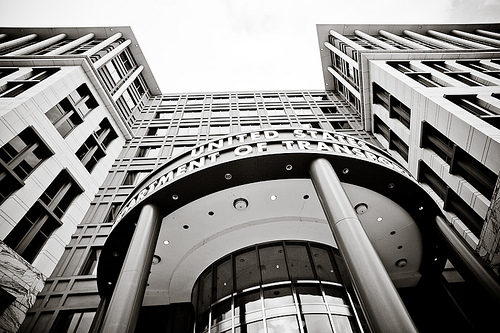
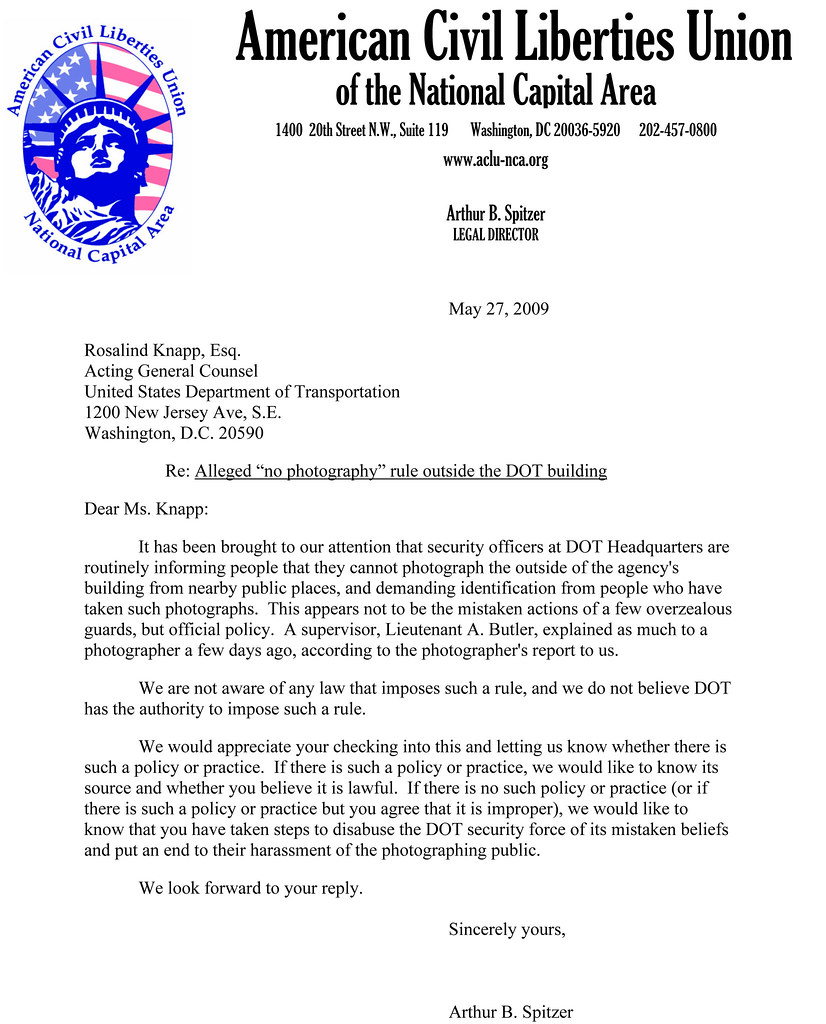
In April we posted on the consistent and regular harassment photographers, including families and tourists, have experienced outside the Department of Transportation headquarters in Washington, DC, and now the ACLU is getting involved. Arthur Spitzer, legal director of the National Capital Area chapter of the ACLU, wrote a letter to the DOT’s acting general counsel requesting explanation of what seems to be their no photography policy on the public streets surrounding the building. As Spitzer writes: “We are not aware of any law that imposes such a rule, and we do not believe DOT has the authority to impose such a rule.” See the whole letter here.

Flickr via Thomas Hawk’s Digital Connection


Spam Blocked