Archive for the 'Photographers’ Rights' Category


Photojournalist Captures Citizen’s Arrest

We wrote about Chicago freelance photojournalist Mike Anzaldi’s brushes with the law last year. And now it seems Anzaldi has found himself in the news again, though this time because he caught a citizen’s arrest on film. He narrates the incident in the above video.

Article via Chicago Now.

Gas Tower Video Has New Home

1659259207_2f995674cf
The Biltmore Hotel, as reflected in The Gas Company Tower. Photo by teamperks

Enjoy the video here.

YouTube – More Like Censor You Tube

securedownload

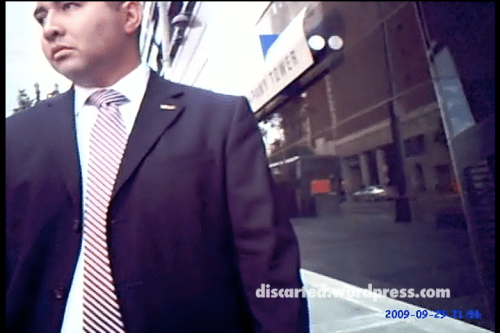
Today YouTube caved to a “privacy violation” complaint and took down the video of our conversation with a The Gas Company Tower security manager. What’s most puzzling is the video doesn’t fall into any of the categories in their Community Guidelines. Not even from the Privacy section:

If a video you’ve recorded features people who are readily identifiable and who haven’t consented to being filmed, there’s a chance they’ll file a privacy complaint seeking its removal.

The great majority of the video is of the guy’s torso. But forget that for a minute: We were on a public sidewalk where there is no expectation of privacy.

What’s more, we regarded the encounter as informative and instructive, especially for the guard. Perhaps he’d go back to his supervisors and they’d brush up on the law so building security and photographers can finally all just get along. From our perspective, it was cordial and no one in their right mind (other than paranoid YouTube execs) would agree this discussion on photographers’ rights was a violation of someone’s privacy.  But it seems someone felt the need to file a bogus complaint.

This is setting a scary precedent. So from now on, anyone can complain to YouTube about a video they don’t like of themselves – like all those cops who beat protestors or smash into bicyclists? They’ll just sign up for an account, file a complaint, and – bam – no more public record?

Oh well, it’s not as if that will really make the video go away or anything. We’ll post a new link soon.

LA’s Gas Tower Full of Hot Air

UPDATE: YouTube removed the video due to an apparent “privacy” complaint.

We had to go to downtown for an errand this week and, since we’d been hearing some reports of continued harassment at US Bank Tower, we thought why not do a little photographers’ rights reconnaissance while we’re there? We’re happy to report that the US Bank Tower is as friendly and respectful as ever, with a security guard coming out after a few minutes to hand us a courtesy card – and then turning right back around to go inside.
One block down at the The Gas Company Tower, however, they are apparently not on the same page (and it’s owned by Maguire Properties and patrolled by Universal Protection Service, same as US Bank). After a minute or so of harmless shooting of an escalator, a security manager who identified himself as Ivan came out and told us we couldn’t take photos of a private building. We told him that’s not true and we were on a public sidewalk. He said it was a private sidewalk (and we were very aware of the easement plaque). The usual back and forth ensued.

We ended up talking to Ivan for a bit, and he changed his tune once he realized he didn’t really have any facts to go on. He ultimately made some comments about respecting photographers’ rights and kept mentioning a courtesy card inside they normally hand out, but he really didn’t seem very prepared to tackle this issue for his superiors. It was interesting that a security manager of a major skyscraper in LA would come out to reprimand photographers and not be armed with courtesy cards, his own business cards, or any knowledge of the law. But, I guess they pay these guys just to reiterate.

The takeaway is this: Knowing your rights and standing your ground is essential. Undoubtedly nine out of 10 photographers security approaches at the Gas Company Tower apologize and leave immediately. The security staff is then emboldened to enforce a nonexistent law and trample on constitutional rights, and there is absolutely no incentive for them to do otherwise.

Interestingly, someone has filed a privacy complaint with YouTube due to the above video. How does it infringe on anyone’s rights? No face is shown, no last name is given; we’re on a public sidewalk discussing a policy that relates to photography in public. What an incredibly lame move from a very small person – someone who is perhaps embarrassed how he comes off? Just speculation, of course.


Photographing Big Trees

Check out this video on how photographer Michael Nichols set about photographing some seriously tall trees. National Geographic sent Nichols into the Redwood Forest for a year to get the image that appears in the magazine’s October issue. A year! Can you even imagine the budget that magazine must have? I’d love to know the final tally on how much the shot cost.

Nichols eventually got the shot with “three cameras, a team of scientists, a robotic dolly, a gyroscope, an 83-photo composite and a lot of patience,” says NPR’s The Picture Show blog. (And it’s pretty awesome indeed.)

Article via The Picture Show

Another Hearing on Photographer Harassment

Erin McCann, a DC photographer and activist for photographers’ rights, sent an email today with news that there will be a Congressional hearing on photographer harassment this Wednesday, September 23 at 2 pm EST.

We posted on last year’s Congressional hearing on photography rules in Union Station, which ultimately clarified the fact that it’s quite legal to shoot there despite multiple incidents where  their security insisted otherwise. Now, it seems Congresswoman Eleanor Holmes Norton (D-DC) wants to get to the bottom of the similarly outrageous  harassment at the Department of Transportation (we’ve posted on it here and here) in a hearing entitled “Risk-based Security in Federal Buildings: Targeting Funds to Real Risks and Eliminating Unnecessary Security Obstacles.”

Erin will be testifying about the recent DOT incidents. From Erin’s email:

There is no law forbidding the taking of photographs of public buildings–federal or not–and yet our current security climate operates under the assumption that photographers are always suspicious. Photographers have been harassed on a regular basis in recent years, and several have been arrested. Del. Norton’s support for our rights is significant and very much appreciated.
Erin will be Tweeting from the hearing and you can follow her Twitter feed here on Wednesday.

Who’s Watching You? Oh Yeah, Everyone Is

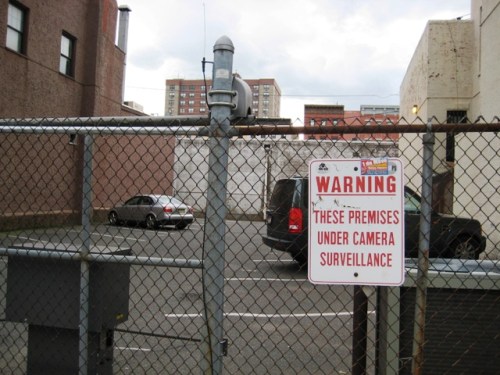
surveillance sign
Hoboken, NJ Photo by let ‘er rip

In so many ways Americans – gladly, willingly – gave up their personal freedoms in the aftermath of September 11. One of those ways is that we now live under surveillance, pretty much everywhere and all the time. Photographer Richard Gordon set out to document the prevalence of surveillance cameras over five years, from 2003 to 2008, in his new book American Surveillance. With photos of security cameras on ceilings and street lamps, in museums and malls, Gordon found there’s precious few places that you’re not being filmed.

The Epoch Times reported on Gordon’s book signing at the University of California, Berkeley recently where he talked about his project – and how he found camera in cities like Chicago and New York, but also suburban malls and rural areas. In one San Francisco mall’s parking structure, he counted 130 cameras. 130! (Do you ever notice how when someone goes missing, like that recent Yale graduate student, there is almost always surveillance footage of them?)

Gordon’s book is a really interesting comment on our times – and a multi-layered issue at that. In terms of street photography, you think, how can anyone object to their photo being taken when it’s taken probably thousands of times a day already? In terms of photographers’ rights, is it fair that certain government and private buildings outlaw photography but are constantly photographing you? And are you fine with your Google searches, emails, grocery store purchases, errands and financial records being tracked in the name of security?

And you might say, “What do I care? I’m a law-abiding citizen, it doesn’t affect me.” But I think the larger issue is that a culture of surveillance breeds a culture of fear, which is very apparent in the US with the accusations of terrorism in very innocuous situations, like with photographing skyscrapers and subway cars. We give up a lot of our innocence when we always suspect the worst of everyone around us.

Article via The Epoch Times

Who Gets to Decide Who Sees War Photos?

This past week saw a lot of discussion about the AP’s decision to run a photo of a mortally wounded marine. Some, including Defense Secretary Robert Gates, balked – he called their insensitivity “appalling.” Others felt it was a true depiction of war, which is – of course – brutal. Regardless, the images that are coming out of the conflicts in Iraq and Afghanistan are nowhere near as searing or evocative as those seen in the Vietnam era. This could be my perception, undoubtedly clouded by the fact that I distrust the government that got us into the mess in the first place, but when photos of coffins of dead soldiers have been banned, you know that we’re not getting the full story.

The controversial photo shows Cpl. Joshua Bernard with his legs severely mangled (or gone) after he was hit by a grenade in an ambush in Afghanistan in August. He died soon after. The photographer, Julie Jacobson, later wrote in her journal about showing the marine’s comrades the photos she’d taken that day:

“They did stop when they came to that moment,” she said. “But none of them complained or grew angry about it. They understood that it was what it was. They understand, despite that he was their friend, it was the reality of things.”

Incidentally, the AP held the photo for three weeks before deciding to publish it. And those who think it was a decision based on sensationalism or money are, I believe, woefully misinformed. Apart from Gates and the military and family objections, I’d really be interested to hear what soldiers fighting over there think – if they object to real and raw, sometimes gruesome, images coming out, or if they see them as a testament to their sacrifice and tangible evidence that real lives are being lost every day.

In his blog, journalist and ASU professor Tim McGuire hits the nail on the head – and he doesn’t think families get to decide what photos are seen in the media.

In Salon, Michael Winship thinks the photo reminds us of a war that’s now gone on longer than World War I and II combined.

Watch a photo montage of the day of the ambush, narrated by Julie Jacobson here.

By the way, if you haven’t seen The Hurt Locker, you should.

Found on Flickr: Eyal Golshani

Mesquite Sunrise

This is another installment in our continuing series where we talk to photographers whose work we’ve appreciated on Flickr.

This week we feature Eyal Golshani.

cinemafia: Would you describe yourself as a landscape photographer to someone you’ve just met? Why, or why not?

Eyal Golshani:  It’s funny you should ask that. I think that in many ways I am still trying to figure it out myself. After doing photography for over three years I have come to realize that I really enjoy travel photography. To me this includes both landscape as well as people. Although I haven’t photographed as many people when compared with landscape, I do have a strong desire to shoot more street photography.

cinemafia: Do you feel that there is a different approach to photographing landscapes than there is to photographing people?

Eyal Golshani: The two couldn’t be more different. With landscape the whole process is very slow and requires careful planning and timing. I spend many hours researching spots for a potential shot – [it’s] always carrying a tripod and a remote shutter release with you, spending 15 minutes to set your gear for every shot, mostly at odd times, double checking you have the correct focus and exposure settings.

Photographing people (street photography) requires a different set of skills. You need to be able to see the potential for a good shot as things happen (aka the decisive moment). As such, you need to be able to think fast and change your camera settings while composing the shot. A lot of people rely on new camera technology to do a lot of this for them. There are a few masters of photography that have the ability to do this manually by knowing their gear and craft (some of the most famous Leica photographers come to mind). This is a skill I hope to possess one day – at the moment I am far from it.

Forgotten

cinemafia: I’ve noticed that one of the focal points in your work is texture. Not only do you seem attracted to it, but you pull it all the way to the forefront in your images. Do you feel that emboldening these textures enhances the way that your photographs are experienced by your audience?

Eyal Golshani: It depends on the subject. I think that it works quite well for subjects that have a beautiful pattern, which leads the eye through the image while keeping things interesting.

cinemafia: From your profile I noticed that you’ve only been working in photography for the last three years or so, correct?

Eyal Golshani: Yes, correct.

cinemafia: Before you began, did you have any other creative outlets? Also, do you think you would have become as involved in photography if the state of its technology (i.e., digital) weren’t at the point that it is today?

Eyal Golshani: I was always interested in doing creative things, but the reasons I became more involved in photography is because it gave me a creative outlet while still giving me an opportunity to use my engineering skills to understand the technical background of using a camera and what makes a good exposure.

Continue reading ‘Found on Flickr: Eyal Golshani’

Naked Man Takes Top Honors

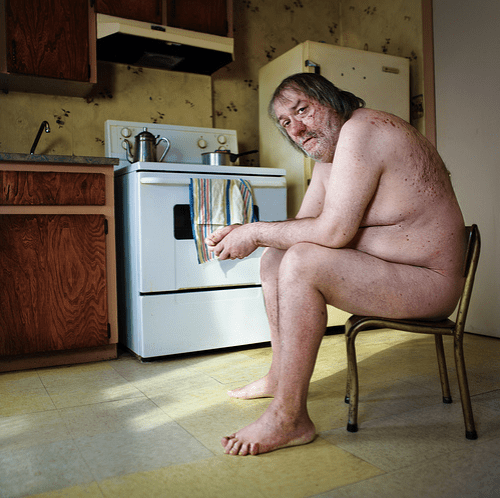
Picture 3 Photo by Benoit Paille

I guess you could call it grief, in the flesh. Benoit Paille‘s portrait of a naked 53-year-old man sitting on a chair in his kitchen won the top prize at the Art of Photography competition this past weekend, beating out 15,000 other entries. Paille, who hails from Canada, said he met the man on the street and was invited back to his apartment, where the stranger stripped down and posed for him. He said he was grieving over recently losing his mother.

Judged this year by the head of photography at the Los Angeles County Museum of Art, the competition is meant to showcase photography from all over the world, by both amateurs and professionals, “so long as part of the image is photographically created.” The 111 photos in the show will be on view at the Lyceum Theatre Gallery in San Diego through November 1.

Article via NPR’s The Picture Show


Spam Blocked