Archive for the 'Documentary' Category


Are You Photographing Only 10%?

 
Photo by raffaespo*

Photographers these days are experiencing some major groupthink.

From the current issue of Nieman Reports, Harvard’s journalism review that is devoted entirely to photojournalism this quarter, there is an excerpt from VII Photo Agency’s Stephen Mayes‘ address at the World Press Photo awards.

Mayes talks about his takeaway from five years as a juror for the awards — that certain subjects in photography are overexposed. And, naturally, that means that most other subjects are largely ignored. This, he reasons, is because of the fact that traditional media outlets are shrinking, so more photographers have turned to competitions as an outlet for their work. Mayes says the jurors are “astonished” by the lack of variety and pinpoints the three common themes: the dispossessed, exotic and foreign.

This assessment really rings true and is something we’ve noticed ourselves. But, at the same time, it seems that the only photography that is noticed or appreciated is foreign, whether it be conflict, poverty or strife. (Chicken and egg problem?)

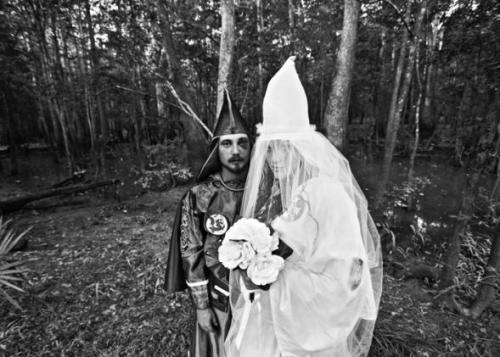
Of the 2009 College Photographer of the Year awards, only one project really stood out as original — Phoebe Sexton‘s series, “Joshua,” on a young bulimic gay man. And that’s why we really like Anthony Karen‘s work. His photos of the KKK are dramatic and powerful but, more importantly, not derivative, addressing a serious, elusive domestic subject matter. 

Mayes breaks it down succinctly here:

Overrepresented: commercial sex, suffering black folk, Muslim women in veils, same sex couples kissing, holding hands.

Underrepresented: middle class, affluent drug users, real sex, personal sex, black culture and expanded vision of black life outside Africa. 

One juror said 90 percent of the pictures are from 10 percent of the world. So how’s that for a challenge — as a photographer, can you seek out the underreported subjects that are inhabiting 90 percent of the world?

Article from Nieman Reports

*This is a good photograph that we are using as illustrative and is in no way meant to impugn the photographer.

Ordinary People

Photo by discarted

If you’re a regular reader of this site, or even someone new to photography, you’re likely already well aware of flickr—Yahoo’s user generated photography site where thousands of people upload their photos on a daily basis and join various groups to share their work, as well as discuss everything related to photography, including our favorite topic—photographers’ rights.

One of these groups is called Humanistic, which was created “In the spirit of William Eugene Smith (1918-1978),” and is dedicated to sharing photography that “…is humanistically driven, with a strong, genuine human-interest theme.

Humanistic was established in May of 2009 and the group administrator, tsienni, is celebrating the group’s steady growth by holding their first contest dedicated to Ordinary People.

The contest is limited to one submission per group member, and the rules are that the image must contain at least two people and not be altered in any way, or excessively processed—which, some would argue is rather arbitrary and nondescript. However, anyone familiar with William Eugene Smith’s work would instinctively know what the contest organizer meant by “excessively processed.” More important though, the first place winner will received $500 worth of Kodachrome.

Kidding. The contest is for fun.

And Kodachrome will be joining the dinosaurs very soon.

The submission deadline is March 10th, so if you  have a photo that you think is worth sharing with others and representative of Smith’s work, be sure to join the group and submit your image by this Wednesday.

Join Humanistic.

Talking to…Photographer Mark Menjivar

foodartist
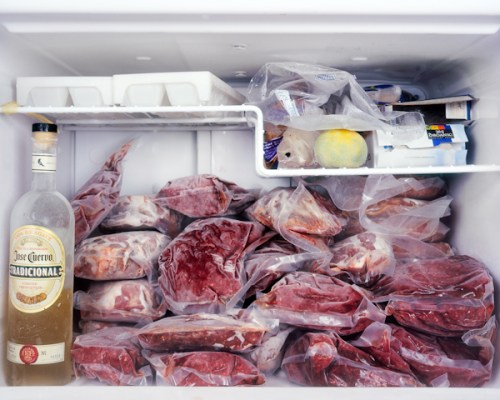
Food Artist | New York, NY | 1-Person Household | Runs small vegan bakery from her apartment. | 2009

What we eat reveals a lot about us. So as social experiments go, photographer Mark Menjivar stumbled on a great one by documenting the contents of peoples’ refrigerators with his photo project, “You Are What You Eat.” Over three years, Menjivar, a native of San Antonio, traveled to 20 communities in about 12 states and photographed 45 fridges (and he plans to do about 5-10 more before he wraps it up). You can see more of the photos on his web site.

Here, we talk to Menjivar about his time looking deep into the fridges of America.

You said you traveled the country for three years exploring the issue of hunger. Was that for this project or something else that this grew out of?
I was working as a project manager of sorts for a documentary on hunger by artist Michael Nye. Michael is great and really encouraged me to pursue my own project as we traveled. About half of the places I visited were due to working on that project, the others from my own dealings.

How did you find your subjects?
I have found people all different kinds of ways. At food banks, local pantries, restaurants, walking up to strangers on the street, etc. Some are family members or a friend-of-a-friend type thing, but most were strangers to me when I invited them to be a part of the project. 

I have really approached the project like a portrait project. When I am drawn to someone for some reason I ask them if they would like to be a part of the project. For me, it is not about getting as many people as I can but a diverse group.

How much explaining or convincing did you have to do? I’d imagine some people would just be naturally incredulous or suspicious.
For sure. I usually end up talking to them a bit before I tell them what I am doing. Most people think it is pretty odd, but only three or four people over three years have said no. I totally respect that as I would be pretty hesitant to let someone come home with me to photograph [my fridge]. There is always this awkward hesitation in the conversation at some point. Some people start to make excuses or say this is an off week. I really love these interactions and almost always have a good conversation with each person.  

Did you find people were embarrassed or shy about having you see their refrigerators?
Some. But most are pretty okay with it. The fridges are photographed “as is.” Nothing added, moved or taken away.

On your web site, you say these are refrigerators from “Vegetarians, Republicans, members of the NRA, those left out, the under appreciated, former soldiers in Hitler’s SS, dreamers, and so much more.” Tell us about the former soldier. How did you come upon him?
I met him at a food bank in the desert. He was a volunteer there and a really hard worker.  He is a food hoarder due to his past experiences with not having food as a POW. In his house there were probably 30 boxes of food lined up in the hallway, and the kitchen was packed. Each night he would head to the dumpsters to reclaim food that had been thrown out.  

carpenter
Carpenter/Photographer | San Antonio, TX | 3-Person Household | 12 Point Buck shot on family property. | 2008

I love the freezer packed with bags of a 12-point buck and a bottle of tequila. Did you find the owners matched their contents?
That family is actually one of the healthiest families that I met. They pretty much only eat meat from sources that they can identify. The meat is from a buck that he killed on his family’s land. He does not use any deer stands, but heads out on foot and sees it as a very respectful act. They also have huge garden beds in the backyard that they share produce from.  

Continue reading ‘Talking to…Photographer Mark Menjivar’

6 Inches of Separation

0366A001Photo by discarted

Eddie Adams Workshop Deadline Is Today

mosaic

Today, May 15th, is the deadline for student photographers and professional photographers (with less than three years experience) to submit their work to Eddie Adams’ Barnstorm XXII, an intensive four-day workshop attended by photography’s top professionals and a selection of 100 students.

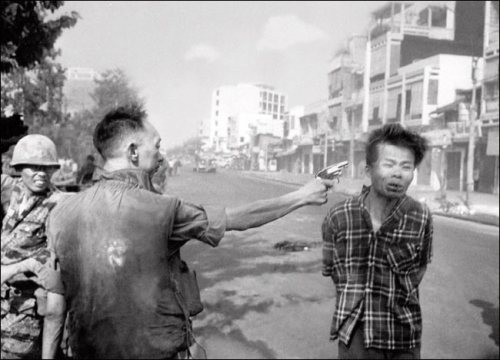
If you’re unaware of Eddie Adams, he is probably most known for taking the image of police chief General Nguyễn Ngọc Loan executing Nguyễn Văn Lém on a Saigon street in 1968. It was a photo that earned Adams the Pulitzer Prize but reportedly caused him great pain, publicly lamenting the image’s notoriety and the hardship it created for Loan throughout his life.

The workshop, started in 1988 by Adams and held in Jeffersonville, New York, is a tuition-free event  and a program deeply focused on photojournalism. During the past 21 years, many known photographers, including Chris Hondros, Rick Loomis and Matt Black, have attended this prestigious gathering. Some would consider the workshop a right of passage for photography’s most talented documentary photographers, launching their careers in a new direction.

In the past, the workshop required photographers to submit a letter of recommendation from a working professional along with their images, but this year that part of the submission process has been removed, making it much easier for documentary photographers who lack connections to professionals to submit their work.

This year I submitted the above 20 images.

Eddie Adams – Iconic War Photographer

eddie_vietnam
Photo by Eddie Adams/Associated Press

I’m not a great believer in the power of the moving image. A still image has greater lasting power. A still photographer has to show the whole fucking movie in one picture. On the screen, it’s over and back in the can in seconds. A still picture is going to be there forever. — Eddie Adams

If you haven’t been haunted by Eddie Adams’ photography, maybe you just didn’t know it was his. His most iconic image, of a South Vietnamese police chief  executing a Vietcong suspect in 1968, won him a Pulitzer Prize and international acclaim. Adams hated being defined by that photo — and the responsibility that came with it. He got into celebrity portraiture when he returned from Vietnam.

In the new book “Eddie Adams: Vietnam,” Adams’ war photography is showcased, including 200 never-before-seen photos that his first wife found in her garage. (And a documentary on Adams, “An Unlikely Weapon,” will be released in April.)

In this week’s New Yorker, there’s a small piece on the gallery show in Brooklyn that coincides with the book’s release. In it, Chris Hondros, a photographer for Getty who’s logged many years in Iraq, comments on war photography then and now:

“That picture is almost a template of what a photographer tries to do in Iraq. At least so far, a truly iconic picture like that has not emerged.” He took one photograph, he said, that reminds people of Adams. “It’s a picture of a little girl. It was after a checkpoint shooting with U.S. soldiers. They shot up a car coming toward them, and it turned out it was just an Iraqi family. They killed the parents, who were in the front seat, and the children in the back survived.” Hondros’s picture shows the girl, one of the survivors, crouching at the feet of an American soldier and holding out her hands, which are covered with blood. “It ran all over the world,” he said. “I got a lot of e-mails—‘This picture is going to stop the war, just like Eddie Adams’s picture.’ This was in January, 2005. And that didn’t happen.” 

Article via The New Yorker

Anthony Karen & the KKK

wedding-high-res
Photo by Anthony Karen

Just when you think we’re getting somewhere, you realize we have a long way to go. Racism is a fact of life in this country, and the Ku Klux Klan is, sadly, very much alive and well. It could be said they’re even more fired up with the election of Barack Obama as president.

We interviewed photojournalist Anthony Karen last June about the unparallelled access he’s had to the KKK, photographing their secret ceremonies and rituals in several states in the deep South. The UK’s Independent recently did this article on the KKK and Karen’s work, and it’s worth a read.

Article via The Independent

My Moment With a Famous Photographer

When it comes to exceptional photography, there are photographers that are known within the photographic community, and then there are photographers that are known by everybody. And if they don’t know the photographer they have certainly seen their work. For instance, raising the flag on Iwo Jima (Joe Rosenthal), the napalm girl (Nick Ut), and the fire hoses in Birmingham (Charles Moore).

One weekend a few weeks back, while shooting a protest against the Israeli invasion of Palestine, I was standing on the edge of the curb right outside the Federal Building in LA, when I turned and saw one of the greats.

Almost instantly I thought, “Wait, is that –? Hold on. Yeah, it is.”

And then I thought, “Should I say something? Should I introduce myself?”

So I did.

Me: Hey, are you –?

He looks at me hesitantly, somewhat put off, like he’d been asked this question too many times his life – quietly hoping that I wouldn’t ask him about his famous photo.

Him: Yeah.

Me: I thought so, you know, I really enjoy your work.

Him: Thanks. Who are you? Who you work for?

Me: My name’s Shawn. I don’t work for anybody. I’m a documentary photographer doing this on my own.

And after I said that it seemed I really turned him off, like because I don’t work for a publication my work must not be any good.

So I thought about leaving, but I wanted to ask him a question about his work documenting one the world’s most violent gangs.

Continue reading ‘My Moment With a Famous Photographer’

City of Lost Carts


Photo by discarted

Our own Discarted is featured in the mini documentary “City of Lost Carts,” a film on his extensive shopping cart photography circa 2006-2007. Shot as part of a 48-hour film contest by filmmakers Karen Kane and Kurt St. Thomas (in which they shot and edited the piece over a weekend), it’s an interesting look at a photographer’s motivation and transformation – and how one subject invariably leads to another.

Watch the film here.

And the Photo of the Year is…


Photo by discarted

Keeping in line with last year’s resolution to procrastinate more, and seeing that we’re already two days into ’09, I’ve finally mustered up the initiative to post my favorite image of 2008.

During the past year I found myself in the middle of all kinds of unforgettable situations, ranging from the most intense protests to the secret sex room of a transvestite hooker.

I lost friends/subjects that I loved dearly to their alcohol and drug addictions, while others decided to move away in order to escape the grind of Hollywood, leaving me hollowed out, deflated, and questioning my intentions. For weeks I would go without shooting anything, asking myself if what I was doing was serving any kind of purpose.

But as the weeks passed and the dust settled on my camera, that indescribable thing inside of every passionate photographer crept quietly back and I found myself with old friends, photographing them again, as if no time had passed. 

For the most part, I consider myself a documentary photographer rather than a street photographer. It’s something I’m quite proud of, and hold the material up to a much higher standard than the street work I have done. 

Now I do realize my documentary subjects’ photos are on my website and flickr, but they are meant to hang in a gallery somewhere and they definitely deserve better than some blog posting, proclaiming they’re my favorite image of ’08. So that is why I chose a “street” shot for my favorite image of the year.

It’s an image, as well as a moment, that has been ingrained in my mind and will remain for many more new years to come.

As for my new year’s resolution, I’ve chosen the path of most resolutionaries and have decided to trim the fat.

But not from me…from my flickr account.

Within the past week, the image tally has been reduced from 1036 to 754.


Spam Blocked