Archive Page 36

Lynsey Addario Talks About “Selfish” Job to NPR

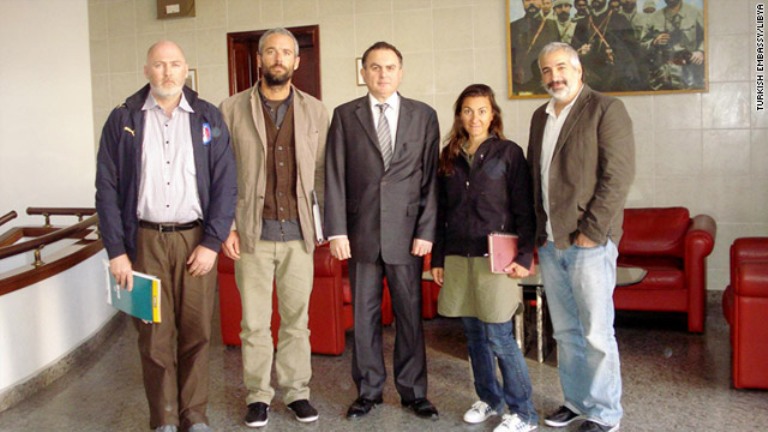
Photo: Turkish Ministry of Foreign Affairs

New York Times photographer Lynsey Addario was on NPR’s “Morning Edition” today talking about her recent time in captivity in Libya. I was surprised at how giddy and upbeat she was in recounting her ordeal, but maybe that’s her way of coping. Or maybe a capture of that nature really isn’t a big deal to war correspondents. But their Libyan driver has not been seen or heard from since that day and he may well have been killed, so while it may be routine for the journalists, it had some pretty awful consequences for someone else.

When host Renee Montagne asked Addario if she would be taking a break now, she replied yes, but it was clear that break meant something like weeks, not long-term. She said: “It’s a selfish profession. Unfortunately I’m very committed to what I do. This is what I’ve done for 15 years. I believe very strongly that the world needs to see what’s happening.”

Source: NPR

discarted

Photography Link Roundup

Photo by Garry Winogrand

•  Nick Turpin of the blog 779 has acquired and published 20 very cool photos from Gary Winogrand’s rarely seen color work. [779 via The Click]

•  Is photographing Nyiragongo, one of the world’s most dangerous volcanos, one of the most dangerous assignments ever? [National Geographic]

•  Recently captured-and-freed New York Times photographer Linsey Addario speaks out on her chosen profession. Just back off, OK? [Lens]

•  Kodak’s CEO saw his compensation package fall 66 percent in 2010 due to hard times in the photography business. Don’t feel too bad for him, though — he still made $3.5 million. [AP]

•  A St. Louis cop took a picture of a dead body at a crime scene with his cell phone and forwarded it to his cop friends. Now they’re all in trouble and they’re suing to block the department from searching their cell phone records. Gross, all the way around. [St. Louis Post-Dispatch]

discarted

El Paso PD Bully, Threaten Anyone Who Records Them

Sounds like the police in El Paso are resorting to good old fashioned bully tactics when it comes to photography and video. Dan Wild told the local NBC affiliate KTSM that police took his camera and deleted all the photos on it after he recorded a raid on a suspect’s house in his neighborhood two years ago. The officer told Wild it was a felony to film a police raid. (I feel like I’ve heard that one before….)

Wild came forward after KTSM aired a report last week on a taxicab inspector named Jesus Lopez-Ledesma who was bullied by El Paso police for recording a confrontational traffic stop with his cell phone. In that incident, officers threatened Lopez-Ledesma’s job and told him that they would give the driver they pulled over his driver’s license information so she could sue him for violating her privacy. (See the video here.) The El Paso police spokesman claimed the officers didn’t do anything wrong and weren’t using intimidation tactics. (That, despite one officer saying, “I’m sure your licensing, your job, depends on your cooperation with the El Paso Police Department.”)

“If we allow police to pick and choose who can film or photograph and who can’t then we might as well call the quits on democracy,” [First Amendment rights expert] David Cuillier said.

Let’s not do that. That seems lame.

Source: KTSM News Channel 9

Hasselblad to the Bone

Photo: Kelly Angood

UK set designer (and part-time cardboard enthusiast) Kelly Angood has created a pretty amazing Hasselblad replica out of cardboard, which is cool (other artists have done similar things) — but hers will actually function as a pinhole camera. This one is designed to use 120 roll film and is a price-upon-request-type piece, but she promises there will be a downloadable version in the next few weeks.

Source: Kelly Angood (via Gizmodo)

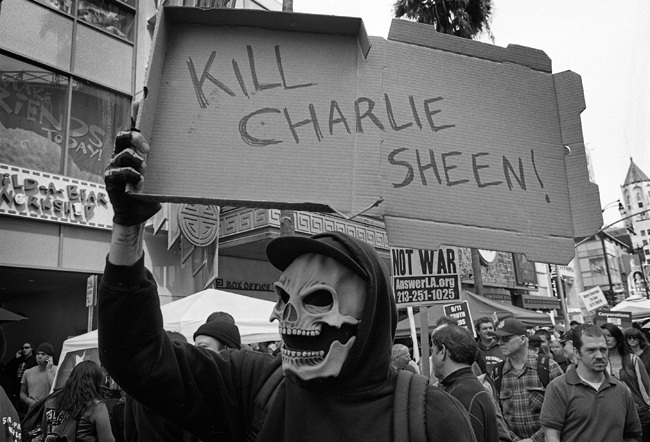
Kill Charlie Sheen!

discarted

Technology & the Hopelessly Out of Date

Technology is supposed to simplify your life, but in some ways it makes everything more overwhelming, doesn’t it? Especially when you’re constantly bombarded with directives like this article in last week’s New York Times, where writer Sam Grobart tells you which gadgets you can keep (alarm clock, books) and which you can get rid of (desktop computer, digital music). Wait, digital music is passe? Already?

No surprise, Grobart says to get rid of the point-and-shoot. His reasoning is that a smartphone can serve that purpose. (But how bad can they be if Steven Spielberg is still using one?)

I fully expect by the end of the year Grobart will write an article that says get rid of everything and just live and breathe through your smartphone.

discarted

More “Kill Team” Mementos From the Front Lines

Photo: Rolling Stone

If Der Spiegel’s photos last week weren’t enough of a taste of the twisted stuff that went on with the “Kill Team” soldiers, Rolling Stone has just published 15 more. In the accompanying article, writer Mark Boal details how two soldiers, Cpl. Jeremy Morlock and Pfc. Andrew Holmes, threw a grenade at, and then opened fire on, a teenage Afghan boy for the pure fun of it.

Then, in a break with protocol, the soldiers began taking photographs of themselves celebrating their kill. Holding a cigarette rakishly in one hand, Holmes posed for the camera with Mudin’s bloody and half-naked corpse, grabbing the boy’s head by the hair as if it were a trophy deer. Morlock made sure to get a similar memento.

 Because there were no repercussions for this killing, the soldiers in the 3rd Platoon were emboldened to go on a murderous rampage over the next four months and kill at least three more innocent Afghans.

Boal writes about the enormous cache of photos and video that was created by members of the platoon during this time, which was a clear violation of Army rules — you cannot take photos of the dead and you certainly can’t share them. (I’m not sure if there is specific rule about creating a clip of two Afghans being blown up set to rock music, but I’m assuming that’s also frowned upon.)

And the army, naturally, tried to cover it all up.

Gen. Stanley McChrystal and President Hamid Karzai were reportedly briefed on the photos as early as May, and the military launched a massive effort to find every file and pull the pictures out of circulation before they could touch off a scandal on the scale of Abu Ghraib.

The article is a must-read, and not in the way that “here’s more proof all military are bad.” Not by a long shot. But this behavior undermines everything the US says it stands for, and excusing and accommodating sociopaths in uniform is never the best policy. That the government does this time and time again is just so disheartening.

Spam Blocked