Archive Page 109

Photojournalist Grapples with Famous Photo

In this article in Sunday’s Washington Post, former Army Times photographer Warren Zinn writes about learning that the subject of perhaps his most famous photo had killed himself. In 2003, Zinn took a photo of Army medic Joseph Dwyer carrying a wounded Iraqi boy that was hailed for its power and message of heroic sacrifice. Dwyer, 31, who was battling PTSD, died of an overdose on June 28. That lead Zinn, who is now attending law school in Miami, to do some soul-searching of his own. As he writes:  

Did this photo have anything to do with his death? News reports said he hated the celebrity that came with the picture. How much, I wondered, did that moment — just 1/250th of a second when three lives intersected on a river bank in Iraq — contribute to the burdens he’d brought home with him? If I’d never taken his picture, would he have ended up as he did? 

After four rotations in Afghanistan and Iraq, Zinn decided the risk wasn’t worth it anymore. He heard from Dwyer via email intermittently, the last one in 2004 saying, “Now looking back on it, it’s one of the greatest things I’ve ever done. I hope you feel the same about what you have done. I truly believe you played an important role in this war. You told everyone’s story.”


But Zinn seems circumspect about that role and his notoriety, writing: 

I’m a little embarrassed when people call the photo iconic or compare it with other famous photos. I was a photojournalist doing my job, just like hundreds of others in Iraq. There were countless pictures produced during the invasion that were better composed, better exposed and more compelling.

 Article from The Washington Post. 

Shooting in NYC Now More Clear-Cut

Photo by discarted

Today the Mayor’s office in New York City announced their new and improved rules governing filming activity in the city. Up until now, filmmakers and photographers have been shooting under rules that allowed for considerable harassment and scrutiny from law enforcement. And the city’s last effort, rules released last summer, were constricting to say the least, essentially requiring any group of two or more people taking photos on city property for more than 30 minutes to have a permit and insurance.

The new rules state, in part:

Permits will not be required for casual photographers, tourists, credentialed members of the media, or other members of the public who do not use vehicles or equipment or assert exclusive use of City property.

The NYC Photo Rights blog says:

Good News!!! Now if only the City of New York would agree to educate their police forces. That is really where the disconnect is. The city government can publish all the rules it wants but it means nothing if their police force continues to harass photographers. The track record of the NYPD in this respect is extremely poor.

Article from the AP via the International Herald Tribune.

Colorado Police Want to Outlaw Back Talk


Photo by Discarted

A Colorado police chief wants to make it illegal for people to talk back to his officers. The Rocky Mountain News reports that Chief Paul Schultz of the Lafayette Police Department, a city located in the Boulder metropolitan area, has asked the City Council to include taunting and profanities as grounds for obstruction charges.

Presumably not realizing how ridiculous he sounded, Chief Schultz explained it this way:

“Officers have been subjected to very abusive language. This gives them a tool. Otherwise, they would just have to stand there and take that verbal abuse.”

Chief Schultz concedes that it would have to take “repeated, prolonged” verbal attacks to warrant arrest, but who’s to say where that line is?

Predictably the Boulder County Civil Liberties Union has taken issue with this, and two council members opposed the ordinance change citing its restriction of free speech. “I don’t think we need to be in the business of regulating speech in Lafayette,” councilman Alex Schatz said. 

To contact Chief Paul Schultz: pauls@cityoflafayette.com

Article from the Rocky Mountain News via Officer.com.

Is Flickr Policing Your Pics?


Photo courtesy of Maarten Dors

Did you know Flickr can choose to delete images it deems inappropriate or not in keeping with their “brand”?

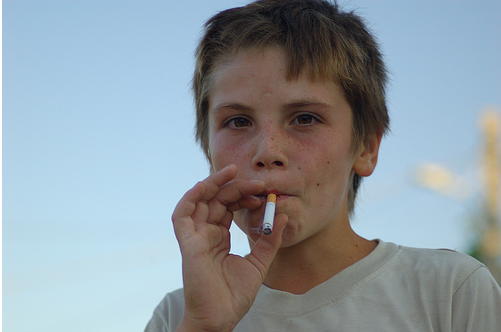
An interesting article by AP writer Anick Jesdanun explores the constraints some service providers willingly impose on their sites. One Flickr member found this out when his photo of a Romanian street kid smoking a cigarette was deleted on “grounds it violated an unwritten ban on depicting children smoking.”

Maarten Dors, the photographer said, “I never thought of it as a photo of a smoking kid. It was just of a kid in Romania and how his life is. You can never make a serious documentary if you always have to think about what Flickr will delete.”

The law though is on Flickr owner Yahoo’s side. It’s totally within a content provider’s rights to police its own content, and, Jesdanun writes, their goal is to “protect their brands and foster safe, enjoyable communities – ones where minors may be roaming.”

Pornography is another issue altogether, but a kid smoking? It’s a reality in many parts of the world — why whitewash it? Ultimately Yahoo agreed with that; after a review Yahoo acknowledged their comunity managers may have been overzealous and Dors’ photo was allowed back on the site. 

Article from the AP via Wired.com.

Getty to Stock Up Via Flickr

Photo by flickr member let ‘er rip

In a deal announced yesterday, Getty can now search Flickr’s vast member archives for appealing images for their own use. Selected Flickr photographers would be invited to join a program and paid the same amount as Getty’s own contract photographers. (Photographers typically get between 30-40% of a $500-600 fee for exclusive rights.)

Jonathan Klein, co-founder of Getty, told the New York Times that this arrangement allows them to take advantage of Flickr’s strengths, which are a depth of images from around the world and covering every imaginable area. Plus, Klein said, they often have an “authenticity” that professional photography might not.

Article via the New York Times.

Oklahoma City Police Harass, Threaten Photog

NewsOn6.com reports that prep school teacher Chris Owens has filed a complaint against the Oklahoma City police and the Oklahoma Highway Patrol after being handcuffed and harassed for taking photos of a car crash scene. Officers told Owens he had to give them his film or he was going to jail.

Owens knew his rights though, and says he “quickly opened the scooter seat, dropped my camera in and locked it, and said ‘No, I won’t give it to you.'” After a heated exchange where the officer was demanding he delete the photos, one officer finally lost it, knocked Owens’ helmet off his head, handcuffed him and put him in a squad car. Which makes me wonder, what’s the big deal about photos of a car crash anyway? That has nothing to do with public security.

Owens, who says he doesn’t want anything more than an apology, asks, “Where’s the checks and balances? Who lets them run like unleashed dogs?” (But he is considering a lawsuit.)

You can send an email to Oklahoma City Police Chief William Sitty through the Public Information Office: ocpd.pio@okc.gov.

Article via NewsOn6.com.

They Do Not Mess Around in Greece

You do not want to get caught taking unauthorized photos in Greece.

Olivier Jobard, an award-winning French photographer working for SIPA Press agency, was arrested and beaten on July 4 for taking photos of a port in the Greek town of Patras. He was working on a story about immigration and didn’t have a permit to photograph the port, which is required by Greek law, although he had been shooting the previous day – and had been stopped twice by guards and allowed to continue.

From the Reporters Without Borders release:

When Jobard was unable to produce a permit, the guard escorted him to a public toilet, pushed him inside, handcuffed him and hit him several times in the face. He then pulled out a knife, cut the strap of Jobard’s camera, threw the camera to the ground and smashed it with his foot.

Reporters Without Borders fully acknowledges Jobard’s need for a permit but condemns the use of violence. Agreed … anyone with half a brain would say it sounds excessive and unnecessary.

Jobard has filed a complaint against the police for assault and battery, meanwhile the Greek media has apparently come out against Jobard, criticizing him while only relaying the “official” (i.e., government) version of the story.

“Blind Ambition: The Ultimate Braille Challenge”


Photo by discarted

Talented writer Heather Murphy wrote this story for the NPR site about the Braille Challenge, an annual contest here in Los Angeles for supersmart blind and visually impaired students who come from all over the country to test their skills in areas like spelling, reading and proofreading.

With an accompanying video by Amir Noori and photos by Shawn Nee (discarted), it’s a multifacted multimedia story — and worth checking out, if I do say so.

Shawn says he was impressed and humbled by the kids he met at that day, noting their self-awareness and complete confidence and “how they were constantly reminding themselves and the people around them that, yes, they’re blind so quit walking on egg shells and just publicly acknowledge it and get comfortable with it because they sure are.”

Read and watch the story here.

A Photographer’s Unique Angle

Photo by Chris Toalson

How’s this for a different perspective? Kevin Connolly was born without legs due to a birth defect. In 2007, he traveled the world for three months — 15 countries, 31 cities — and took over 32,000 photos of people staring at him.

Connolly, 22, is a unique guy, to put it mildly. He competed in the X Games monoski-cross for disabled skiers and placed second. He has prosthetic legs but doesn’t use them or a wheelchair; he prefers to get around on a skateboard. He was alone for half of his three-month travels. (And he only got hit by a car once.)

He held his camera at his hip and looked away while taking the photos so people wouldn’t change their expression or feel self-conscious. His aim was to find the commonalities in the world — in its reaction to someone like him.

As he told the Christian Science Monitor:

“The thing I just loved was you had an executive-looking type guy in say New York City, someone who’s clearly wealthy enough to afford a very nice suit and a good cell phone, staring at you in the exact same way that a beggar in Ukraine would.”

Fifteen of his photos are on display at the Kennedy Center in Washington, D.C. through July 20.

To see more of Connolly’s work, check out his web site.

Or read more about his story in The Washington Post.

Charges Dropped In Albequerque Case

KOB.com is reporting that charges were dismissed against Rick Foley, an Albequerque NBC news photographer who was arrested  by APD Officer Daniel Guzman after exchanging words at a crime scene. We posted about this story in the beginning of June — viewing the tape of the incident, most would conclude that the officer’s behavior was egregiously aggressive and an inappropriate response.

The Albequerque Journal reported today that Judge Benjamin Chavez said the charge of failure to obey an officer wasn’t viable because the citation didn’t provide sufficient information detailing the crime that took place that night.

Officer Guzman is on paid leave and his disciplinary hearing is scheduled for next week. This incident has prompted Police Chief Ray Schultz to review the way his department handles the media at crime scenes.

Sometimes things are handled correctly, and this is good development for journalists’ rights.

Via KOB.com


Spam Blocked