Archive for the 'Street photography' Category


NYPD Told to Back Off Photographers

3009922004_fc37daaa79
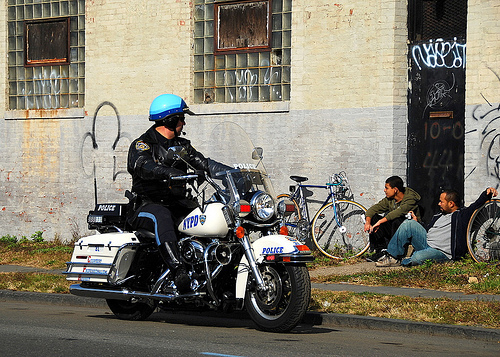
Photo by lempkin

Responding to numerous complaints by individuals and public advocacy groups, the NYPD has finally issued a department order reaffirming the rights of photographers and tourists to take photos in the city. The New York Post reports today:

“Photography and the videotaping of public places, buildings and structures are common activities within New York City . . . and is rarely unlawful,” the NYPD operations order begins.

It acknowledges that the city is a terrorist target, but since it’s a prominent “tourist destination, practically all such photography will have no connection to terrorism or unlawful conduct.”

The department directive — titled “Investigation of Individuals Engaged in Suspicious Photography and Video Surveillance” — makes it clear that cops cannot “demand to view photographs taken by a person . . . or direct them to delete or destroy images” in a camera.

This is a big step in the right direction. In a city with so many irresistible photo opportunities it’s a shame there are any impediments to capturing them.

Article via The New York Post

Google Street View Employee Objects Over Photo

2871091674_d230968e83
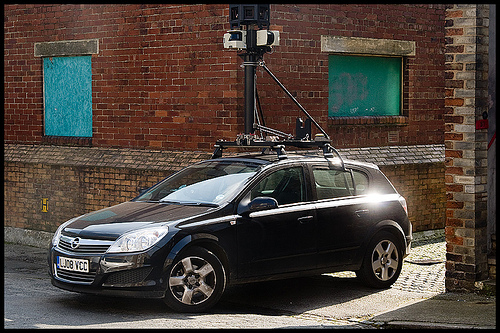
A Google Street View car in York, England. Photo by itspaulkelly

In what could be the supreme irony, a Google Street View employee objected to his photo being taken while working to capture public streets and landmarks. The Telegraph reports that an English  photographer spotted the Google car in Dorset, and when he started taking photos, the employee, who was visibly agitated, told him, “Don’t you take pictures of me, mate.” Then he actually asked the photographer to blur out his face in the photos like Google Street View does.  Seems like someone’s maybe in the wrong line of work.

Article via the Telegraph

Helen Levitt — Eye on the Streets

artwork_images_138991_163502_helen-levitt
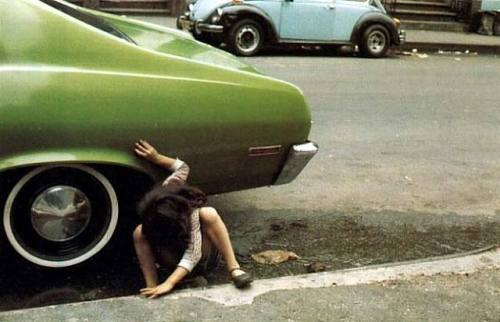
Photo by Helen Levitt, New York, 1980

Helen Levitt, the acclaimed New York street photographer, died last weekend at the age of 95. NPR did a nice retrospective piece on her this week where the reporter recalls two interviews she had previously done with her. At one point, the reporter asks Levitt what she thinks about a particular photo. Levitt says, “Just what you see.” When asked why it’s so difficult for her to talk about, Levitt says, “If it were easy to talk about, I’d be a writer. Since I’m inarticulate, I express myself with images.”

Listen to the whole piece here.

This is also a great book of her work.

Oh, How the Apple Has Fallen

picture-6 Screen grab from Apple.com

With the advancement of technology and the proliferation of  rapidly outdated gadgets, Apple once again releases another featureless iPod. Planned obsolescence is alive and well.

Lacking any control buttons on Apple’s newest iPod shuffle, your headphone jack has officially been highjacked by Apple, restricting you to don their iconic white headphones to operate “the first music player to talk to you.” Enslaved by this monopolized feature, we will all now walk the streets as Apple’s permanent billboards, unable to use another brand’s headphones with this battery-sized rectangle.

With a sleek, catchy design and ability to hold 1000 songs,  Apple’s “amazingly small” device will fit easily into our consumer-driven culture, compelling us to purchase a second one as soon we lose the first one after attempting to use it with our “eyes closed.” And in case you’re lucky enough to only lose the headphones (which is the only way to play Apple’s tiniest music player),  it will cost you just $79 to purchase a brand new set of Apple’s in-Ear Headphones — the entire cost of a 4GB iPod Shuffle (including the headphones).

Way to go, Apple. Just like your stock price, your newly designed and “innovative” products have fallen far from the tree and are now just fermenting on the ground.

Note: We realize this site is about photography and photographers’ rights, but we do know a lot of photographers who listen to music via an iPod while out shooting. And even if you don’t, chances are you’re an Apple customer, it being a monopoly and all.

Online Maps Now, Street Photography Next?

picture2051
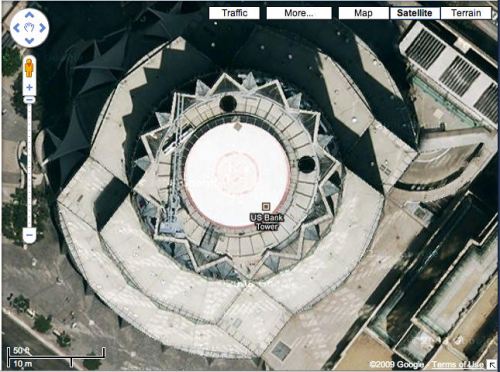
Photo of our favorite building, LA’s US Bank Tower, from Google Maps

Assemblyman Joel Anderson has introduced legislation in California that would restrict the amount of detail involved in online mapping tools. In other words, he doesn’t want terrorists getting too familiar with the air ducts in a government building’s air shaft.

In the measure Anderson proposed last month, government buildings, along with schools, hospitals and churches, would be blurred in online satellite images-and violators will have to pay a $250,000 penalty per day.

The question that arises then is, where does it end? We blur out government buildings and schools, but really is that protecting us when these facilities are accessible through all manner of photos, maps and, uh, the street? And what does this say about street photography in general? Undoubtedly it will feed into the overall paranoia and fear of cameras, making things that much worse. Will street and architectural photographers eventually be forced to blur their images because it contains one these “sensitive” structures that Anderson is trying to eliminate from online maps? We will no longer be able to post images on the web of people, buildings and things that are clearly visible from public spaces? Maybe we should just jump in the DeLorean and head back to 1984 before it’s too late.

And, lastly, are we not trying to solve a massive global ideological problem with tiny, insignificant Band-Aids?

CNN.com has this interview with Anderson today, where among other things, Anderson says, “The fact is I would be remiss in my job if I didn’t take this seriously.” But really, is it an assemblyman’s job to take on technology, or is he looking for more high-profile causes to attach his name to? (Anderson also sponsored a bill which forced state pensions to stop investing in companies doing business with Iran.)

Article via CNN.com

Thanks to Geoff for the link.

I’d Hate to Be This Guy’s Lawyer

2473047860_07b7be6cc9
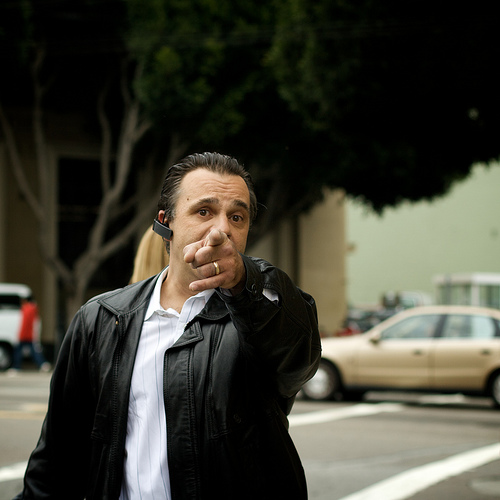
Photo by Jeremy Brooks

This is from an old post on flickr, but still great.

Photographer Jeremy Brooks came upon this angry guy yelling at a homeless man on a corner in San Francisco. He went over to investigate, camera in hand, and the angry man soon turned on him. Mr. Angry Overreaction Man, as Brooks dubbed him, screamed and yelled, threatened him, bumped him with his chest, and told him if the picture ended up on the internet he’d call his lawyer. Brooks stood his ground and got this shot, which fittingly, is now on the internet. 

Brooks says: 

So, Mr. Angry Overreaction Man, your photo is now on the internet. Call your lawyer. Tell him somebody on a public sidewalk took your photo while you were on a public sidewalk. Then tell him you physically assaulted the photographer. See what he says.

Read the whole post on Jeremy Brooks’ flickr page.

Found on Flickr: ockermedia

better-hope-the-wind-doesnt-change

This is another installment in our continuing series where we talk to photographers whose work we’ve appreciated on Flickr.

This week we feature Lee Jordan/ockermedia.

cinemafia: The first thing I want to ask you is how you began doing street photography, as it is generally a different story for everyone who does it. Did you have any particular influences that helped you along the way?

ockermedia: My first connect to photography was in college in 1986. I was 16, and just left school to go to college to study media and film. My first year was taken up by a film project called “Life in the Shadows.” I met many a colourful character – one called Teddy Ruxpin and another called Elvis… back then, as you may or may not remember, tramps were real tramps! Quirky characters who drank far too much, lived under bridges and made funny grunts and noises at people as they walked by, good, old massive beards… anyway it was a good short film that paved the way into my sports filming career.

Although my filming progressed into extreme sports, I remained interested in capturing local street life and would often include edits of street people in sports videos. In terms of other artists that have inspired me, Joel Meyerowitz’s 1980s New York street photography was certainly influential; Martha Cooper and Henry Chalfant also influenced my style as I was interested in all aspects of street culture, street art, music, sports and lifestyle. It was only at the start of ‘08 [that] I picked up a DSLR and started my photography hobby. Having enjoyed all aspects of the creative control that filming gave me, I found digital photography a very accessible medium.

cinemafia: Why do you think it is important to photograph people who live or otherwise spend most of their time on the streets? Do you think these types of photographs will ever really make any difference in the world?

ockermedia: I think that it is an important record of people whose lives go largely undocumented and unrecorded [as] they slip through the net of any government statistic. Excluded from any family photograph, they have little or no paper trail of bank statements and addresses. A photograph gives them a lasting image, a record of their existence. “I am” is the simple statement they make in the photos. It is the way we view their existence that influences how we look at the photographs.

I think that street photography provides an important insight to all lifestyles in the city, for both current and future generations. We should all spare a thought for these otherwise forgotten souls. However, while I think that photographs of marginal characters in society can be useful in promoting awareness of social and cultural issues and provoke debate, I do not take the photos with this as an agenda; it’s simply a personal record of the characters I meet.

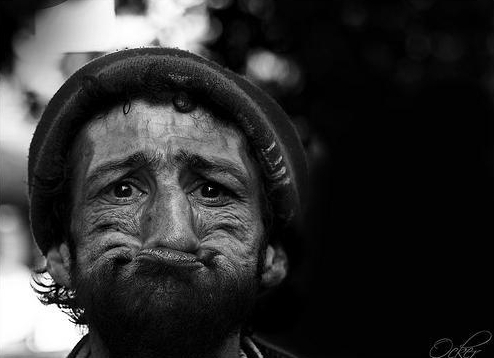
goliath

cinemafia: One of my favorite shots of yours is of Goliath (above). It’s a striking image, and the story behind it is all the more interesting. It speaks a lot to the idea that those of us who shoot people who are frequently on the streets, whether by choice or by chance, often come to know these people very well, even becoming  friends with them. I wonder if you could talk a little about how it feels going out and seeing these people regularly, and how you think they feel about you photographing them.

ockermedia: Goliath is a gentle giant of a man that I met while shooting on the streets of Bristol. [I] sat on a bench having an in depth chat about life, and his role in it, and then I realized that I knew him many years ago. Back in his heyday he was a bouncer on the doors of many an establishment I frequented. Many Bristol locals would remember him from the Thekla, late 80s, early 90s, as the dominating figure on the door. He then went onto explain that he was also head of security at many famous festivals like Glastonbury, Reading, Leeds,etc, etc. But because of the nature of clubs and festivals he ended up an alcoholic, drinking maybe 30 cans of strong larger a day! So much of his time [now] is spent sitting around on streets drinking all day. However he does have a house – and a big house in the most sought after part of Bristol, yet he spends most of his time on the streets.

I know I was fuelling his addiction, but I bought him a couple of beers to say thanks for the photos. This put a beaming smile on his face – RESPECT he said! As I was leaving he called me back. He offered to repay my gift of beer with some old photography books he had. I didn’t want to take his books, but I saw it as a chance to see him more over the lonely Christmas period, if only to make sure he was well and happy. He is the most gentle of giants with an honest heart, and most of all, he is my new friend.

Continue reading ‘Found on Flickr: ockermedia’
Found on Flickr: evg3 photography

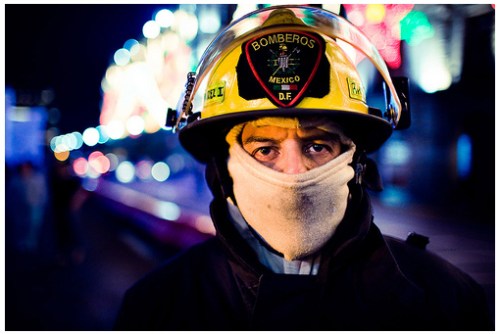
evg3_1

This is another installment in our continuing series where we talk to photographers whose work we’ve appreciated on Flickr.

This week we feature evg3 photography.

cinemafia: Your body of work spans many genres, from journalism to fashion to lifestyle. Yet, there seems to be a common theme or connection between all of your photographs that is difficult for me to describe. Could you tell me how you feel about the different kinds of work that you do, and how they might all come together?

evg3 photography: I think I’m looking for stories; there’s always a story behind a good image, you can feel it in a landscape, in a face, in the composition that suggests something you usually never see. Anyway, most of my work focuses on portraits or places that show you somehow the human existence.

cinemafia: You have many examples of street photography, or perhaps street documentary, in your stream that is taken from daily life in Mexico City. Being one of most highly-populated urban areas in the world, I wonder if you’d talk a little about the unique dynamic of approaching and photographing people there. In Los Angeles, there is a culture of suspicion and contempt for many people who photograph strangers in public, and I wonder what are the similarities or differences there in Mexico City.

evg3 photography: Indeed, most people don’t want just to be photographed, it’s kind of invasive. I believe the key is to get closer in order to make a great image, to tell a story; it’s about being human. Most photographers use the camera to take “snapshots” that only show the surface, not the real person. That happens with places too; a serious photographer needs [to be] going deeper, to share yourself, be a friend. I bring always with me an iPod touch with my portfolio to show my portraits – that works great to give an idea that I’m a serious photographer.

evg3_3

cinemafia: I wanted to ask you about something you put in your flickr profile, and it has to do with the idea of the photographer and the camera, a kind of “man vs. machine” concept. This is a an important discussion because it is true that many budding photographers get caught up in buying the best camera and gear and lose sight of what it is they’re trying to do. I wonder if you can talk a little bit more about this – give us some details as to why it’s not the equipment but the eyes and brain behind it.

evg3 photography: Cameras are only tools; when you need special equipment [it] is because you have something in mind. I think most of those “photographers” don’t have a clear idea of what they want. It’s the same with software.

Continue reading ‘Found on Flickr: evg3 photography’

And the Photo of the Year is…


Photo by discarted

Keeping in line with last year’s resolution to procrastinate more, and seeing that we’re already two days into ’09, I’ve finally mustered up the initiative to post my favorite image of 2008.

During the past year I found myself in the middle of all kinds of unforgettable situations, ranging from the most intense protests to the secret sex room of a transvestite hooker.

I lost friends/subjects that I loved dearly to their alcohol and drug addictions, while others decided to move away in order to escape the grind of Hollywood, leaving me hollowed out, deflated, and questioning my intentions. For weeks I would go without shooting anything, asking myself if what I was doing was serving any kind of purpose.

But as the weeks passed and the dust settled on my camera, that indescribable thing inside of every passionate photographer crept quietly back and I found myself with old friends, photographing them again, as if no time had passed. 

For the most part, I consider myself a documentary photographer rather than a street photographer. It’s something I’m quite proud of, and hold the material up to a much higher standard than the street work I have done. 

Now I do realize my documentary subjects’ photos are on my website and flickr, but they are meant to hang in a gallery somewhere and they definitely deserve better than some blog posting, proclaiming they’re my favorite image of ’08. So that is why I chose a “street” shot for my favorite image of the year.

It’s an image, as well as a moment, that has been ingrained in my mind and will remain for many more new years to come.

As for my new year’s resolution, I’ve chosen the path of most resolutionaries and have decided to trim the fat.

But not from me…from my flickr account.

Within the past week, the image tally has been reduced from 1036 to 754.

Found on Flickr: Gumanow

gumanow_2

This is another installment in our continuing series where we talk to photographers whose work we’ve appreciated on Flickr.

This week we feature gumanow.

cinemafia: Many of your photographs are done in the street photography vein and are taken in public at close proximity to strangers, often with them obviously aware that you are photographing them. Many people would find this kind of photography uncomfortable or impossible, yet others seem to thrive on it. What does this overt process mean to you, and how do you think it affects the people who see the end product?

gumanow: First off, let me say that I am honored that you and discarted have selected me for this interview. Thanks!

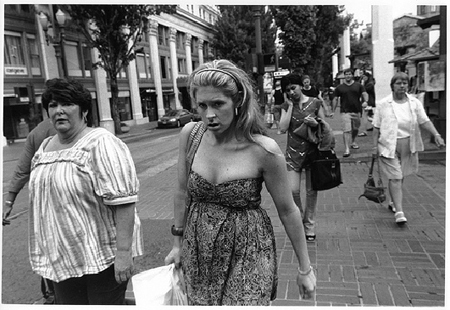
I would have to say that I thrive on getting close. Sometimes now I wish I could get even closer. Yeah, many photographers find it uncomfortable to shoot close. A lot of the time my subjects think I’m shooting behind them or they got in my way and are sorry. If they do see me, I usually give them a nod or smile. Most of the time this disarms them – I did say “most” of the time!

When I first started out shooting street I was uncomfortable with getting close to people. I started out shooting from the chest without the camera to my eye, however, this lead to a lot of very poor results. This was one of my first street shots of people. You can see in this shot by the position of my shadow that I don’t have the camera up to my eye. I shot this from my chest and you can tell by the level of the perspective. Now I shoot exclusively with the viewfinder to my eye. I still feel nervous, uncomfortable, scared, and my heart races. But after the first few shutter clicks I feel right at home and energized.

gumanow_11

I’ve heard from a lot of beginning street shooters that say if you get close you are interfering with the “slice” of life you are trying to capture. And while I’m striving for that slice, sometimes being a character in the shot is interesting as well – and that interaction with people. By putting the viewfinder to my eye I am in effect saying, “I’m taking your picture!” I’m not going to hide or pretend that I’m not. How they react to me is just as much part of the “slice” as anything else.

I’ve also seen a lot of shots using a telephoto lens from far away and the photographer still gets noticed. My approach is to get into the action, be a part of the street scene. Most of the time people don’t notice me and when they do, I try to get the shot in that split second between when they first notice me and when they react. Sometimes a glance your way can really make the shot.

Continue reading ‘Found on Flickr: Gumanow’


Spam Blocked