Archive for the 'Police Harassment' Category


Videographer Attacked by Plainclothes Cops

Have you ever wondered who are the ones watching the watchmen?

Well, it’s people like Jacob Crawford of CopWatch in San Francisco, who learn the hard way that the watchmen do not like being watched and will do anything to blind your prying eyes.

Such as this unidentified female officer who attacked and unlawfully detained Crawford for videotaping her and asking questions that she refused to respond to but is legally obligated to answer. The officer also claimed, “You can’t film people who don’t want to be filmed,” after Crawford was handcuffed, lying face-down in the street, and surrounded by other cops.

Just so you know, former undercover officer, we can film you—and people like Jacob Crawford are going to continue watching you with their cameras. So get used to your newfound viral glory because our cameras are everywhere—actually protecting and serving the public.

More important, your actions were criminal, and if you weren’t a cop, you would be spending the night in jail with the other criminals.

Here’s Crawford’s account of what happened:

“On November 18th I was assaulted by Plain Clothes Officers. We started off our shift at 16th in Mission in Sf by seeing several strange people. I assumed them to be plain clothes officers because I could see vests under their shirts. When they refused to identify themselves I wondered whether indeed these were “on the job” cops. Many cities around the country are known for having rogue units that take the “law” into their own hands, or are involved in organized crime. As I questioned a woman on her involvement she grabbed my camera and ran at me. From all directions came men who neither identified themselves as cops or gave orders. I assumed I was getting attacked, and I was unsure of by who. As I ran into 16th street two cops cars pulled up with lights on, it was at that point that I stopped and let the arriving officers take me down. Within seconds they could see that the move was faulty, and they released me with no charge[.]”

New Haven Asst. Police Chief Arrests Man for iPhone Video

A fish rots from the head down. Especially in the New Haven (CT) police department. That’s where Assistant Chief Ariel Melendez ordered the arrest of Luis Luna for filming an altercation with his iPhone one early morning in September. Luna, 26, says police took his iPhone, erased the video he took of officers breaking up a fight outside a bar, and then charged him with interfering with police. He spent the night in jail.

Assistant Chief Melendez noticed Luna and approached him “in a very intimidating manner,” Luna recalled. He asked what Luna was doing.

“I said, ‘Filming,’” Luna recalled. “He grabbed my phone and walked away.”

Melendez ordered officer Kristen Fitzgerald to arrest Luna for interfering.

“I just could not believe it,” Luna said.

Apparently this isn’t the first time police in New Haven have been caught harassing and even confiscating camera phones in the recent past. But still, Police Chief Frank Limon claims that he knows filming police is not illegal.

Assistant Chief Melendez didn’t get the memo though, despite 31 years on the force. He doesn’t mind using jackbooted tactics to enforce nonexistent laws. Know why? Because he knows he’ll get away with it.

Source: New Haven Independent

The Terrible Myth

In light of the extremely lenient sentence that ex-BART cop Johannes Mehserle received last week for killing an unarmed Oscar Grant, it seemed appropriate to post this excerpt from a speech William Kunstler gave in the 1970s regarding the legitimacy of the United States justice system.

The above video is also included in the thought-provoking documentary William Kunstler: Disturbing the Universe.

“Suspicious Activity Reporting,” And We All Lose

In an op-ed column today, the ACLU’s Michael German takes on “Suspicious Activity Reporting” (SAR) programs employed by the government in an effort to identify criminals and terrorists. The only problem? When the criteria of so-called suspicious activity is so broad as to include people taking photographs, jotting down notes, wearing hooded sweatshirts, etc., it essentially criminializes everyday, legal activities and makes all of our lives not just more uncomfortable, but less free. Moreover, as German notes, there is no evidence that “these programs have identified a single terrorist plot.”

A program that violates American values and fails to keep us safe is a lose-lose proposition. Law enforcement already has the authority it needs to fight crime and terrorism without sacrificing the rights of those it seeks to protect.

Incidentally, German is a former FBI special agent and intelligence expert.

Read the column here.

“Officer Bubbles” Will Sue You

Remember in the old days when cops would raid your parents’ home and charge you with illegal wiretapping after you uploaded a video to YouTube, showing one of America’s ‘finest” violating the law, wielding a gun, killing someone, or just acting like a power-tripping thug who should not be wearing a badge?

Well, that’s like soooooo two months ago.

Because if you upload a video of a cop acting like a jackass there is now the possibility that you could be sued by the officer. And if you leave disparaging comments and make your own parody videos ridiculing the cop for his egregious behavior, YOU WILL BE SUED for defamation in a frivolous lawsuit.

In his statement of claim, Josephs calls the cartoons and several comments “devastatingly defamatory,” alleging they have brought him “ridicule, scandal and contempt both personally and as a member of the (Toronto Police Service).”

Boo hoo.

Source: The Star

DC Police Seize Camera, Delete Photos

According to the video’s description, police seized the camera and deleted its contents, but the video was retrieved using file recovery software.

Here is a longer version of the video (which was also deleted by police) showing a heavily armed police force harassing a group of peaceful animal rights protesters.

DHS Officer Bans Photographer From Public Protest in Los Angeles

Last week on October 5, I decided to head to downtown Los Angeles to photograph a rally that was being held at the federal building. What was dubbed as a National Day of Action against FBI Repression ended up being a major non-event, and only about 5-10 people were there to protest the FBI’s recent raids that targeted political activists in Illinois and Minnesota.

So for a photographer hoping to capture another protest with the usual high energy associated with these kinds of events, there really wasn’t much to photograph. Plus, it started raining fifteen minutes into this tiny protest, and that was still before anyone even arrived. However, at the same time the rain started falling, a Department of Homeland Security vehicle arrived, which caused me to believe that people were going to show up—at some point—and they did.

I stuck around and burned the roll’s last few frames on the lackluster protesters that finally arrived and used the very last frame for the Homeland Security decal that was on the front fender of the DHS SUV. It seemed like an important stock image to get, seeing that DHS has been known to harass a photographer or two. I thought I could use my photo for future posts dealing with DHS harassment rather than pulling the DHS decal from the web.

Well, I should’ve known that I would be posting a video showing a DHS officer prohibiting me from returning to a protest that was being held on a public sidewalk before I even processed the roll of film I shot that day.

Student Arrested For Recording Cops

The video taken by Hartford appears to show that the officers only arrested the original student because Hartford began filming. One officer, who began dancing when the camera was turned on, looked into the camera and said, “Watch this.” He then asked the student who they were questioning whether he was with Hartford. When the student replied yes, the officer turned to another officer and said, “Cuff him up.”

Article from The Quinnipiac Chronicle

Two Misdemeanor Charges for Student Photog

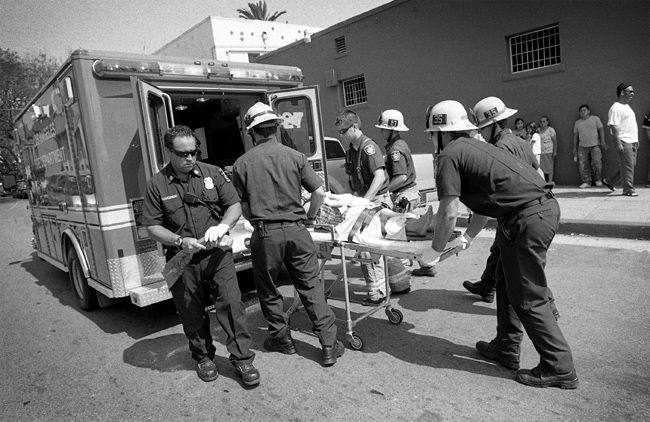
Photo by Shawn Nee / discarted (Used to show that photographs of patients and ambulances are not illegal)

Justin Kenward, photo editor of the Chaffey College student newspaper, The Breeze, is facing criminal charges (that will likely be dropped by a level-headed judge on October 18), after photographing a car accident victim near the school’s newsroom.

According to the Student Press Law Center, Kenward began photographing the victim as he was being loaded into the ambulance on a stretcher by emergency personel. Kenward claims that the victim did not have an issue with being photographed, and that the man (who was talking on his cell phone at the time) even smiled and waved at him. But fire personnel attending to the patient are saying the opposite, claiming that the man objected to being photographed and that Kenward was interfering with them.

“Firefighter medics reported that while they were attending to a person experiencing chest pain, a photographer began taking photographs of the patient despite the patient’s objections, and allegedly interfered with the care of the patient,” according to a press release from Chaffey College.

According to SPLC’s report, a paramedic then told Kenward he was not allowed to photograph the patient due to doctor-patient confidentially. So Kenward obliged and moved back.

Minutes later, campus cadets arrived on scene, and like fire personnel, told the photo editor that he could not photograph the incident. However, Kenward identified himself as press, which caused the cadets to walk away.

“I took that as a green light and continued shooting,” Kenward said.

However, at that point, another firefighter again told Kenward he could not take pictures.

He was about twenty feet away when a firefighter said no pictures were allowed. Kenward argued with the man, took down his name and went inside.

Putting morals aside (which is simply one man’s opinion versus another man’s opinion), photographing a victim inside of an ambulance, which still has its doors open, is not against the law, nor does it violate doctor-patient confidentially. And how can someone even argue that this does violate doctor-patient confidentiality when a doctor isn’t even present? Is it maybe because this paramedic was inventing a non-existent law based on their own morals, rather than following actual law? Possibly.

But if the paramedics’ claims are true, and the victim did object to being photographed, it doesn’t matter because the accident occurred in public where an expectation of privacy does not exist. Which means, anybody (including accident victims) can be photographed despite their objections. So it appears these paramedics, firefighters, and campus cadets need training regarding photographers’ rights and the First Amendment.

Seriously though, when are firefighters and police officers going to realize that they are not victim watchdogs in charge of censoring anybody trying to document an incident scene that involves injured people? That is not their job. Nor is it their job to threaten college reporters with expulsion if they do not kowtow to their unlawful demands, such as what one officer tried to get Kenward to do.

Shortly after, an emergency team member came in with a police officer. Kenward, the newspaper adviser and a Breeze reporter spent about an hour discussing the matter with the police. The officer wanted the images but the group refused. Kenward said the officer threatened to expel him from campus for two weeks if he did not hand over a copy of images.

Thankfully, the officer’s threats had no effect on Kenward who held strong to his position and did not hand over the photos.

“I knew he wasn’t able to actually expel me, that’s up to the school board,” Kenward said.

More important, law enforcement does not have the legal authority to demand the images either. Especially in California, which has very strict shield laws that protect journalists from the prying eyes and hands of cops. Greg Leslie, an attorney for Reporters Committee for Freedom of the Press explains:

“You cannot seize the work product — including notes and photographs — even if you have a search warrant,” Leslie said. “The proper route would be for them to subpoena the photos.”

Greg continues, bolstering the fact that law enforcement or firefighters can not prevent photographers (or anybody as a matter of fact) from documenting accident or crime scenes, including when victims are inside ambulances:

“You can always take pictures at a crime scene, but you can’t interfere,” Leslie said. “Even taking pictures inside an ambulance is not necessarily illegal.”

But despite all of that, the unknown officer did not relent and eventually returned hours later, charging Kenward with “interfering with a firefighter and disobeying an order from a firefighter.” Which, as we all know, are your standard “contempt of cop” charges that all cops use when somebody hasn’t violated any laws but stood up for their rights and didn’t acquiesce to their imperious tactics and empty threats.

“I wanted to scream,” Kenward said.

So do we.

Article via SPLC
Duane Kerzic Suing Homeland Security

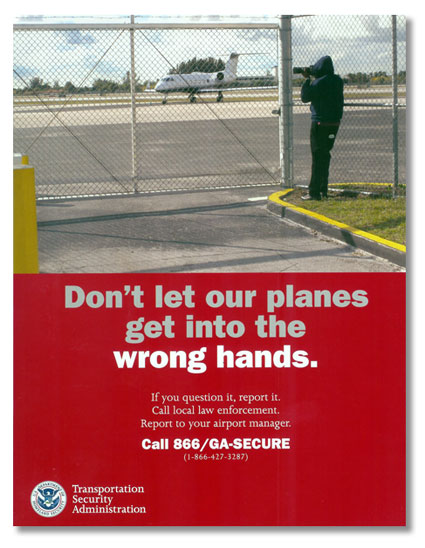
You might remember Duane Kerzic as the photographer who was detained and cited for trespassing in 2008 by Amtrak police for taking pictures inside New York’s Penn Station while participating in Amtrak’s annual photo contest, “Picture Our Train.” Kerzic was later vindicated by an undisclosed financial settlement and an appearance on “The Colbert Report,” and now he’s a plaintiff in a federal lawsuit challenging the constitutionality of the U.S. Department of Homeland Security’s laptop search policy at the border.

According to NPPA:

In July 2007, Kerzic was returning to the United States from a trip to Canada where he’d been photographing lighthouses and national parks for a story. He was riding his motorcycle and his laptop and camera gear were in his saddlebag when he arrived at the Customs and Border Protection inspection point at the Thousand Island border crossing. When agents asked him where he was going and then referred him to secondary screening, he was asked to wait inside a building while his motorcycle and saddlebag remained outside. Kerzic could see CBP agents going through his belongings outside, and in a few minutes a CBP agent came into the building with Kerzic’s laptop in his hands.

After looking through the photographer’s laptop for about 15 minutes, Kerzic was permitted to leave and to enter the United States.

The policy authorizes US Customs and Border Protection agents to conduct suspicionless searches on U.S. citizens’ electronic devices at international borders and then copy and distribute the devices’ contents (even after the individual is permitted entry into the United States). And that, needless to say, is deeply concerning to journalists who rely heavily on protecting their sources from disclosure and possible retribution to do their jobs.

As a First Amendment concern NPPA’s lawyer, Mickey H. Osterreicher, believes that “government officials’ unfettered ability to search journalists’ laptops and other electronic devices will have a chilling effect on their ability to gather and disseminate the news once it becomes widely known that any information they gather may be subject to search and seizure without probable cause or reasonable suspicion.”

“This will directly impact their ability to provide confidentiality to their sources,” Osterreicher said. “One can only imagine the added difficulty, if not impossibility, for journalists to conduct interviews, report on foreign relations or cover stories involving allegations of corruption when news sources believe that the information gathered abroad may be reviewed, copied and shared by agencies of the government without any of the normally guaranteed Constitutional protections.”

More important, these DHS policies not only impact journalists, but all Americans.

“Allowing government officials to look through American’s most personal materials – the things we store in our laptops, cameras, and cell phones – without reasonable suspicion is unconstitutional and inconsistent with American values, and a waste of limited resources. It doesn’t make us ‘safer’. Instead it ‘builds a bigger haystack’ and diverts resources away from proven law enforcement methods.”

The lawsuit, which was filed on behalf  of the National Press Photographers Association, the American Civil Liberties Union, New York Civil Liberties Union, the National Association of Criminal Defense Lawyers, graduate student Pascal Abidor, and Duane Kerzic as plaintiffs against Janet Napolitano, the U.S. Department of Homeland Security head, argues that Americans do not relinquish their constitutional rights when they decide to travel outside the United States, i.e., protection from unreasonable searches and seizures that are protected by the Fourth Amendment.

Source: NPPA Joins Federal Lawsuit Challenging Constitutionality of DHS Laptop Search


Spam Blocked