Archive for the 'Photographers’ Rights' Category


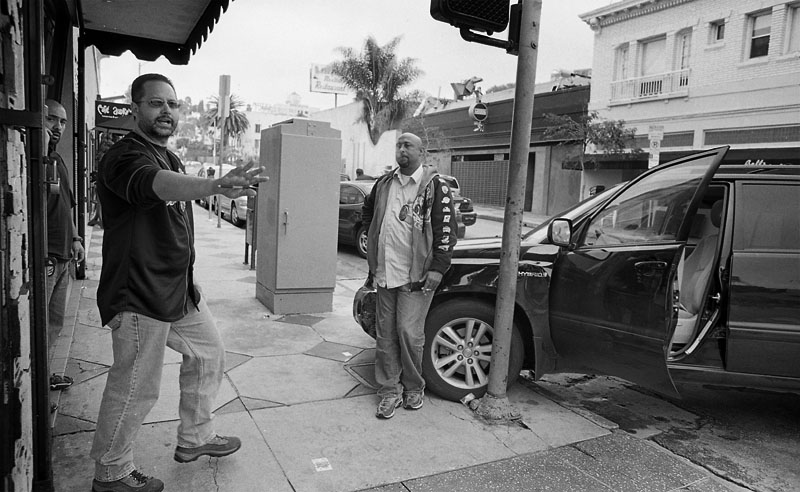
NYPD Act Like Fools, Mess With Photographer

Photos from The Villager

Clayton Patterson is a  fixture on the Lower East Side of New York, having documented the neighborhood for 25 years. He’s an artist, activist, photographer for The Villager newspaper, has published books, had a documentary made about him, and been featured in the New York Times.

But being the true iconoclast that he is, his relations with the Seventh Precinct haven’t always been rosy.

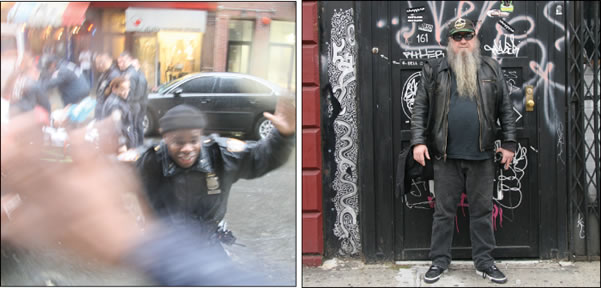
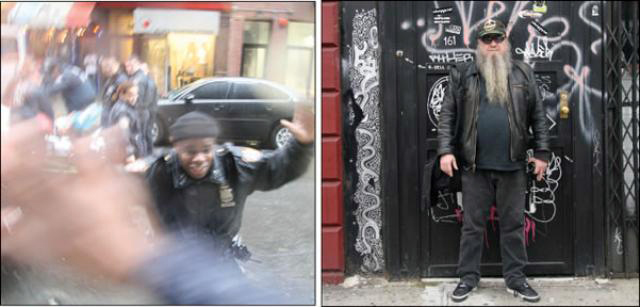
On March 13 he was trying to photograph a stabbing victim on Orchard Street when police bizarrely and belligerently harassed and tried to intimidate him. In their effort to block Patterson from shooting the scene, at various points: an officer smashed into him and accused him of starting it; the sergeant screamed at him — “I’m f—ing tired of you!”; two other officers jumped around wildly in front of his camera yelling “I’m a monkey”; and then an officer positioned his squad car on the sidewalk, directly in front of Patterson, to block him.

Now, there is a history here. Patterson has been arrested 14 times over the years, all when he was shooting photos. He is currently suing the NYPD over a 2008 incident where he was arrested for photographing a fire and not stopping when he was told to. So, the precinct officers know who he is (check out his photo — he’s hard to miss), and they want payback. I get it.

But it doesn’t make it right.

For officers to behave like this — in a ridiculously immature manner to impede a photographer who has every legal right to be there? I don’t care whether you like him or not; he could be the biggest thorn in your side, but that’s called life. As long as he’s following the rules, deal with it.

Show your support for photographers’ rights by calling the NYPD’s Seventh Precinct Captain Nancy Barry at (212) 477-7731.

Article from The Villager

Watch Out, Ottawa


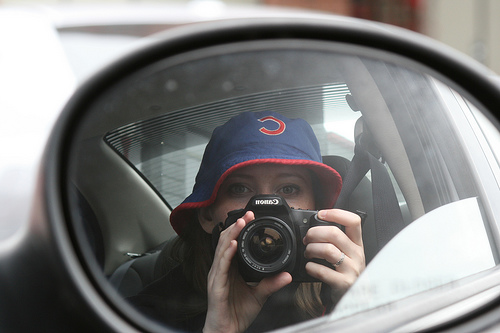
Photo by Transit Scope

In another example of security theater — measures that make the public feel like their government is working to keep them safe but are largely ineffectual — the transit authority for greater Gatineau and Ottawa in Canada have instituted a security initiative where riders are asked to be on alert for suspicious activity. Among the suspicious things to look out for:

An individual taking photos or pictures in a location that has no particular interest, drawing maps or sketches, taking notes or wandering in the same location for an unusually long time;

The problem with this directive of course is that who is determine what has “no particular interest”? I might find subway tracks extremely interesting to photograph, but a fellow passenger thinks they’re not of interest and reports me to the authorities. Problems ensue.

And if you want to the sketch the subway? Well, just forget about it…especially if you are prone to pacing.

Article from Boing Boing

First Amendment Showdown

Photo by discarted

The Christian Science Monitor turns its focus on photographers rights this week, reporting on the ongoing clash between police and the photographers who shoot them.

CSM says that the increase in amount of camera seizures and photo deletion is testing First Amendment protections and names a few well-known incidents, including the recent trial in New Orleans where two photographers accused police of wrongful arrest and lost, Carlos Miller‘s trial for refusal to stop taking photos of police in Miami, and the Oakland cop who shot and killed an unarmed man in a BART station.

It’s disappointing that the article says police “often have the upper hand in court.” But it also doesn’t come as a surprise — we’ve seen it a lot here in the blogosphere with reaction to photographer vs. law enforcement incidents as an indication that many people seem to slavishly support police actions despite evidence that shows a clear overstep of legal boundaries.

Nevertheless, the article quotes attorney Bert Krages who says photos (and video) are the best defense when accused photographers are (falsely) accused of obstruction, which is a common charge in these scenarios. He also recommends that photographers who find themselves in these situations file a report with internal affairs and contact local media as they should have a vested interest in photography in public places.

And, finally, from Marjorie Esman of the Louisiana ACLU:

We have this thing called the Constitution, and the idea that you can’t film something that you can see is ludicrous. The sad thing about these cases is it suggests that police don’t want people to know what they’re doing, which then implies that they’re doing something that they don’t want people to know that they’re doing.

Article from Christian Science Monitor

50 Cent’s Goon Assaults Photographers

Has-been rapper 50 Cent employs bodyguards who like to beat up photographers. As seen in this clip, a bodyguard goes after a couple of photographers waiting outside the rapper’s hotel in Denmark, physically assaulting them — even putting his hands around one’s neck at one point. On an oddly crazed tear, the bodyguard then goes into the photographer’s car and steals his camera. The photographer also claims he deleted his photos.

The bodyguard, whose name has not been released, was later arrested and charged with assault.

Perhaps the bodyguards would be wise to realize paparazzi photos of 50 Cent would only benefit the rapper’s career at this point (if an outlet would even buy them)…. I mean, wow. Talk about misguided anger.

Article from New York Daily News

Don’t Ask, Tell, or Be Yourself


Photo by Jeff Sheng

This week the New York Times ran a piece on Southern California-based photographer Jeff Sheng, whose series and book “Don’t Ask, Don’t Tell,” features that very hot-button topic of homosexuals in the military. Though the faces of the servicemen and women are obscured, the portraits are a clear statement about the military’s shameful policy.

Sheng, who himself is gay, tells the story of his path to this book, and it’s interesting how it evolved from him being a closeted athlete who never felt like he could be himself to wanting to document gay athletes he admired for being out and proud. That turned into the well-respected project “Fearless,” which continues to tour the country (including a stint at the Olympics). And from that, because of the reaction he got from military personnel who were moved and inspired, he turned his focus to DADT.

Sheng talks about originally wanting to do a documentary for “Fearless” but decided against it because he didn’t think people who are already opposed to the concept would ever watch it. (Such is the closed mind.) So he decided to do photographs, and his assessment of the power of photos is a good one:

 “But people can happen upon a picture. Some pictures — like the ones of civil rights protestors being attacked by dogs — sum up what’s really at stake. People who don’t even mean to see it end up seeing it. And then things change.”

Article from New York Times

The Consumerist, the New Censorist?

Meg Marco by Meg Marco

UPDATE: The discarted user account is no longer available on Consumerist. Maybe it was deleted by them? Guess we shouldn’t have written this post.

The Consumerist is a well-known website that prides itself on highlighting the persistent, shameless gaffes of modern consumerism – and the latest scams, rip-offs, hot deals and freebies. However, despite all of these great things Consumerist stands for, apparently some people who work for Consumerist don’t have a problem with being a hypocrite, or silencing their critics by censoring them in their online comments.

For instance, Meg Marco, Consumerist’s Co-executive editor, recently posted a brief summary of an incident involving a Burlington, Vermont, street photographer who was banned from a mall for an entire year, even though what he was doing was completely legal. Meg writes:

A coffee shop in Vermont has issued an one-year universal trespass order that bans a local amateur photographer from 67 establishments on the Church Street Marketplace because he would not comply with repeated requests to stop photographing the patrons and employees of a coffee shop. Here’s his Flickr stream.

This one should be fun. On one side you have a guy who is perfectly within his rights to hang out and photograph people in a public place. On the other hand you have a coffee shop and 66 other merchants who are sick of their customers and employees being creeped out by a guy taking pictures.

She continued by selectively pulling the following from the much larger and original article in Seven Days:

About a month later, during a February snowstorm, Scott shot some pictures of a woman smoking a cigarette outside Uncommon Grounds on Church Street. Scott claims he was about 50 feet away when the woman, an employee of the coffeehouse, noticed his camera and asked him not to take her picture. Scott claims he backed off. But the woman also asked Scott to delete the pictures he’d already taken of her. He refused. The following Monday, March 1, a Burlington police officer again showed up at Scott’s workplace, and this time issued him a one-year universal trespass order that bans him from 67 establishments on the Church Street Marketplace. If Scott enters any of them, he could be arrested.“If I had been drunk and gone into Uncommon Grounds and created a loud scene, I can understand why they wouldn’t want me in there,” Scott says. “But I wasn’t even in the store. I wasn’t even in front of the store.”

Manager Mara Bethel tells a different story.

“We’ve had a problem with him a number of times before — taking pictures of women, specifically, on the sneaky side of things — without asking their permission,” she says. “A number of customers have come in and said, ‘There’s a guy out there taking pictures and it’s really creeping us out.’”

Bethel confirms that Scott didn’t enter the coffeehouse to take pictures, nor does she describe his pictures as “lewd.” Nevertheless, she says, Scott’s persistence and demeanor were “unsettling” to her and other employees.

“For the young women around here, it felt really uncomfortable, someone kind of lurking about, and then quickly taking their picture and turning away,” Bethel says. Moreover, when someone asked Scott what he was doing, she claims he became defensive and argumentative.

And finally she ended in her own words with:

It seems that both parties are within their rights. The photographer can stand outside creeping people out and the coffee shop and other merchants can ban him from coming inside for whatever reason they like…

After reading what Meg wrote, it was very clear to me that I did not agree with Meg or her obvious stance on the matter. Nor did I agree with the way she chose to write her post (especially her selective editing and her repeated use of the word creepy), which was clearly biased with a very obvious subtext that screamed Dan Scott was a perv for taking pictures of people in public without asking for their permission. Which is rather an ironic position for Meg to take, but we’ll get back to that a little later. (However, stay tuned, there is a twist to Meg’s story.)

So of course I decided to write a comment on the Dan Scott post that was very critical of Meg Marco. However, it’s no longer there along with other comments that were critical of her post.

And unfortunately, I didn’t save my original comment posted to Meg Marco’s article because  I thought I didn’t need to since was I posting it to Consumerist, which I mistakenly thought, is about truth, fairness and impartiality. But apparently that is not the case with Meg Marco—she likes to censor her critics.

But hopefully someone at Consumerist other than Meg Marco will read this and we’ll be able to get my original comment as well as the other comments that were not approved, or deleted after the fact, back online so everybody can read them and formulate an opinion for themselves, rather than having it shaped by Meg Marco and her personal crusade against Dan Scott.

I can’t guarantee the accuracy of the following, and I’m sure my original comment to Meg was much more eloquent, but here’s the gist of what I posted:

Meg Marco-

This is probably the briefest and shittiest summary you could have written regarding Dan Scott’s situation. It is clearly biased and also very apparent that you wrote this in support of Uncommon Grounds and with a personal agenda. Rather than asking everybody else what they thought of the situation, why didn’t you just have the brass to come out and say that you don’t agree with what Dan Scott is doing, even though taking pictures of people in public without their permission is perfectly legal. Reading something like this, where there is a clear agenda, just makes me question the legitimacy of all Consumerists writers.

Fail.

What is so ironic though about Meg’s position (this is where I get back to what I touched upon earlier), as well as extremely hypocritical of her, is the fact that it appears Meg also enjoys taking photos of strangers without asking for their permission. Which is exactly what Dan Scott was doing. Hmm.

Check out Meg’s flickr stream here, along with her Strangers set here, which both consist of photos of people whom she didn’t ask for their permission before she snapped away.

What’s really creepy, though, is the fact that Meg has a photo of a little girl’s ass! And she didn’t even ask the girl for permission.

That’s just plain creepy.

Creepy photo by Meg Marco

And there’s even more photos of children in her Strangers set.

Double creepy.

I’m curious to know how Meg would feel if she was banned from a public place for an entire year for taking this photo because a few people didn’t agree with what she was doing even though it is a perfectly legal thing to do, nor is she required to justify her actions to anyone.

Meg Marco, YOU ARE A HYPOCRITE.

To contact Meg Marco, email her at marco@consumerist.com.

You Digg?
Update: VT Photographer Retires

The controversy has gotten to banned mall photographer Dan Scott. He writes on a Flickr group page that he will no longer be taking pictures, in the Church Street Marketplace or anywhere else.

A commenter who claimed to have knowledge of those involved posted here that Scott was indeed harassing people at the Uncommon Grounds coffeeshop, and it’s apparently turned into an ugly story in Burlington. Scott, however, sounds pretty sincere in this Flickr post. He also links to the offending photo, which seems like classic street photography stuff to me. Is it possible Scott creeped this woman out by shooting her from afar? Sure. Does he have every right to shoot on public streets? Yes.

There’s three sides to every story – his, their’s and the truth. We’ll leave it at that.

 Story via War on Photography

Charles Moore, 1931-2010


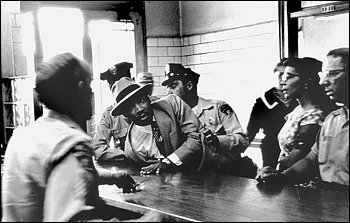
Birmingham, Alabama 1963 Photo by Charles Moore

Influential civil rights photographer Charles Moore died last week  in Florida. He was 79. His iconic images from the 50s and 60s, especially those of police, fire hoses and dogs attacking black protesters, were widely credited with changing the national mood and paving the way for civil rights legislation. Without his images appearing in Life magazine, the average American couldn’t really understand what was going on. His impact can probably not be overstated.

In Birmingham when I saw the dogs I don’t think anything appalled me more, and I’ve been to Vietnam,” Mr. Moore told the New York Times in 1999. “I photographed it, and the world rushed in. I realized the power of even one image. . . . What changed was my awareness. I wanted to show how awful, how vulgar, how terrible this whole thing was.”

For more, read the Washington Post tribute and watch the BBC slide show.

Vignettes of Cuba

Called “Habana Vieja,” this is a pretty gorgeous video of Cuban life by Montreal filmmaker Van Royko.

From Vimeo

LA’s Shopping Carts, Reclaimed

Considering Shawn’s history and peculiar interest in abandoned shopping carts (he is known as discarted), this project is one we can definitely appreciate. Visual designer Ramon Coronado created the Mercado Negro (“black market”) collection with the purpose of reclaiming an everyday object and giving it another purpose. Coronado also says it’s a comment on the shortage of recreational spaces in LA. He explains:

Shopping carts exist everywhere and anywhere throughout the city of LA and include themselves as part of LA’s landscape. A shopping cart says a lot about a city. Seeing one on every block adds attention to the poverty and that there is no control of private property.

Read more about Mercado Negro here.

And, hey, why don’t you join the discarted group on Flickr while you’re at it?


Spam Blocked