Posts Tagged 'first amendment'

ACLU Bad, Newark Police Good

In a recent article on the Newark Star-Ledger site, George Berkin, a contributor to something called “NJ Voices,” writes on the case of Newark teen Khaliah Fitchette who was unlawfully detained in March 2010 for taping a medical emergency on a city bus with her cell phone. During the incident, Fitchette was handcuffed, her cell phone was seized and the video was deleted, and the police tried to charge her with obstruction of justice. Last week, the ACLU filed a lawsuit in federal court on her behalf.

Berkin is a big fan of the bible and Sarah Palin but not of abortion and evolution. So if you want to take a wild guess on where he’ll come down on the issue, go ahead. If you’re stumped, for Berkin, it all comes down to being thoughtful.

A thoughtful person would have realized, “Now I understand why the police, angered by my defiance expressed by my refusal to stop taping, would have handcuffed me. I certainly did not enjoy being handcuffed and being held in custody for several hours. But,” a thoughtful person would have concluded, “I certainly brought that unpleasantness upon myself.”

Fitchette wasn’t being thoughtful when her rights were violated, and she should just learn some thoughtfulness and not attempt to tape anything in public because it might hurt someone’s feelings, and if she is unlawfully detained and her constitutional rights are violated because of her thoughtless behavior, she should accept that and not participate in the ACLU’s vendetta against the Newark police department. (A police department, mind you, that has a well-earned reputation as one of the most corrupt in the nation.)

Here’s an interesting twist for Berkin, who hates government spending: Lawsuits like these cost taxpayers A LOT of money. And they are entirely avoidable.

Source: Newark Star-Ledger

New Haven Police: Go Ahead, Record Us

The New Haven Police Department is re-training its force in accordance with a new policy, General Order 311. That policy states that cops can no longer arrest citizens for recording them in public. The caveat is that recording is permitted as long as it doesn’t interfere with police activity or jeopardize anyone’s safety, and you might think that would be abused. But, the order addresses that issue:

“The video recording of police activity in and of itself does not constitute a crime, offense, or violation. If a person video recording police activity is arrested, the officer must articulate clearly the factual basis for any arrest in his or her case and arrest reports.”

And as Assistant Chief Tobin Hensgen, who lead a training session (see above video), said:

“If a citizen wants to exercise his First Amendment rights and photograph you while you’re in a squad car and uniform or on detail while you’re performing your duties, as long as they’re legal, you have no expectation of privacy.”

The policy was initiated by Police Chief Frank Limon after a rash of incidents over the past year involving citizens and recording, where police clearly abused their authority. The New Haven Independent was a champion of the cause, and this is an impressively swift reaction by the police if you want to look at it optimistically.

Or, as a commenter put it: “Breaking News Flash—Cops ordered to Not arrest someone who is NOT breaking the law.”

Source: New Haven Independent

Duane Kerzic Suing Homeland Security

You might remember Duane Kerzic as the photographer who was detained and cited for trespassing in 2008 by Amtrak police for taking pictures inside New York’s Penn Station while participating in Amtrak’s annual photo contest, “Picture Our Train.” Kerzic was later vindicated by an undisclosed financial settlement and an appearance on “The Colbert Report,” and now he’s a plaintiff in a federal lawsuit challenging the constitutionality of the U.S. Department of Homeland Security’s laptop search policy at the border.

According to NPPA:

In July 2007, Kerzic was returning to the United States from a trip to Canada where he’d been photographing lighthouses and national parks for a story. He was riding his motorcycle and his laptop and camera gear were in his saddlebag when he arrived at the Customs and Border Protection inspection point at the Thousand Island border crossing. When agents asked him where he was going and then referred him to secondary screening, he was asked to wait inside a building while his motorcycle and saddlebag remained outside. Kerzic could see CBP agents going through his belongings outside, and in a few minutes a CBP agent came into the building with Kerzic’s laptop in his hands.

After looking through the photographer’s laptop for about 15 minutes, Kerzic was permitted to leave and to enter the United States.

The policy authorizes US Customs and Border Protection agents to conduct suspicionless searches on U.S. citizens’ electronic devices at international borders and then copy and distribute the devices’ contents (even after the individual is permitted entry into the United States). And that, needless to say, is deeply concerning to journalists who rely heavily on protecting their sources from disclosure and possible retribution to do their jobs.

As a First Amendment concern NPPA’s lawyer, Mickey H. Osterreicher, believes that “government officials’ unfettered ability to search journalists’ laptops and other electronic devices will have a chilling effect on their ability to gather and disseminate the news once it becomes widely known that any information they gather may be subject to search and seizure without probable cause or reasonable suspicion.”

“This will directly impact their ability to provide confidentiality to their sources,” Osterreicher said. “One can only imagine the added difficulty, if not impossibility, for journalists to conduct interviews, report on foreign relations or cover stories involving allegations of corruption when news sources believe that the information gathered abroad may be reviewed, copied and shared by agencies of the government without any of the normally guaranteed Constitutional protections.”

More important, these DHS policies not only impact journalists, but all Americans.

“Allowing government officials to look through American’s most personal materials – the things we store in our laptops, cameras, and cell phones – without reasonable suspicion is unconstitutional and inconsistent with American values, and a waste of limited resources. It doesn’t make us ‘safer’. Instead it ‘builds a bigger haystack’ and diverts resources away from proven law enforcement methods.”

The lawsuit, which was filed on behalf  of the National Press Photographers Association, the American Civil Liberties Union, New York Civil Liberties Union, the National Association of Criminal Defense Lawyers, graduate student Pascal Abidor, and Duane Kerzic as plaintiffs against Janet Napolitano, the U.S. Department of Homeland Security head, argues that Americans do not relinquish their constitutional rights when they decide to travel outside the United States, i.e., protection from unreasonable searches and seizures that are protected by the Fourth Amendment.

Source: NPPA Joins Federal Lawsuit Challenging Constitutionality of DHS Laptop Search

Filming Chicago Police OK, Audio Not

NPR did a piece this morning on Chicago artist Chris Drew, who’s made it his mission to make sure the First Amendment works. What started as an act of civil disobedience — Drew is a crusader for free speech and wanted to test laws regarding where artists can sell their work — turned into a felony charge for illegal eavesdropping. It turns out he had recorded his arrest and in Illinois it’s illegal to record conversations without consent of all parties.

The Chicago police union claims, if you can believe this, that recordings like these could inhibit officers from doing their jobs. Or…if they do their jobs professionally and competently, if they happen to be recorded, an audio recording would make absolutely. No. Difference.

“The general theme that drifts through these cases is very clear,” [Illinois ACLU lawyer Harvey] Grossman says. “Law enforcement, in these instances, is rebelling and is refusing to allow public scrutiny of their behavior. And they are using the eavesdropping statute as a weapon against civilians.”

On August 18, the Illinois ACLU filed a federal lawsuit challenging this law.

Story from NPR

The United States vs. Photography

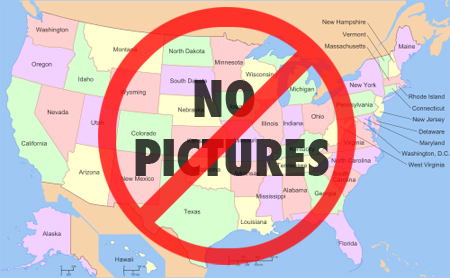
Starting this week we will begin an in depth look at how each of the 50 United States perceives photography by looking at each state’s Department of Homeland Security web page. We will start with Alabama and then move to Alaska. From there, we’ll continue alphabetically through all 50 states, compiling them in our list, “The United States vs. Photography.”

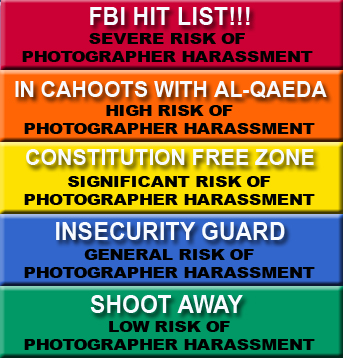
The process should take a couple of weeks to complete, and each state will be graded using our own Photography Advisory System, which is a parody system based on the U.S. Department of Homeland Security’s Homeland Security Advisory System. But rather than using our system to manufacture terror and instill fear in the public, we will do the opposite, and use our system to show how paranoid our government is when it involves people taking photos in public.

We also hope that our research will help advise photographers and tourists on which states are not friendly to them. We don’t want anyone unlawfully detained, harassed or arrested for exercising their First Amendment rights within a state that will happily take your money but not respect your constitutional rights.

Armed But Not Dangerous


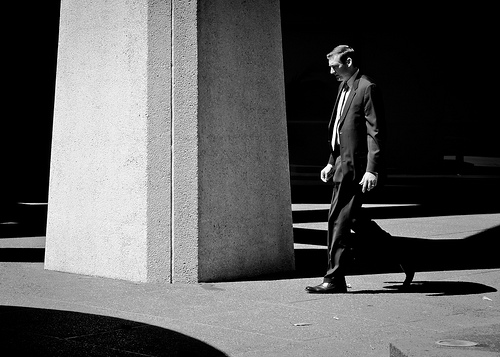
Photo by Justin.Beck

Wouldn’t it be a shame if pictures like this weren’t possible because of ignorant security guards? The photographer of this shot at the Transamerica Building in San Francisco was harassed by a guard who was “concerned” by his presence — on the public sidewalk — and made a point of bringing a camera out to take photos of him. (The subject of the photo is another member of the security staff.)

In a recent post, the New America Foundation’s Media Policy Initiative blog cautions about the dangers of letting fear and security concerns, however real or imagined, overshadow First Amendment protections.

But in the modern information society, the camera is not a weapon; on the contrary, it’s increasingly the main tool of citizen journalists in their effort to spread information. The easiest way that an average person can contribute to the news ecosystem—one of the prime opportunities for civic engagement—might be to take just one picture.

New Rule Blocks Press From Covering Spill

A new rule went into effect last Thursday that bars journalists, reporters and photographers from getting within 65 feet of the oil-soaked beaches, wildlife and booms in the Louisiana Gulf. What does this mean for news coverage going forward? Oh, just that it’ll be really, really sanitized. We’ll no longer see those heartbreaking/maddening photos of sad birds drenched in oil or booms sitting uselessly in marshlands.

Violators could face a fine of $40,000, a felony charge and one to five years in jail. The Coast Guard’s point man Thad Allen says it’s not unusual at all to establish these kinds of safety zones. Hmm…but it does seem unusual to establish this zone on day 73 of the worst oil spill disaster in US history — after nearly three months of futile efforts that are only working toward making BP and government officials in charge of this clean-up look evermore incompetent. It’s so blatantly self-serving, it’s hard to believe they think we’re that dumb. But they’ll get away with it, so I guess we are that dumb.

Anderson Cooper is pissed — as we all should be! He makes a good case for transparency above, saying a rule like this “makes it very easy to hide failure and hide incompetence.” We have a right to see how this spill is unfolding. This is the system of checks and balances — and we need it; it works quite well in disasters like these. Write your representative. Demand they abolish this rule. Don’t take this one lying down.

Read more about this story on Slate, The Raw Story and The Huffington Post.

Photographers, Police & the Law

Photo by discarted

Al Tompkins of Poynter.org puts out an incredibly useful daily tip sheet of ideas and issues called “Al’s Morning Meeting” that journalists can then localize and adapt for their own communities. In response to the recent Gizmodo article, “Are Cameras the New Guns?“,  he interviewed Robb Harvey and Richard Goehler, two lawyers specializing in media issues, about the tension between law enforcement and photographers. It’s an excellent interview with a lot of salient points about photographers’ rights.

Al Tompkins: Are you seeing any new sensitivity by police to being photographed/videotaped?

Robb Harvey: The police have always been sensitive to accusations of wrongdoing or overreacting. I believe they are reacting to emerging technologies that allow millions of people to record events in real time, so we are likely to see more postings claiming misconduct and more efforts by police to prevent those postings.

The recent prosecutions mentioned in the Gizmodo article involved participants in the police action — persons being arrested or later charged. The video they have taken may be their best defense to the charges. Is the next step that law enforcement can prosecute recordings by bystanders? If that were the case, the widely disseminated video of the assault on Rodney King might never have seen the light of day.

Media organizations must remain vigilant and work to prevent the application of these laws in an unconstitutional way.

Richard Goehler: I would not say that I have seen any “new” sensitivity by law enforcement or firefighters here. In the past, I have heard about instances where police might confiscate or threaten to take a camera or recorder, but I would not call it a major newsgathering problem or interference.

I found the Gizmodo article very interesting. It seems to me that most of the cases highlighted in the article involved circumstances in which the videotaping or recording was of alleged abuse and/or improper conduct by the police. As a result, the police appeared more aggressive and more motivated to take action concerning the videotaping.

Often it appeared that the actions by law enforcement were in direct retaliation for the videotaping that had taken place. It was also interesting that these cases all took place in states or jurisdictions that have “two-party consent” statutes that let police officers make the argument that they had not consented to the videotaping.

Another interesting point about the cases in the article is that none of them involved traditional/mainstream media companies/reporters/videographers in their news gathering efforts. My sense is that law enforcement, even in a “two-party consent” state or jurisdiction, would be very cautious about trying to pursue claims like this against the media because doing so would surely bring a huge amount of attention and publicity with plenty of amicus support from other media organizations and journalism groups like the Reporters Committee for Freedom of the Press and the Society of Professional Journalists.

Read the whole article on Poynter.org

Judge Rules In Favor of Photog

Hey, guess what? It turns out the police are not allowed to seize a photojournalist’s camera, which we all knew but, still, sometimes these things have to go to a higher court so we can double-check. On Friday, a judge ruled that a search warrant used to review David Morse’s photos from a December 2009 UC Berkeley protest was invalid.

While covering the protest for IndyBay, Morse was arrested, along with seven others, and charged with assaulting a police officer and vandalism among other things. A few days later, all the charges were dropped and Morse’s camera was returned, but his storage devices never were. The university was also ordered to return all of Morse’s photos on Friday.

From the San Francisco Chronicle:

Morse was covering the demonstration outside Chancellor Robert Birgeneau’s campus residence for the San Francisco Bay Area Independent Media Center, also known as Indybay. Morse repeatedly identified himself as a journalist before he was arrested by campus police, which obtained a search warrant to look at his photos before he was released on bail, according to the First Amendment Project.

Score one for the constitution (and the First Amendment Project).

Article from San Francisco Chronicle and IndyBay

Chevron Forces Documentarian to Spill

In an effort to defend itself in a $27.3 billion lawsuit, Chevron is trying to get 600 hours of raw footage from the filmmaker behind the 2009 documentary “Crude.” The lawsuit involves 30,000 Ecuadoreans who are suing Chevron for polluting a big chunk of the Amazon rainforest through drilling and dumping, and the documentary covered the ongoing fight.

The “Crude” filmmaker was fighting the request, citing the First Amendment and journalist privilege, but a judge overruled him last week and is allowing Chevron to subpoena their footage. Documentarians and filmmakers are worried the case sets a dangerous precedent. Michael Moore weighed in, claiming the ruling would amount to a chilling effect on whistleblowers. Ric burns told the New York Times that the decision “contributes to a general culture of contempt for investigative journalism.”

The result, he said, would be that “next time, there won’t be a ‘Crude.’ There won’t be a film. That’ll be good for Chevron, I guess. Because the next time you go, you’re going to have a much leerier group of informants.”

Article from New York Times (via The Click)


Spam Blocked