Posts Tagged 'anti-terrorism measures'


“Security Theater” – We’ve Got a Front Row Seat

64365384_0c98675fed
Photo by Thomas Hawk

Bruce Schneier is a cool head and a voice of reason when it comes to security and terrorism, and he has been outspoken on the issue of photographers’ rights. In his recent essay for the NewInternationalist, Schneier makes some salient points as usual. 

“Security theater” is the term Schneier uses to refer to measures that essentially make the public and government feel good but do little to actually prevent an incident. He writes:

An example: the photo ID checks that have sprung up in office buildings. No-one has ever explained why verifying that someone has a photo ID provides any actual security, but it looks like security to have a uniformed guard-for-hire looking at ID cards. Airport-security examples include the National Guard troops stationed at US airports in the months after 9/11 — their guns had no bullets. The US colour-coded system of threat levels, the pervasive harassment of photographers, and the metal detectors that are increasingly common in hotels and office buildings since the Mumbai terrorist attacks, are additional examples.

That makes perfect sense. When law enforcement and security guards harass photographers shooting in public places, it’s not like they’re really deterring terrorists or uncovering any plots, it just makes them feel like they’re doing their part in fighting a very intangible, nebulous enemy. 

And in a larger, big-picture sense, these misguided tactics work toward eroding our civil liberties and making us all feel a little less free than we were before. So in essence, this decision to criminalize very mundane, previously acceptable things (street photography, shampoo bottles on airplanes, etc.), it is us, the American people, who bear the brunt of the war on terror and find our lives are less pleasant and free than they were before. Joe Schmo Terrorist in Syria or wherever? He’s doing just fine.

And by the way, the best way to combat terrorism? Schneier says the most effective defenses are those you won’t even see in your day-to-day life: “investigation, intelligence, and emergency response,” and beyond that, it’s really about “our social and political policies, both at home and abroad.”

Schneier reminds us that the best way to deal with our new way of life, this all-consuming fear of terror, is not to overreact. As he says, terrorism is actually very rare. Don’t give into the hype, the hysteria, the suspicion lurking around the corner. It’s just not worth it and does nothing toward keeping us safe.

Read the whole piece on his blog: Schneier on Security.
Who’s Watching You? Oh Yeah, Everyone Is

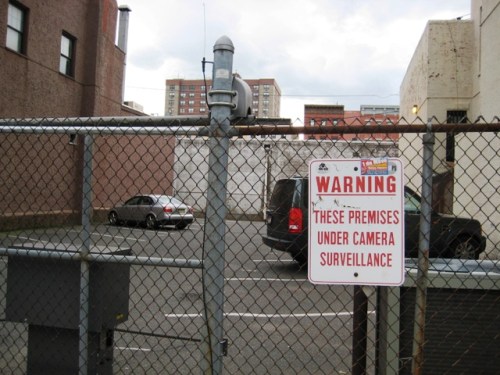
surveillance sign
Hoboken, NJ Photo by let ‘er rip

In so many ways Americans – gladly, willingly – gave up their personal freedoms in the aftermath of September 11. One of those ways is that we now live under surveillance, pretty much everywhere and all the time. Photographer Richard Gordon set out to document the prevalence of surveillance cameras over five years, from 2003 to 2008, in his new book American Surveillance. With photos of security cameras on ceilings and street lamps, in museums and malls, Gordon found there’s precious few places that you’re not being filmed.

The Epoch Times reported on Gordon’s book signing at the University of California, Berkeley recently where he talked about his project – and how he found camera in cities like Chicago and New York, but also suburban malls and rural areas. In one San Francisco mall’s parking structure, he counted 130 cameras. 130! (Do you ever notice how when someone goes missing, like that recent Yale graduate student, there is almost always surveillance footage of them?)

Gordon’s book is a really interesting comment on our times – and a multi-layered issue at that. In terms of street photography, you think, how can anyone object to their photo being taken when it’s taken probably thousands of times a day already? In terms of photographers’ rights, is it fair that certain government and private buildings outlaw photography but are constantly photographing you? And are you fine with your Google searches, emails, grocery store purchases, errands and financial records being tracked in the name of security?

And you might say, “What do I care? I’m a law-abiding citizen, it doesn’t affect me.” But I think the larger issue is that a culture of surveillance breeds a culture of fear, which is very apparent in the US with the accusations of terrorism in very innocuous situations, like with photographing skyscrapers and subway cars. We give up a lot of our innocence when we always suspect the worst of everyone around us.

Article via The Epoch Times

Homeland Security Renews Photography Suspicion

0382A012Critical infrastructure. Photo by discarted

Homeland Security head Janet Napolitano told reporters last week that we all need to be aware and on the lookout for terrorists on the prowl, and that means calling in photographers “continually taking photographs of a piece of critical infrastructure that doesn’t seem to make any sense.” Jeesh, way to set us back, oh, about eight years, Janet. I feel like I’m having flashbacks to a different administration.

Just when it looked like there was a little progress, with Amtrak and the NYPD revising or clarifying their policies – now, law enforcement has a renewed mandate to harass photographers who “continually” shoot, say, their local ports or skyscrapers. I can just see the cop or security guard who finds that type of photography just “doesn’t make sense.”

Article from PDNPulse

Read the National Press Photographers Association response here

In the Name of Terrorism, More Fear in London

street_chemicals_poster

street_chemicals_cctv

It’s been a good week for paranoia-inducing ad campaigns. London has rolled out its latest counter-terrorism posters, which feature, among others images, a full trash can and a security camera with the message that people need to report on their neighbors and fellow citizens when things seem off. This is in addition to the posters released earlier that specifically targeted photographers and cell phone users.

Incidentally, a three-year study released in February found that the anti-terror methods employed in places like the US and the UK are illegal and counter-productive. While the study specifically referred to the detainment and torture of terrorism suspects, I think it can be applied to the overall climate for so-called “suspicious” activity, including photography. Our leaders not only don’t have a problem with using our fear to implement measures that are not legal or ethical, they are relying on it as a tool of governance.

“Many governments, ignoring the lessons of history, have allowed themselves to be rushed into hasty responses to terrorism that have undermined cherished values and violated human rights,” said the chairman of the study’s panel of legal experts.

To boil it all down, it just seems so incredibly ham-handed. Do people need to be reminded to report something they feel is suspicious? And why do our governments need to fight the the nebulous beast that is international terrorism by impairing their own peoples’ quality of life? 

Article via Boing Boing


Spam Blocked