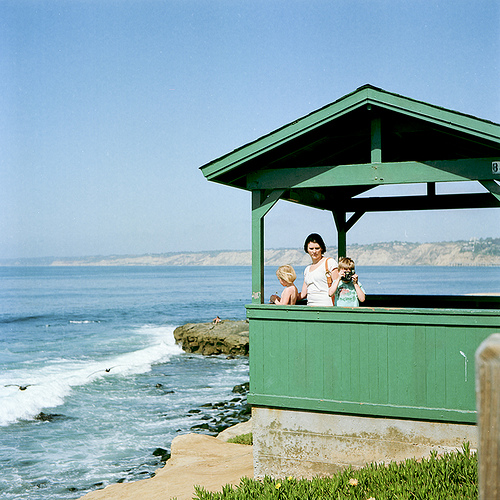
Photo by Brian Auer
Archive Page 99
California Coasting
Published April 5, 2009 Photographers' Rights Leave a CommentTags: beach photo, Brian Auer, California, Flickr, La Jolla
Photo by Brian Auer
The Annenberg Space
Published April 3, 2009 Photojournalism Leave a CommentTags: Annenberg Space for Photography, Los Angeles
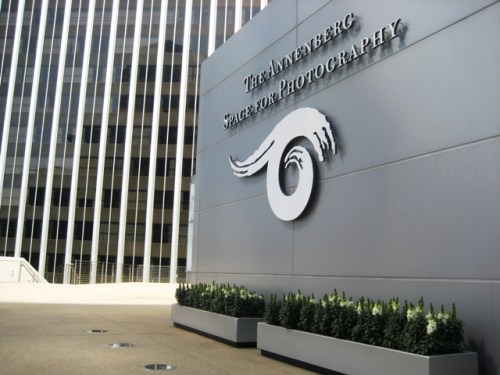
We finally made it to the Annenberg Space for Photography in Century City this week. Just a week old, the Space’s mission is to be a community center that showcases both digital and print photography — a sort of heavenly high-tech hang-out for fans of the art form.
The venue itself is sleek: all clean lines and modern design, with fresh white flowers in vases and multiple flat screens relaying image after striking image. The current exhibit is called L8S ANG3LES, and it features the work of 11 photographers with varying styles: John Baldessari, Julius Shulman, Tim Street-Porter, Douglas Kirkland, Greg Gorman, Lauren Greenfield, Catherine Opie, Carolyn Cole, Lawrence Ho, Kirk McKoy and Genaro Molina.
Eleven photographers is a lot for the amount of space they have, and there wasn’t really enough of each photographer to give you a decent overview, or even introduction, though there were multiple videos running that offered more of each photographer’s work. We particularly liked Julius Shulman (awesome California architecture), Douglas Kirkland (amazing celebrity portraits) Genaro Molina (never heard of him but want to know more), Catherine Opie (though not the best representation of her work on display) and Carolyn Cole (powerful war/strife photography). (Lauren Greenfield? Still don’t get her.)
In the back there is a kitchen (presumably for parties) and a reference room with cool magazines and rare photography books (Helen Levitt, War by the VII agency and Falkland Roadby Mary Ellen Mark to name just a few), with a table where you can just sit down and read for hours if you wish. They’ll also be offering a regular lecture series and workshops (most of the current exhibit’s stars are coming to speak, including Douglas Kirkland and Carolyn Cole).

The location I have to say is not ideal, and one wonders why they chose a site that is nestled so deep within a corporate compound that’s anchored by CAA. The main drawback is the parking situation and the maze-like process you go through to find the Space. It’s not one of those places where if you have an hour to kill you’ll just drop by. It’ll probably take you half that time to park and find the place. But, alas — such is the price to pay for great, free photography.
A note about photography on the premises since there was a report recently about the overzealous CAA security guards harassing people: They don’t allow photography inside the Space, however you can take exterior shots and bring your camera inside with you. I was able to sneak the shot above, but I was politely asked not to take any in the area with the photography.
No Photography Allowed in Downtown Phoenix?
Published April 2, 2009 Photographers' Rights , Police Harassment 4 CommentsTags: Phoenix, Phoenix Police Department
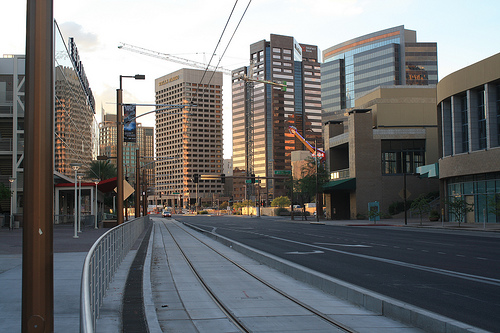
Photo by simax105
If a recent report is any indication, Phoenix seems to be even less evolved than Los Angeles when it comes to photography. Today the blog DowntownPhoenixJournal relays an incident where two amateur photographers were harassed and berated by a police officer, who basically told them they weren’t allowed to take photos of pretty much anything in Phoenix.
The photographers made the mistake of photographing the light rail stop Central Station, which sparked the ire of this particular cop, who accused them of taking photos of a federal building (which happened to be in the other direction, but nevermind that). The list of prohibited subjects, he said, also included the light rail, bus stops, bank buildings, stadiums and street lights. When asked to clarify which statute he was enforcing, the police officer told them to Google it. (Far be it for the police to explain the law — that would be too much work, right?) Their detention was a Homeland Security issue, he said. (And that should be enough for us to just shut up and comply, dammit!)
After running their ID’s and telling them he’d be watching them, the police officer let the photographers go. Phoenix, thankfully, is still safe.
Read the full account here.
Helen Levitt — Eye on the Streets
Published April 2, 2009 Street photography Leave a CommentTags: Helen Levitt, NPR
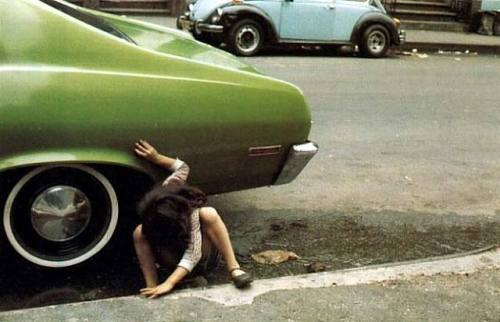
Photo by Helen Levitt, New York, 1980
Helen Levitt, the acclaimed New York street photographer, died last weekend at the age of 95. NPR did a nice retrospective piece on her this week where the reporter recalls two interviews she had previously done with her. At one point, the reporter asks Levitt what she thinks about a particular photo. Levitt says, “Just what you see.” When asked why it’s so difficult for her to talk about, Levitt says, “If it were easy to talk about, I’d be a writer. Since I’m inarticulate, I express myself with images.”
Listen to the whole piece here.
This is also a great book of her work.
Aerial Photo’s Views Skyrocket Thanks to Spellings
Published March 31, 2009 Photographers' Rights 5 CommentsTags: aerial photograph, Atwater Village Newbie, Flickr, Spelling Mansion

Photo by Atwater Village Newbie
When Candy Spelling put her Holmby Hills house on the market last week, a Flickr user saw his page views go through the roof. It just so happened that an LA photographer, who goes by Atwater Village Newbie (and runs a local blog by the same name), had been taking a helicopter tour about a year ago and spotted the extravagant mansion (also known as the “Spelling Manor” in pretentious-speak). He thought it’d make for a good photo. “The sheer size of the house caught my eye, of course, as did the idea of getting a rare peek into the backyards of the rich and famous,” he says.
It wasn’t until a fellow Flickr user commented that the house looked to be the Spelling mansion that AVN knew what an interesting shot he indeed had. With the real estate listing announcement, AVN released many of the rights of the photo under Creative Commons to encourage people to use it and link back to his work. The Flickr photo went from 9,000 views on the day of the announcement, March 25, to 39,000 views on March 29. About a third of the views came from this Daily Telegraph article out of Australia.
And if you’re interested in the Spelling abode, the most expensive residence in the U.S., it’s going for $150 million. Bad economy? Not for some!
Loading or Carb-Loading?
Published March 29, 2009 Photographers' Rights 85 CommentsTags: hollywood, hypocrisy, Los Angeles, parking enforcement, Vievu
With this post, we diverge from our central theme of photography and photographers’ rights to just peoples’ rights — that is to say, our rights as people to have our tax dollars well-spent and our city employees follow the very laws they enforce.
Case in point: this video, taken this past week in East Hollywood, where our dogged local parking enforcement officer uses the loading zone as a parking spot for her lunch break. This is the same parking officer who tirelessly drives up and down our neighborhood blocks all day long, looking for cars on the wrong side of the street on street cleaning days and in red zones and with expired meters.
Somewhere we missed it in the Los Angeles city code where parking enforcement officers don’t need to obey the law. Wow, what a job perk! If someone has a copy of that, please send it our way.
*Shot with the Vievu wearable recording device.
Under Water
Published March 29, 2009 Photojournalism 1 CommentTags: Dave Arntson, Fargo ND, flooding, Moorhead MN

Photo by Dave Arntson
Sometimes I feel bad for the parts of our country that experience a disaster (natural or otherwise) but don’t have the good fortune of being in New York or DC. There is a major city under water right now, but you barely hear about it.
Fargo, North Dakota’s biggest city, and its surrounding communities have been inundated by unprecedented flooding this past week. At one point the Red River peaked at 40.82 feet, more than 22 feet over flood stage. If that happened in midtown Manhattan, you better believe it would be the world’s greatest tragedy and the coverage would be unending. (And I lived in New York City for seven years and I love the place, but the melodrama gets to me.)
Photojournalist Dave Arntson posted a series of pictures on his web site this week which are worth taking a look at — they’re great photos of the scene in Fargo and neighboring Moorhead, Minn., but, at the bare minimum, they will make you feel thankful you’re dry.
In the Name of Terrorism, More Fear in London
Published March 25, 2009 Photographers' Rights , Police Harassment Leave a CommentTags: anti-terrorism measures, london, Metropolitan Police, surveillance, terrorism


It’s been a good week for paranoia-inducing ad campaigns. London has rolled out its latest counter-terrorism posters, which feature, among others images, a full trash can and a security camera with the message that people need to report on their neighbors and fellow citizens when things seem off. This is in addition to the posters released earlier that specifically targeted photographers and cell phone users.
Incidentally, a three-year study released in February found that the anti-terror methods employed in places like the US and the UK are illegal and counter-productive. While the study specifically referred to the detainment and torture of terrorism suspects, I think it can be applied to the overall climate for so-called “suspicious” activity, including photography. Our leaders not only don’t have a problem with using our fear to implement measures that are not legal or ethical, they are relying on it as a tool of governance.
“Many governments, ignoring the lessons of history, have allowed themselves to be rushed into hasty responses to terrorism that have undermined cherished values and violated human rights,” said the chairman of the study’s panel of legal experts.
To boil it all down, it just seems so incredibly ham-handed. Do people need to be reminded to report something they feel is suspicious? And why do our governments need to fight the the nebulous beast that is international terrorism by impairing their own peoples’ quality of life?
Article via Boing Boing
Eddie Adams – Iconic War Photographer
Published March 24, 2009 Documentary 3 CommentsTags: Eddie Adams, New Yorker, Vietnam, war photography
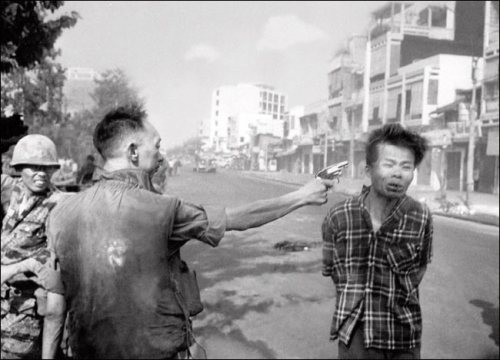
Photo by Eddie Adams/Associated Press
I’m not a great believer in the power of the moving image. A still image has greater lasting power. A still photographer has to show the whole fucking movie in one picture. On the screen, it’s over and back in the can in seconds. A still picture is going to be there forever. — Eddie Adams
If you haven’t been haunted by Eddie Adams’ photography, maybe you just didn’t know it was his. His most iconic image, of a South Vietnamese police chief executing a Vietcong suspect in 1968, won him a Pulitzer Prize and international acclaim. Adams hated being defined by that photo — and the responsibility that came with it. He got into celebrity portraiture when he returned from Vietnam.
In the new book “Eddie Adams: Vietnam,” Adams’ war photography is showcased, including 200 never-before-seen photos that his first wife found in her garage. (And a documentary on Adams, “An Unlikely Weapon,” will be released in April.)
In this week’s New Yorker, there’s a small piece on the gallery show in Brooklyn that coincides with the book’s release. In it, Chris Hondros, a photographer for Getty who’s logged many years in Iraq, comments on war photography then and now:
“That picture is almost a template of what a photographer tries to do in Iraq. At least so far, a truly iconic picture like that has not emerged.” He took one photograph, he said, that reminds people of Adams. “It’s a picture of a little girl. It was after a checkpoint shooting with U.S. soldiers. They shot up a car coming toward them, and it turned out it was just an Iraqi family. They killed the parents, who were in the front seat, and the children in the back survived.” Hondros’s picture shows the girl, one of the survivors, crouching at the feet of an American soldier and holding out her hands, which are covered with blood. “It ran all over the world,” he said. “I got a lot of e-mails—‘This picture is going to stop the war, just like Eddie Adams’s picture.’ This was in January, 2005. And that didn’t happen.”
Article via The New Yorker
Chicago to Give Security Guards More Power?
Published March 23, 2009 Security Guard Harassment Leave a CommentTags: Chicago, Chicago Police Department, citations, Mayor Richard Daley, security guards
In what has to be the king of bad ideas, Mayor Richard Daley of Chicago said a proposal to give private security guards the authority to write tickets might just be a good thing for the city.
The Chicago Tribune reports that two South Side alderman proposed the idea to allow the private armed security guards that patrol their districts to have ticket-writing authority for minor infractions, like loitering, graffiti and parking violations. They reason that that will free up the real cops to focus on violent crime.
“It’s not a bad idea,” Daley said. “The more police you have out there … I like the concept … it will help us.” Does Daley really understand the proposal? They are not proposing more police on the street. They’re proposing to give non-police more police-like authority.
In a city known the world over for its colossal corruption problem, giving what amounts to hourly contractors the authority to ticket whomever they see fit is rife with problems. Questions that immediately pop to mind…. Who are the security guards accountable to? Will they have additional training in law enforcement? What happens when the guy they’re trying to ticket for tagging pulls a gun?
It seems like, counter to the plan, you will see an uptick in violence and unrest coming from altercations with inexperienced guards and petty criminals, along with wrongful citations and claims against the city.
Thankfully the police union denounced the idea, and let’s hope the proposal doesn’t go far. In the Chicago Sun-Times, the Fraternal Order of Police’s Greg Bella said, “When you put somebody out there who does not know the job, it makes double work for us.”
While I am no fan of cops writing citations, I would much prefer to get one from them over a clueless power-tripping security guard with no real background in law enforcement. Can you imagine if these guys had that power?
Article from the Chicago Tribune and Chicago Sun-Times
 boywithgrenade.org
