Archive for the 'Photojournalism' Category


Famed Photographer’s Double Life

The Commercial Appeal in Memphis dropped a bombshell this week – that famed civil rights photographer Ernest Withers was also working for the FBI as a paid informant. Many people, including Withers’ family, expressed shock that the photographer could have been at the same time documenting the black community’s struggle and helping the government keep tabs on it. The Appeal was able to obtain more than 7,000 pages of documents that outlined Withers’ work for the FBI in the 1960s, including handing over photos and names of people involved in protest activities.

Known as the “original civil rights photographer,” Withers was on the front lines during some of the era’s seminal events, including the Emmett Till trial, the integration of Ole Miss and Martin Luther King’s assassination.

Withers’ actions are infuriating. As documentary photographers, we all know how difficult it is to earn someone’s trust and be allowed entry into their private lives. We are privileged when that happens. But when someone like Withers comes along, his behavior casts a looming shadow of distrust over all of us. If Withers were alive today he should be expelled from the profession and marked with a scarlet I—for informant. That way, everyone would know how much of a disgrace he his, despite his fascinating work.

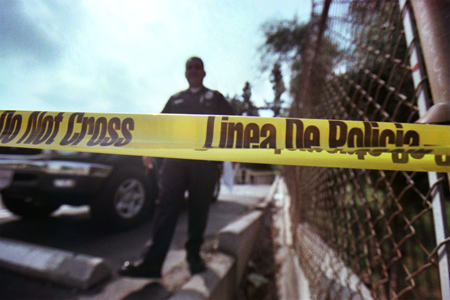
On a personal note, a few years ago I was on Sunset Boulevard and an LAPD officer asked me what I knew about some people I was photographing and if there was anything I would like to share with him. I told him I didn’t know anything. The cop then let out this dismissive chuckle and said, “Oh yeah?”, knowing that what I just said was absolutely not true. That’s all I said and walked away. Like most documentary photographers, I would never betray the people I photograph.

Articles from Commercial Appeal and AP
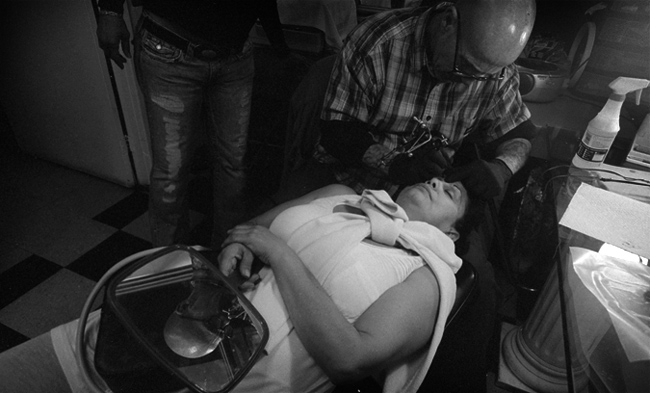
Tattoos By David

Photo by Shawn Nee / discarted

You a Sneakin’ Mutha…

discarted

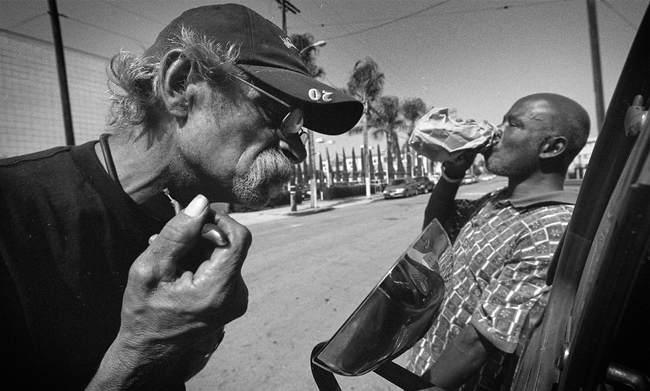
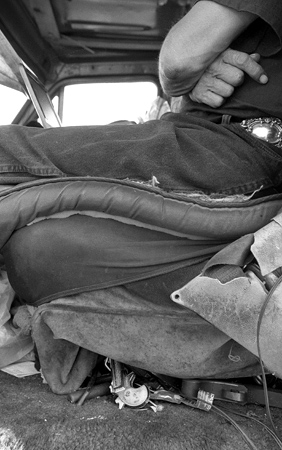
I sit in the driver’s seat of William’s truck as rush hour traffic collects just below us on the 101 freeway. It’s August and sweat collects on the back of my neck and arms as the first significant heat wave brings triple digits to Los Angeles. It’s so hot out that if you look at the pavement long enough, you can see the shadows of invisible nuclear vapors slithering across the sidewalk.

I’m bored and even more depressed, but can’t stop myself from coming here. I think about all of the things I’ve fucked up in my life. I think about my family that I’ve been away from for almost a decade. I think about my ex-girlfriend. I think about leaving L.A., so I can see my family and ex-girlfriend. I think about this prostitute I wanna photograph.

And then a cockroach pokes its body out from in between the bent pages of an 18 magazine that’s been dumped on the dashboard. It’s female and carrying eggs. I think about crushing it with my hand, but it zigzags across a collection of odd items and junk and then crawls into an empty Shasta can before I can make a decision. Growing up people would often say that a cockroach could survive the aftermath of an atomic bomb, but in Los Angeles, when you wake up in morning you can find dozens of them dead on the sidewalk.

I sit in the driver’s seat of William’s truck watching them, waiting for something to happen.

Me: That doesn’t hurt?

William: Fifteen yars locked up, whadda you think?

CLICK.

Joe: Ooh there he go again with that camera…sneakin’ mutha fucka takin’ my picture! Right when I’m takin’ a drink too! You a sneakin’ MUTHA FUCKA!

Williams shitty plastic razor scrapes across his neck. A drop of blood pokes through his skin.

Joe: WILLIAM! How come you don’t ever let me sit in the truck, but you let h-i-m?

Joe takes another big drink, consuming what’s left of his 211. He looks at me.

Joe: You still my boy.

Joe raises a tightened fist and pushes his arm through the driver’s window. I reciprocate and press my knuckles against a collection of open sores and wonder what diseases he might have.

The thought passes and the day drags on.

LAPD Sergeant Fires Away on YouTube

While YouTube is great fun for silly cat videos and clips of kids freaking out after the dentist, it’s also fertile ground for angry, arrogant, illiterate people. Exhibit A:

“your a dick ? what would u wanna video/pictures? a dead guy.. what the fuck are you gona do with the video of a dead guy.. get a life you fuking cunt,”

Interestingly, the comment was left by AbawiTariq, a sergeant with the LAPD, according to his YouTube profile.

Nothing but the best in Los Angeles. Seriously, Chief Beck – that is who you want representing your force?


Photojournalism Dead…Officially?

Photo agency director Neil Burgess knows how to kick a horse when it’s down. In an essay on the Editorial Photographers UK site, he writes on a grim topic – the end of photojournalism. In his 25-year career he’s watched the evolution of photography, from blossom to bust. And now, he sees “no photojournalism being produced.” Sure, there are still photos being taken to accompany stories, portraits commissioned, that sort of thing, but he claims media outlets “no longer fund photojournalism. They no longer fund photo-reportage. They only fund photo illustration.”

As everyone knows, media outlets just don’t have the money to fund serious, substantive photojournalism — they barely have money to fund the newsprint anymore. With the rise of citizen journalism and the democratization of cameras, there’ll be plenty of photos, to be sure. But, as Burgess says, “what about the guys who produce stories, who cover issues rather than events?”

It’s a digital world, we’re just living in it.

Read the whole essay on EPUK.org

Stupid Questions

discarted

I see something that I’ve never seen before. I bend down in the middle of the street as cars, attempting to avoid the bumper to bumper orgy on Western Avenue take a hard right down La Mirada Ave., and speed past behind me—their hot exhaust fumes graze my back. I’m invincible holding this camera.

Me: Is it loaded?

William (watching a movie): Boy, you ask some stupid questions.

I move my camera and crouch lower. My right knee cracks, and then the shutter as a Beamer lays on its horn and keeps going.

William: I got an M-16 too, but that’s buried in the back.

Earning Her Wings

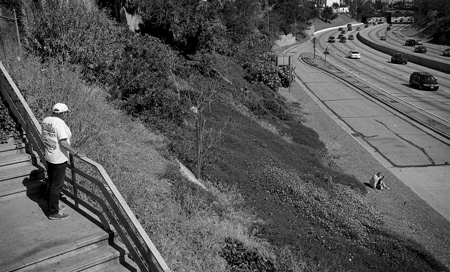
Tracy (high and inebriated): Mistah, you shouldn’t be down there. The cops are gonna come.

No response.

Tracy: Hey pal, get outta there…you’re gonna get killed!

Man (infuriated): WHY DO YOU THINK I’M DOWN HERE!!!

Tracy: Sir, you shouldn’t try to kill yourself.

Man (high on meth): I know.

Photos by Shawn Nee/discarted

British Police: “We don’t have to have a law”

British police have been told they shouldn’t harass professional or amateur photographers because – get this – it’s not an illegal activity, but those orders sometimes have a hard time reaching the rank and file. Or maybe it just becomes a lot more difficult if certain officers don’t have to follow things like “laws.”

On Saturday, freelance photographer Jules Mattsson, 16, was shooting an Armed Forces Day parade in Romford in London when he was harassed by officers who told him, among other things, that taking photos of children…and military…and police are all illegal.

How could that be? Where are those laws on the books? That’s what Mattsson thought, and when he tried in vain to assert his rights, he was told: “We don’t have to have a law.”

But Mattsson wasn’t your average pushover, so the officers resorted to stuff like telling him he was “in the way” and an “agitator” and a “threat under the terrorism act.”

The confrontation is priceless in its illustration of the hapless and ill-informed police officer who wants to throw his weight around just because he can. You can read a transcript on the Libertarian Party Members’ Blog here.

Article from The Independent and Jules Mattsson

Among Protests, 2 Photographers Arrested at G-20

UPDATE: Time has published “10 Scenes from the Battlefield,” a collection of fairly arresting images from the G-20 protests.

The G-20 Summit was underway this weekend and so were the arrests. More than 600 people were arrested, and the small northwest Toronto courthouse that was processing them was overwhelmed.

On Saturday, two National Post photographers were arrested while covering protests surrounding the summit. Brett Gundlock and Colin O’Connor were charged with obstructing a peace officer and unlawful assembly, held for 24 hours, and have since been released. They describe their crappy conditions in jail here (though, truth be told, it seems standard as jail goes).

While there were reports of violent and destructive rioters, many people reported being picked up for arbitrary or nonexistent offenses. Even two members of the Canadian Civil Liberties Association, a group that was monitoring civil right abuses at the protests, were arrested. As the National Post reported, the Canadian Civil Liberties Association weren’t pleased with how events unfolded:

“It would appear that the presumption of innocence has been suspended during the G20,” the group said, complaining of a “serious violation of basic rights of hundreds of people.”

The above video, the aptly named “The Battle of Toronto,”  was shot by YouTube user yfcandme, who says he was attacked by protestors while filming. Looking at the police presence it’s hard to believe it’s for an economic meeting and not World War III.

Article from National Post

Photographers, Police & the Law

Photo by discarted

Al Tompkins of Poynter.org puts out an incredibly useful daily tip sheet of ideas and issues called “Al’s Morning Meeting” that journalists can then localize and adapt for their own communities. In response to the recent Gizmodo article, “Are Cameras the New Guns?“,  he interviewed Robb Harvey and Richard Goehler, two lawyers specializing in media issues, about the tension between law enforcement and photographers. It’s an excellent interview with a lot of salient points about photographers’ rights.

Al Tompkins: Are you seeing any new sensitivity by police to being photographed/videotaped?

Robb Harvey: The police have always been sensitive to accusations of wrongdoing or overreacting. I believe they are reacting to emerging technologies that allow millions of people to record events in real time, so we are likely to see more postings claiming misconduct and more efforts by police to prevent those postings.

The recent prosecutions mentioned in the Gizmodo article involved participants in the police action — persons being arrested or later charged. The video they have taken may be their best defense to the charges. Is the next step that law enforcement can prosecute recordings by bystanders? If that were the case, the widely disseminated video of the assault on Rodney King might never have seen the light of day.

Media organizations must remain vigilant and work to prevent the application of these laws in an unconstitutional way.

Richard Goehler: I would not say that I have seen any “new” sensitivity by law enforcement or firefighters here. In the past, I have heard about instances where police might confiscate or threaten to take a camera or recorder, but I would not call it a major newsgathering problem or interference.

I found the Gizmodo article very interesting. It seems to me that most of the cases highlighted in the article involved circumstances in which the videotaping or recording was of alleged abuse and/or improper conduct by the police. As a result, the police appeared more aggressive and more motivated to take action concerning the videotaping.

Often it appeared that the actions by law enforcement were in direct retaliation for the videotaping that had taken place. It was also interesting that these cases all took place in states or jurisdictions that have “two-party consent” statutes that let police officers make the argument that they had not consented to the videotaping.

Another interesting point about the cases in the article is that none of them involved traditional/mainstream media companies/reporters/videographers in their news gathering efforts. My sense is that law enforcement, even in a “two-party consent” state or jurisdiction, would be very cautious about trying to pursue claims like this against the media because doing so would surely bring a huge amount of attention and publicity with plenty of amicus support from other media organizations and journalism groups like the Reporters Committee for Freedom of the Press and the Society of Professional Journalists.

Read the whole article on Poynter.org


Spam Blocked