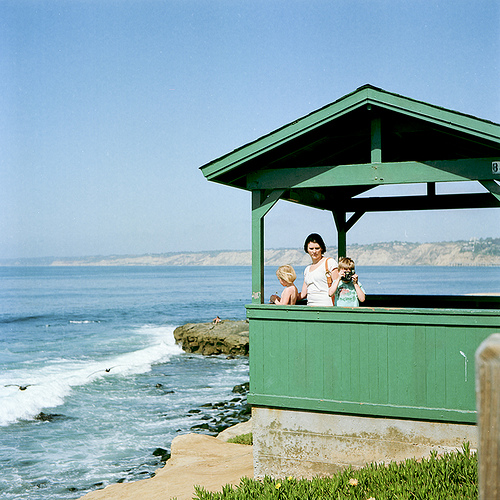
Photo by Brian Auer
Archive for the 'Photographers’ Rights' Category
California Coasting
Published April 5, 2009 Photographers' Rights Leave a CommentTags: beach photo, Brian Auer, California, Flickr, La Jolla
Photo by Brian Auer
No Photography Allowed in Downtown Phoenix?
Published April 2, 2009 Photographers' Rights , Police Harassment 4 CommentsTags: Phoenix, Phoenix Police Department
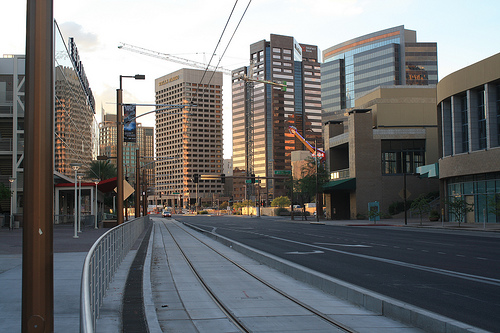
Photo by simax105
If a recent report is any indication, Phoenix seems to be even less evolved than Los Angeles when it comes to photography. Today the blog DowntownPhoenixJournal relays an incident where two amateur photographers were harassed and berated by a police officer, who basically told them they weren’t allowed to take photos of pretty much anything in Phoenix.
The photographers made the mistake of photographing the light rail stop Central Station, which sparked the ire of this particular cop, who accused them of taking photos of a federal building (which happened to be in the other direction, but nevermind that). The list of prohibited subjects, he said, also included the light rail, bus stops, bank buildings, stadiums and street lights. When asked to clarify which statute he was enforcing, the police officer told them to Google it. (Far be it for the police to explain the law — that would be too much work, right?) Their detention was a Homeland Security issue, he said. (And that should be enough for us to just shut up and comply, dammit!)
After running their ID’s and telling them he’d be watching them, the police officer let the photographers go. Phoenix, thankfully, is still safe.
Read the full account here.
Aerial Photo’s Views Skyrocket Thanks to Spellings
Published March 31, 2009 Photographers' Rights 5 CommentsTags: aerial photograph, Atwater Village Newbie, Flickr, Spelling Mansion

Photo by Atwater Village Newbie
When Candy Spelling put her Holmby Hills house on the market last week, a Flickr user saw his page views go through the roof. It just so happened that an LA photographer, who goes by Atwater Village Newbie (and runs a local blog by the same name), had been taking a helicopter tour about a year ago and spotted the extravagant mansion (also known as the “Spelling Manor” in pretentious-speak). He thought it’d make for a good photo. “The sheer size of the house caught my eye, of course, as did the idea of getting a rare peek into the backyards of the rich and famous,” he says.
It wasn’t until a fellow Flickr user commented that the house looked to be the Spelling mansion that AVN knew what an interesting shot he indeed had. With the real estate listing announcement, AVN released many of the rights of the photo under Creative Commons to encourage people to use it and link back to his work. The Flickr photo went from 9,000 views on the day of the announcement, March 25, to 39,000 views on March 29. About a third of the views came from this Daily Telegraph article out of Australia.
And if you’re interested in the Spelling abode, the most expensive residence in the U.S., it’s going for $150 million. Bad economy? Not for some!
Loading or Carb-Loading?
Published March 29, 2009 Photographers' Rights 85 CommentsTags: hollywood, hypocrisy, Los Angeles, parking enforcement, Vievu
With this post, we diverge from our central theme of photography and photographers’ rights to just peoples’ rights — that is to say, our rights as people to have our tax dollars well-spent and our city employees follow the very laws they enforce.
Case in point: this video, taken this past week in East Hollywood, where our dogged local parking enforcement officer uses the loading zone as a parking spot for her lunch break. This is the same parking officer who tirelessly drives up and down our neighborhood blocks all day long, looking for cars on the wrong side of the street on street cleaning days and in red zones and with expired meters.
Somewhere we missed it in the Los Angeles city code where parking enforcement officers don’t need to obey the law. Wow, what a job perk! If someone has a copy of that, please send it our way.
*Shot with the Vievu wearable recording device.
In the Name of Terrorism, More Fear in London
Published March 25, 2009 Photographers' Rights , Police Harassment Leave a CommentTags: anti-terrorism measures, london, Metropolitan Police, surveillance, terrorism


It’s been a good week for paranoia-inducing ad campaigns. London has rolled out its latest counter-terrorism posters, which feature, among others images, a full trash can and a security camera with the message that people need to report on their neighbors and fellow citizens when things seem off. This is in addition to the posters released earlier that specifically targeted photographers and cell phone users.
Incidentally, a three-year study released in February found that the anti-terror methods employed in places like the US and the UK are illegal and counter-productive. While the study specifically referred to the detainment and torture of terrorism suspects, I think it can be applied to the overall climate for so-called “suspicious” activity, including photography. Our leaders not only don’t have a problem with using our fear to implement measures that are not legal or ethical, they are relying on it as a tool of governance.
“Many governments, ignoring the lessons of history, have allowed themselves to be rushed into hasty responses to terrorism that have undermined cherished values and violated human rights,” said the chairman of the study’s panel of legal experts.
To boil it all down, it just seems so incredibly ham-handed. Do people need to be reminded to report something they feel is suspicious? And why do our governments need to fight the the nebulous beast that is international terrorism by impairing their own peoples’ quality of life?
Article via Boing Boing
Pre-Olympic Fear and Paranoia in Vancouver
Published March 22, 2009 Photographers' Rights , Police Harassment 4 CommentsTags: Canada, Olympics, TransLink, Vancouver

Photo by cabbit
It seems Canadian authorities want to get in on the action of harassing photographers.
According to the CBC, an advertising campaign was launched in Vancouver in advance of the 2010 Winter Olympics to encourage citizens to be more vigilant about possible terrorism. With the tagline “Report the suspicious, not the strange,” the ads can be seen in TransLink stations throughout the city. The problem is, the campaign is essentially spreading suspicion and fear of cameras.
As Richard Smith, who is a communications professor at Simon Fraser University, says in the article, “You’re asking people to make judgments about others’ behaviour. What makes something suspicious — is it the clothes I wear, the colour of my skin? How far do we go down that path?” Exactly. Your offbeat architecture photographer could be my fundamental terrorist on a mission.
Encouraging awareness is great, and I have no problem with that. However, ad campaigns like this are specifically targeting photographers and thereby criminalizing them. I don’t worry so much about the citizens’ reaction, but I do think this legitimizes law enforcement’s wanton and unwarranted harassment of photographers.
How much do you want to bet photographers on Vancouver’s public transit system are going to encounter a lot of problems in the coming year? (Keep us posted.)
Article via CBC
Don’t Mess With Texas…Cops
Published March 15, 2009 Photographers' Rights , Photojournalism , Police Harassment Leave a CommentTags: Action 4 News, journalist arrested, Mission Texas, Victor Castillo
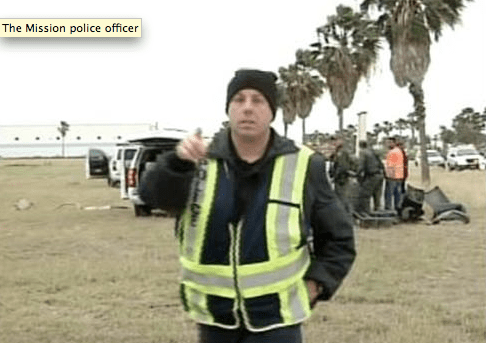 Image from Action 4 News
Many police officers don’t engender respect because they don’t treat people with it. Time and time again this happens, and the scenario is always the same. A reporter who is doing his job and doesn’t kowtow to a cop’s demands then gets arrested. The charges are invariably “resisting, ” “obstructing a peace officer” or “interfering with public duties.”
The latest case of police abuse of power comes out of Mission, Texas, where Action 4 News reporter Victor Castillo was arrested this past Thursday while videotaping a crime scene. In the video, Castillo had a minor confrontation with Officer McCrea of the Mission Police Department — actually more more like an exchange of words — and it seems that McCrea didn’t feel like Castillo was being sufficiently deferential so he arrested him.
Just because officers have the ability to arrest anyone they feel like doesn’t mean they should. How about practicing some restraint sometimes? I would imagine dealing with confrontation is a key part of the job description.
If I were a betting man, I would put my money on all charges being dropped and Castillo filing a lawsuit against McCrea and the Mission Police Department for violating his 1st Amendment rights and for being unlawfully arrested.
On the other hand, I wouldn’t put anything on McCrea being disciplined for his actions. That’s just not how it works in this country. Cops like McCrea can break the law and keep their jobs, but it’s the taxpayers who pay for their crimes.
To voice you concerns contact Chief Leo Longoria of the Mission Police by clicking here.
Article via ValleyCentral.com
Thou Shalt Not Lie: Police Arrest Priest, Falsify Report
Published March 13, 2009 Photographers' Rights , Police Harassment Leave a CommentTags: Connecticut, East Haven Police Department, Father James Manship, New Haven, Officer David Cari, racial profiling
In a case much larger than photographer’s rights, possibly involving police harassment and racial profiling, a Connecticut police force’s alleged racist agenda surfaces with the arrest of a priest who tried to videotape an incident at a Latino market. While it’s a classic cop vs. perp scenario, one thing is clear – the officer’s report doesn’t match the videotape.
Father James Manship went to the Ecuadorean-run My Country Store in February to document the ongoing harassment of immigrants in the New Haven area. The police were there to confiscate the collection of license plates the owner had on his wall, but it was Father Manship who was arrested and charged with disorderly conduct and interfering with police.
In the police report he filed – which only surfaced two weeks later – Officer David Cari of the East Haven Police Department claims he didn’t know what the priest had in his hands, calling it an “unknown shiny silver object.” He says he felt unsafe. “Not knowing if Manship was holding a camera or a possible weapon,” he writes, he asked the priest to reveal what he was holding and he wouldn’t.
However, in the footage that Father Manship shot, Officer Cari clearly sees the camera and says, “Sir, what are you doing? Is there a reason that you have a camera on me?” To which Manship responds, “I’m taking a video of what’s going on here.” (Cari was probably counting on the footage never seeing the light of day and his abuse of power would go unnoticed – as so many likely do.) You can read the whole fictionalization – I mean, report here.
So who are we to believe? Father Manship, a Catholic priest who has devoted his life to helping his immigrant parishioners, or another entitled cop who was finally caught because of his own recklessness?
I’m sure you’ve all heard the phrase “the videotape doesn’t lie.”
Article via the New Haven Independent
Copyright Infringement vs. Artistic Freedom
Published March 12, 2009 Photographers' Rights Leave a CommentTags: AP, copyright infringement, intellectual property, Obama Hope poster, Shepard Fairey
In this clip, Shepard Fairey, artist of “Hope” poster fame, defends himself against the AP’s allegations that he stole the image on which the obsequious illustration was based. (For background, you can see our post from early February.)
Fairey, who seems to have never met a copyright he didn’t want to infringe, claims these type of lawsuits will hinder artistic expression. While he believes in intellectual property, he says, “Is it really fair for the AP to send a ripple of fear out to that entire community [of politically themed artists] that they will not make art for fear of having, you know, congress coming after them for copyright law? … This is something that I need to fight just for the sake of artists in general, not just for me.”
I am torn. On the one hand, the photographer deserves his due. But the AP asking for damages seems excessive – can’t they prove their point with him paying the original licensing fee? It’s a slippery slope, as they say. If the AP doesn’t defend its copyrights, especially in such a high-profile case, then does everyone have free reign to take photos and manipulate them as they see fit?
Does it matter?
Online Maps Now, Street Photography Next?
Published March 11, 2009 Photographers' Rights , Street photography 4 CommentsTags: California, Google Maps, Joel Anderson, online mapping tools, photography laws
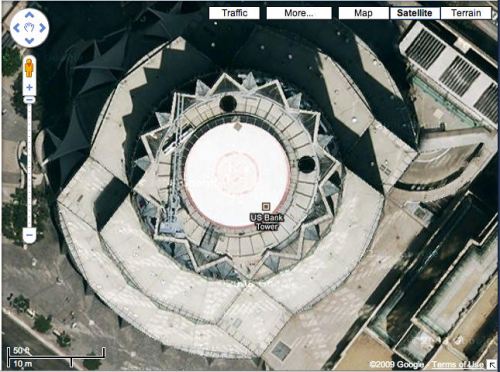
Photo of our favorite building, LA’s US Bank Tower, from Google Maps
Assemblyman Joel Anderson has introduced legislation in California that would restrict the amount of detail involved in online mapping tools. In other words, he doesn’t want terrorists getting too familiar with the air ducts in a government building’s air shaft.
In the measure Anderson proposed last month, government buildings, along with schools, hospitals and churches, would be blurred in online satellite images-and violators will have to pay a $250,000 penalty per day.
The question that arises then is, where does it end? We blur out government buildings and schools, but really is that protecting us when these facilities are accessible through all manner of photos, maps and, uh, the street? And what does this say about street photography in general? Undoubtedly it will feed into the overall paranoia and fear of cameras, making things that much worse. Will street and architectural photographers eventually be forced to blur their images because it contains one these “sensitive” structures that Anderson is trying to eliminate from online maps? We will no longer be able to post images on the web of people, buildings and things that are clearly visible from public spaces? Maybe we should just jump in the DeLorean and head back to 1984 before it’s too late.
And, lastly, are we not trying to solve a massive global ideological problem with tiny, insignificant Band-Aids?
CNN.com has this interview with Anderson today, where among other things, Anderson says, “The fact is I would be remiss in my job if I didn’t take this seriously.” But really, is it an assemblyman’s job to take on technology, or is he looking for more high-profile causes to attach his name to? (Anderson also sponsored a bill which forced state pensions to stop investing in companies doing business with Iran.)
Article via CNN.com
Thanks to Geoff for the link.
 boywithgrenade.org
