Archive for the 'Photography' Category


Wackenhut/G4S Guard and Photographer Face Off

When it comes to watching security guards harassing photographers, Tom McElvy’s video of his encounter with a Wackenhut/G4S security guard at the Bank of America Center in Norfolk, VA, is one of the more cordial exchanges that’s been uploaded to the web this year. Maybe I’m partial to blonde haired girls with blue eyes and a nice Virginia accent, but most photographers would likely prefer an encounter with this Wackenhut/G4S guard than with the US Bank Tower’s Patrick Silver or the Port of Long Beach guard who didn’t care about the law.

No, there’s not much excitement occurring in McElvy’s video (both people handle themselves well), but based on the text and what is said in the video, there is evidence pointing to a history of harassment and an illegal policy that is creating a hostile environment for photographers who shoot around this Bank of America location. More important, the people in charge of this place, such as Chris Taylor and this girl’s “superior,” who is informing this girl to tell people they can’t photograph the property, may not know what the First Amendment entails.

But maybe they do and simply don’t care about constitutional rights and will continue harassing photographers as long as they can get away with it.

So maybe a flash mob at the Bank of America Center is needed to help educate whoever is running this operation?

Bank of America Center
1 Commercial Place
Norfolk, VA 23510
Street Photography: Documenting the Human Condition – Part 2

Part three will be posted tomorrow.

If you haven’t seen part one click here.

Jessica

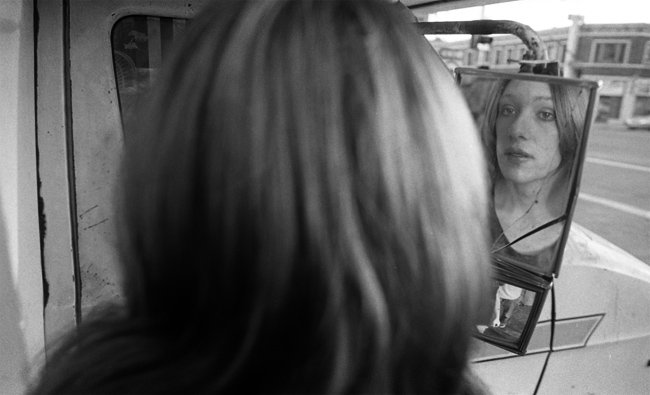
Photo by Shawn Nee / discarted

Street Photography: Documenting the Human Condition – Part 1

Stay tuned for parts two and three, which will be posted tomorrow and Friday.

But if you can’t wait until then, check out Chris Weeks’ Vimeo page.

Engaged Observers at the Getty

Photo Courtesy of Mary Ellen Mark

The Getty Museum is one of the most awesome locations in LA, but it’s more heralded for the architecture and views than the collections, truth be told. But the current exhibit,  “Engaged Observers: Documentary Photography Since the Sixties,” makes a trip there definitely worth the while. Featured photographers include titans of the genre — Philip Jones Griffiths, Leonard Freed, W. Eugene and Aileen M. Smith, Susan Meiselas, Mary Ellen Mark (an all-time favorite), Lauren Greenfield, Larry Towell, Sebastião Salgado and James Nachtwey.

From Brett Abbott, associate curator of photography at the Getty, in an interview with the Stockland Martel blog:

While certainly not comprehensive, the final group of nine essays is meant to be diverse (in subject matter, approach, medium, and date) so as to map the boundaries, developments, and goals of the tradition over the course of about 50 years.

The exhibit runs until November 14, 2010.

Oregon Officer Crashes Car, Harasses Witness for Snapping Photos

When Hillsboro, Oregon, resident David Emerson witnessed an officer-involved car crash he did what a lot of people do nowadays – he pulled out his cell phone to take photos. The unnamed Hillsboro officer objected (naturally) and told Emerson he had to delete the photos or he would confiscate the phone.

Emerson thinks the officer’s behavior was due to the fact that he was speeding through an intersection without his lights and siren on when he crashed into a Buick and then (to save his own butt) tried to convince Emerson otherwise.

Sorry, officer, but if you weren’t doing anything wrong and have nothing to hide why the paranoia over someone taking pictures of a public and newsworthy event? Is it because you really didn’t have your lights and sirens on when you caused that collision and sent yourself and the other driver to the hospital?

On the other hand, the Hillsboro cops are now trying to say that the unknown officer  never told Emerson to delete his pictures, that the Buick driver “failed to yield” to the officer, and that the cop was only trying to tell Emerson that investigators could confiscate his phone for evidence.

Sure, fellas, keep telling yourself that. But why hasn’t the Buick driver been cited yet for “failing to yield”? And why haven’t investigators asked Emerson to see his photos? Seems like the photos would be very important and useful in determining what really occurred. However, that’s probably not what they’re trying to find out—cover-ups generally don’t involve getting to the truth.

Personally, I’m more inclined to believe a guy on the street who has nothing to gain or lose from this incident than a cop clearly trying to protect himself.

As KATU reported:

“…the officer never told Emerson to delete his photos. After all, they say, that would be completely against protocol.”

Indeed.

Article from KATU

Polling Time: discartedblog vs. boywithgrenade

You may have noticed the significant changes on our blog recently. To explain, we thought it was time to make the site a little more visually appealing and original. From the very beginning we were never really fans of our standard WordPress K2-Lite template, and we especially had issues with the .wordpress hijacking our URL, but that’s what you get for free.

So along with these visual changes, we have also decided to finally change the name of the blog, which, we admit, is probably not the best thing to do after two years of posts. We’re guessing this may confuse some people, but hopefully most of you won’t having any trouble tracking us down. It’s only the internet—it’s not that big.

But here’s our dilemma: We’re not sure what to call ourselves.

Should we stick with what we know and use discartedblog? Or should we totally revamp the name and go with something new and exciting and take a chance on boywithgrenade?

Now I understand that this blog, my work and my real name (Shawn Nee) are all intertwined with the name discarted, however I’m not too concerned with that and would actually like to disconnect my documentary work and discarted from my involvement with the photographers’ rights campaign. They’re two completely different sides of my personality and that’s how I would like to keep them. I don’t want a potential employer to think that I’m some kind of troublemaker when I’m actually a very empathetic, devoted, trustworthy photographer when it comes to documenting the people I photograph.

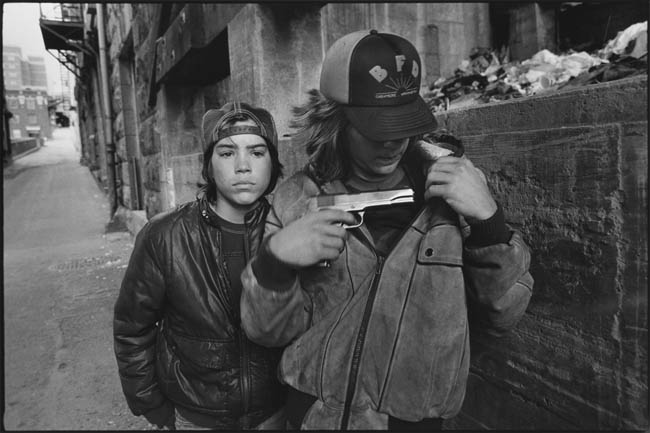
So based on that reasoning, I’m in favor of boywithgrenade, which is an ode to the famous Diane Arbus photo. I think it’s a great name that will help symbolize what this site is about and the new direction that we’ll be heading in — which will be more emphasis on great photographers and their work (we will be accepting photo essay submissions), exhibits and more general topics concerning photography. We also plan to bring you more, expanded and compelling interviews with accomplished photographers and up-and-comers.

But don’t worry; we’re still going to cover photographers’ rights and continue to discuss the issues that photographers are facing today because we strongly believe that no one should be harassed, detained or arrested for perfectly legal behavior.

So, onto the future … what should it be: discartedblog or boywithgrenade?

A Cure for the Monday’s: Fujifilm’s FinePix X100

It’s Monday. You wake up, shower, get dressed, and head out the door. You’re dreading the next five days as you stand in line waiting for your daily morning pick-me-up. The thought of your boss’ unpleasant stench breath makes your face cringe as you subconsciously take a step back into the guy behind you, who’s also in line waiting for his daily morning pick-me-up. “Sorry.”

You get to work, slide into your chair, open up your email, and then you see it—an RSS feed announcing the development of Fujifilm’s FinePix X100—a cure for the Monday’s.

From Fujifilm’s website:

The FinePix X100 is aimed at the professional photographer or keen enthusiast looking for exceptional quality pictures from a compact camera. It is designed to appeal to the millions of DSLR users who need a slim back-up camera for high quality in-fill shots when the use of a bigger SLR system is either inconvenient or impractical. Or, of course, it can be used as a professional’s only top-end camera, if size and versatility are the primary considerations.

With the goal of creating a camera with the “highest quality possible lens and sensor combination,” the X100 will be fitted with a 23mm f/2 Fujinon fixed lens (equivalent to 35mm), a 12.3 megapixel APS-C CMOS custom sensor, a ISO range of 200 to 6400, and a hybrid viewfinder that allows the operator to choose between an optical viewfinder mode, or an electronic viewfinder mode. Which, according to Fujifilm, gives the user “the best of both worlds.”

And with a rumored selling price somewhere between $1400 and $1750, the X100 is definitely causing me to second guess my unyielding desire to still purchase a Contax T3 or Nikon 35Ti for those tight situations or times when a smaller camera is more ideal than a giant SLR. Yes, some of us still shoot film.

But still, let’s hope that other companies follow Fujifilm’s lead and begin developing their own compact-sized, professional digital cameras with fix lenses—that can be changed out!

Now that’s a feature we would certainly all like to see built into the next generation of these cameras.

For more details and specs, check out Fujifilm’s announcement here.

“Don’t Ask, Don’t Tell” at Kaycee Olson Gallery

Jeff Sheng, the Los Angeles based artist responsible for the provocative photo series “Don’t Ask, Don’t Tell”, will be exhibiting his work at the Kaycee Olson Gallery in Los Angeles.

Haunting and yet sad, the controversial series examines the U.S. military’s “Don’t Ask, Don’t Tell” policy by showing gay servicemen and women posing in their uniforms with their identities concealed—their faces obscured by a faint shadow, their partner’s hand, or the slightest tilt of the neck.

The images certainly evoke an impenetrable sense of loneliness and confinement, forcing the viewer to grapple with the silence and invisibility that these men and women must feel when in uniform.

The exhibit runs until October 23, 2010.

KAYCEE OLSON GALLERY
2685 S. La Cienega Blvd.
Los Angeles, CA 90034
310.837.8945

Hours: Tuesday – Saturday 11:00am to 6:00pm

Photo by Jeff Sheng / Kaycee Olson Gallery

Famed Photographer’s Double Life

The Commercial Appeal in Memphis dropped a bombshell this week – that famed civil rights photographer Ernest Withers was also working for the FBI as a paid informant. Many people, including Withers’ family, expressed shock that the photographer could have been at the same time documenting the black community’s struggle and helping the government keep tabs on it. The Appeal was able to obtain more than 7,000 pages of documents that outlined Withers’ work for the FBI in the 1960s, including handing over photos and names of people involved in protest activities.

Known as the “original civil rights photographer,” Withers was on the front lines during some of the era’s seminal events, including the Emmett Till trial, the integration of Ole Miss and Martin Luther King’s assassination.

Withers’ actions are infuriating. As documentary photographers, we all know how difficult it is to earn someone’s trust and be allowed entry into their private lives. We are privileged when that happens. But when someone like Withers comes along, his behavior casts a looming shadow of distrust over all of us. If Withers were alive today he should be expelled from the profession and marked with a scarlet I—for informant. That way, everyone would know how much of a disgrace he his, despite his fascinating work.

On a personal note, a few years ago I was on Sunset Boulevard and an LAPD officer asked me what I knew about some people I was photographing and if there was anything I would like to share with him. I told him I didn’t know anything. The cop then let out this dismissive chuckle and said, “Oh yeah?”, knowing that what I just said was absolutely not true. That’s all I said and walked away. Like most documentary photographers, I would never betray the people I photograph.

Articles from Commercial Appeal and AP


Spam Blocked