Archive for the 'Photography' Category


Complaint Against LAPD’s Paul Espinoza Sustained

I was detained again recently (actually handcuffed and placed in the patrol unit) in Hollywood while photographing some people I’ve been following for a couple of weeks. My account of what happened, along with my footage (which is securely online already and stored on multiple hard drives that are not at my residence), will be released in the near future, but the experience has motivated me to finally comment on some letters I received in November 2010 from LAPD’s Chief of Police Charlie Beck and Paul Espinoza—the Northeast Patrol Division officer who unlawfully detained me because I photographed him and his partner performing a traffic stop on Hollywood Boulevard in February 2010.

The first paragraph of Chief Beck’s letter states the following:

An investigation into your complaint that was reported on February 21, 2010, regarding the conduct of an employee of the Los Angeles Police Department has been completed.  The investigation has gone through several levels of review, including myself and the command staff of Internal Affairs Group.  Your allegations that an officer was discourteous and unlawfully detained you were classified as Sustained.  This means the investigation determined that the act alleged occurred and constitutes misconduct.  An appropriate penalty will be imposed; however, Penal Code Section 832. 5 precludes me from disclosing the specific penalty.

And Paul Espinoza’s apology letter says:

I am the officer with whom you had contact on February 21, 2010.  You should know there was a complaint lodged against me and I am sure you will be informed by the Department that complaint has been sustained.  I wanted to write you a personal letter to apologize for my actions on that day.  The Department has provided me training and I assure you I will handle similar situations in the future much differently.  I am very proud to be a Los Angeles Police Officer and will do my best to serve you and the community to the best of my abilities in the future.

I hope the next time we meet it is under better circumstances.  Again, please accept my apologies.

When I first received the letters I was initially pleased and certainly felt vindicated—especially towards my harshest online critics who inaccurately claimed that I was never detained and should have waited for the supervisor to arrive to say whatever it is that they thought I should have said to him.

Well, as all will know now, as some of us already knew then—I was unlawfully detained and treated disrespectfully. It’s that simple, and for full-brained people it really isn’t all that hard of a reality to grasp once you see the video.

As for the people who criticized me for not sticking around to speak to the supervisor, what they may not realize is the fact that speaking to a supervisor might well not resolve anything. More important, I don’t need to complain to Espinoza’s superior at the time; I can complain by filing a complaint with LAPD later. The two do not go hand in hand. Which, are both very good reasons why I left.

This was not my first time being detained, and I understand how the detainment and complaint process works. Plus, I have a lawyer friend who I can contact when I need advice or a legal question answered.

So once all the Monday-morning shutterbugs decide to stop taking family portraits, studio shots of fruit and martini glasses, and macro-shots of flowers and bugs and get their detainment cherry popped for taking legal pictures in public (which are decent enough to share with the rest of the world), then I’ll listen to what they have to say.

Sorry to digress, but all things must be addressed.

Then I read the letters again and thought about the outcome a little more. What did they do to make sure Espinoza wouldn’t do something like this again? And why does California Penal Code Section 832.5 (as well 832.7) prevent me and the public from knowing Espinoza’s “appropriate penalty”? For all I know, Espinoza’s appropriate penalty was to write a forced apology letter because he was caught on video screaming about his First Amendment rights, while at the same exact moment derailing my constitutional rights.

I should have the right to know Espinoza’s penalty, and so should you. We have the right to know the complaint history against all law enforcement officers in this country. This should be easily accessible information, rather than locked up and hidden from public scrutiny.

Penal codes such as 832.5 and 832.7 (which prevent LAPD from releasing information even about complaints that were determined valid), should not exist because all they do is raise credibility issues within the confines of law enforcement and stir contempt throughout the public.

We need to change this.

Push Comes to Shove for Arizona Police

This week at a contentious school board meeting in Tucson, KOLD News 13 photographer Edgar Ybarra was shoved by Tucson Police officers and barred from covering the event.  Police defended their actions and said he was in the way; Police Chief Roberto Villasenor told KOLD he “was standing right in the pathway” and refused to leave. Ybarra said he was just trying to cover the story. The video shows what seems to be unnecessary aggression against Ybarra. 

As the Tucson Weekly reports:

KOLD cameraman and filmmaker Edgar Ybarra, who was following police and Castillo with his camera, was roughly pushed by the police and forced out of the building along with Baldenegro, Garcia, Rodriguez and several other activists. (It’s important to note that Ybarra tried to get the police to let him back in so he could continue to work, while his reporter co-worker waited for him in the lobby. They refused to let him back in, although they did let another cameraman in to continue working.)

Maybe shoving is something taught in police school in Arizona? It seems so by the looks of this video, where a 15-year-old girl is slammed to the ground by Phoenix Police Officer Patrick Larrison. (Go to about 1:56 if you want to see something truly alarming.) Amazingly, the police department wasn’t aware of the incident until a staffer saw the video on YouTube and alerted the higher-ups. There is now a criminal and internal investigation underway in that case.

Source: KOLD and Tuscson Citizen

Photography Link Roundup

Photo: Tech. Sgt. Manuel J. Martinez, U.S. Air Force/DoD 

•  These dogs are a lot tougher than you: a photo essay on the military’s best friend. [Foreign Policy]

•  AP and Reuters are not covering Fox News’ Republican presidential primary debate tonight because the organizers are not allowing photography during the event. [Politico]

•  Bill Keller on Joao Silva and war photographers. [New York Times Magazine]

•  Deconstructing that now-famous photo of the Situation Room. [WWD and Washington Post]

•  “How We Hire Photographers” from a New York magazine editor. [PhotoShelter]

Malls Across America

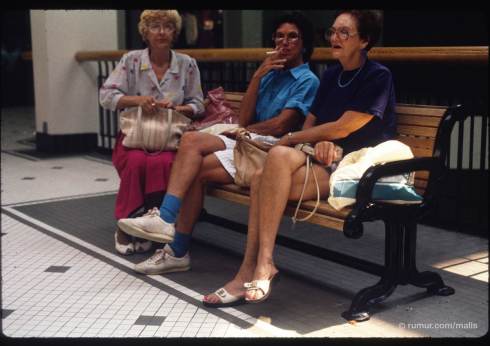
Photo by Michael Galinsky

How strongly do you believe that American mallgoers in 1989 deserve their own book? Enough to give to Michael Galinsky’s Kickstarter project?

In 1989, following in the footsteps of Robert Frank, Garry Winogrand, and William  Eggleston, I drove across the country and documented malls across America.  I had a cheap Nikon FG-20 and an even cheaper lens – but I had a lot of passion. I shot about 30 rolls of slide film in malls from Long Island to North Dakota to Seattle.  It was hard to tell from the images where they were taken, and that was kind of the point. I was interested in the creeping loss of regional differences.  I thought a lot about Frank’s “The Americans” as we drove from place to place without any sense of place.

Cat-Shaped Camera

Why would I need a small camera in the shape of a camera, you ask? Good question.

It allows you to take photos and movies like a cat is taking them. The camera does not carry a monitor, so you cannot see what you are about to take. But it is not as complicated as it may seem. All you need is, a little effort to, be a cat.

Source: Superheadz (via Gizmodo)

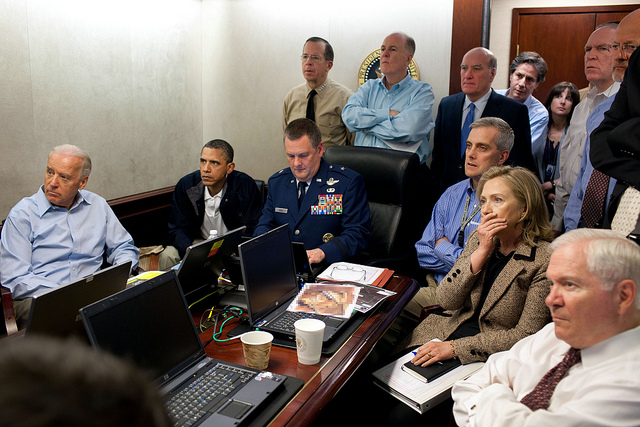
Watching the Situation in the Situation Room

Photo by Pete Souza

President Barack Obama and Vice President Joe Biden, along with members of the national security team, receive an update on the mission against Osama bin Laden in the Situation Room of the White House, May 1, 2011.

Bin Laden Dead

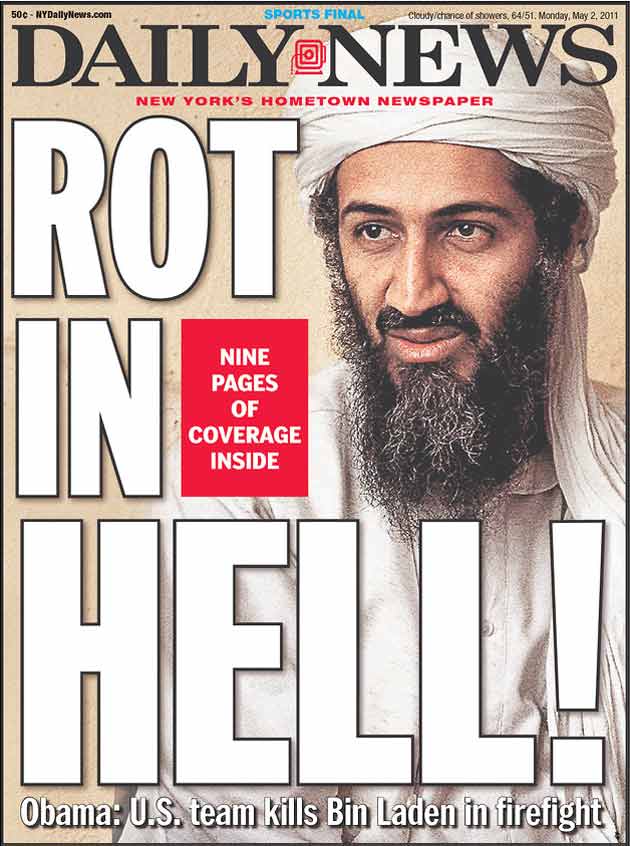
Osama bin Laden is dead, and from the looks of this roundup of the newspapers today, everyone is pumped. You gotta love the enthusiasm and crassness of the tabloids: “We Got the Bastard!” and “Rot In Hell!”

When reports said he was hiding out in a $1 million compound in a modern Pakistani suburb, this is not what I pictured. A million dollars, and they didn’t even have a phone or internet connection? I guess it all went to the 18-foot walls.

It was a good idea to have the special forces kill him directly — what must that have felt like? — instead of flattening him with a bomb. But still, I need some proof. (This photo of a dead bin Laden has proven to be a fake.) Remember when  Saddam Hussein’s sons were killed in 2003 there was much disbelief and skepticism from the Muslim world. I’d be shocked if the same thing didn’t happen here.

Getting the Iconic Tornado Shot

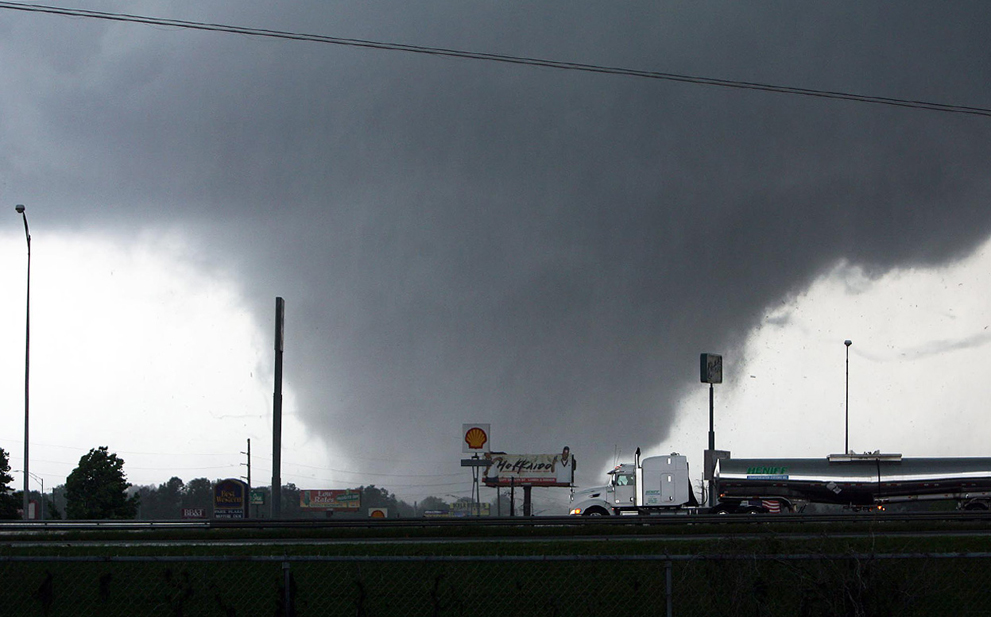
Photo by Dusty Compton/Tuscaloosa News

Poynter.org has the story behind the Tuscaloosa News‘ photograper Dusty Compton’s photo, which made the covers of newspapers across the country, and his experience covering the aftermath.

The most challenging aspect of covering the tornado, Compton said, has been figuring out when to intervene.

“We were there before the firefighters and police officers were there yesterday, and we were walking through rubble, not knowing whether everyone was out of it yet,” said Compton. “I wondered, ‘Should I be shooting photos or should I be lifting boards and bricks to see what was underneath it?’ ”

At one point, while Compton was taking photos of a house that had been destroyed, he saw two people calling out a woman’s name. They said they weren’t able to find their friend, who had been in the house that Compton was photographing.

“I put my camera over my shoulder and started calling for this lady’s name,” Compton said. “We didn’t find her there.”

Source: Poynter.org

White House Bans Reporter for Camera Phone Use

In a move that seems more in line with the previous administration, White House officials have banned a San Francisco Chronicle reporter from covering the president in the Bay Area. Reporter Carla Marinucci used her camera phone to capture protesters at a fundraiser at the St. Regis Hotel, which violated rules specifically for “pen and pad” reporters. So she’s no longer part of the press pool, despite earlier claims that this White House would be the most transparent in history,

In the video (seen here),  you can hear the protesters singing “We paid our dues, where’s our change?” 

“We’ve come full circle here,” Tom Rosenstiel, director of the Pew Foundation’s Project for Excellence in Journalism told me today. “A newspaper reporter is being punished because she took pictures with a moving camera. We live in a world where there are no longer distinctions. The White House is trying to live by 20th century distinctions.”

To be fair, Marinucci’s rule breaking didn’t just affect the president’s image, but it could be seen as a slight to her fellow reporters too. When you’re part of a pool there are guidelines about the information collected, and it’s not really fair if you’re breaking them so you can get the scoop. But, the administration’s harsh actions just make them look bad — and thin-skinned.

Source: San Francisco Chronicle


Spam Blocked